
Business was the first thing I ever taught. I was 17, tutoring economics and accounting at a community college, and I spent the next decade building business curriculum for tutoring students, an MBA, and a stretch designing finance lessons at Pearson before landing in the personal finance course I teach full time now. So when I say business is the most teachable corner of CTE, I mean it: your students walk in already holding the raw material (a paycheck that somehow vanished, an ad that worked on them, a side hustle they’re quietly daydreaming about). The job is pulling the concept out of what they’ve already lived.
This is the start-here map for the whole business program, whether you’re teaching a single Intro to Business elective or juggling five preps from accounting to entrepreneurship. We’ll cover what actually counts as “business,” where to start, what a strong business lesson looks like, and how each subject teaches best (with the project that makes it click). Some of these deserve their own deep dive, so we’ll link out as we go.
The short version: High school business breaks into five big subjects (entrepreneurship, marketing, personal finance, accounting, economics), and each one teaches best through a different kind of real-world project, not a textbook march. Start from a decision students can picture making, pull the content in to serve that decision, and grade the reasoning. Personal finance is having a moment (30 states now require it to graduate), so if you teach it, you’re exactly where the demand is.
What courses count as high school business?
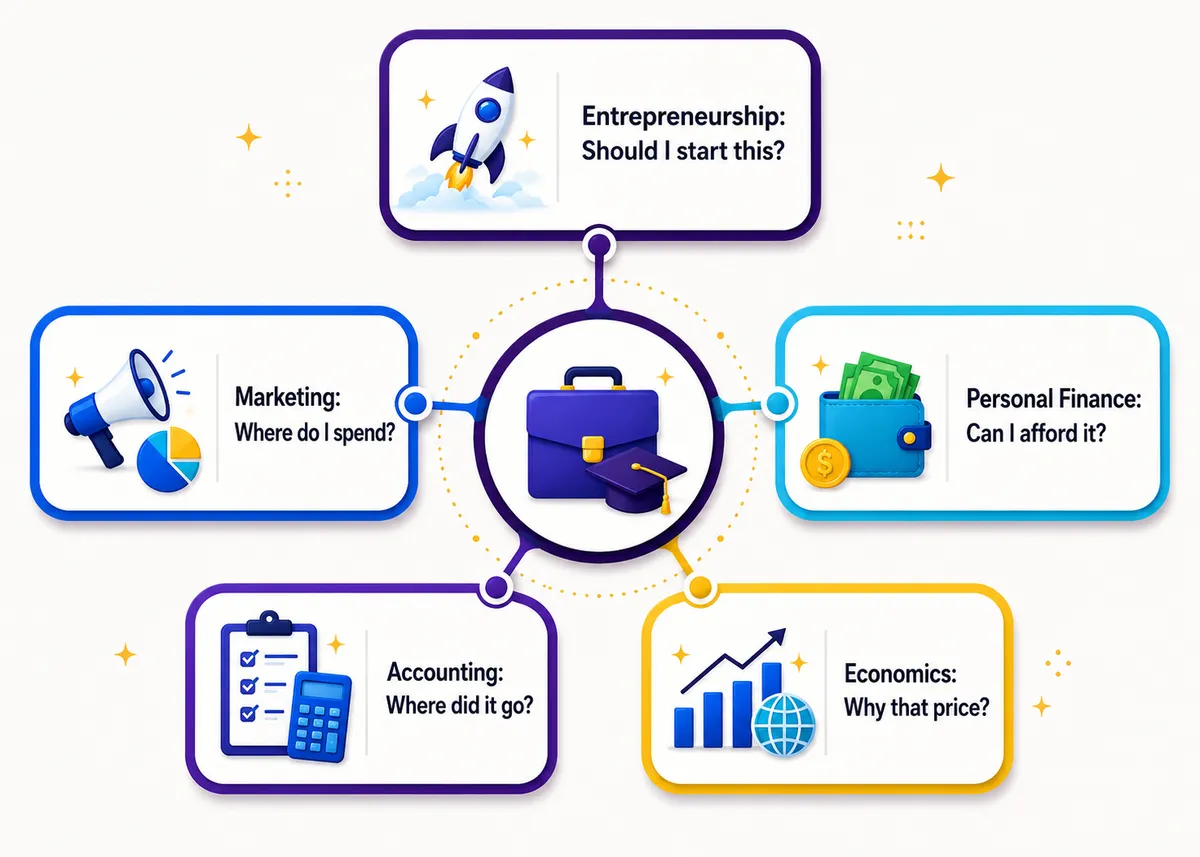
“Business” is an umbrella, not a single course, which is why a business teacher so often ends up with three or four preps that don’t look much alike. In most programs the umbrella covers five big subjects:
- Entrepreneurship: starting and running a venture (idea, plan, pitch).
- Marketing: finding a customer and reaching them (the marketing mix, branding, digital and social).
- Personal finance: managing your own money (budgeting, credit, saving, investing, taxes).
- Accounting: tracking a business’s money (the accounting equation, debits and credits, financial statements).
- Economics: how scarcity, markets, and incentives drive decisions.
Intro to Business usually samples a little of each, then the upper-level electives go deep on one. It’s worth knowing where this sits in the bigger CTE picture: in the modernized 2024 National Career Clusters Framework, business spans two of the three “cross-cutting” clusters (Management and Entrepreneurship, and Marketing and Sales), which is the framework’s way of saying business skills run through nearly every career path, not just one lane. If you want the wide-angle view of how CTE works as a whole, How to Teach CTE is the umbrella guide this one lives under.
Where should you start?
If you’ve been handed the program and a blank semester, resist the urge to open at chapter one of whatever textbook came with the room. Start with money or a decision your students already care about. A personal-budget reality check, a “would you fund this business” vote, a teardown of an ad they all know: any of these previews the course and tells you who’s in the room on day one.
That first week is also where you set the tone that business class is a place where you do things, not just define them. We break down concrete openers in First Week of Business Class Activities, but the principle is simple: lead with a decision, not a definition, and let the vocabulary follow.
What makes a good business lesson?
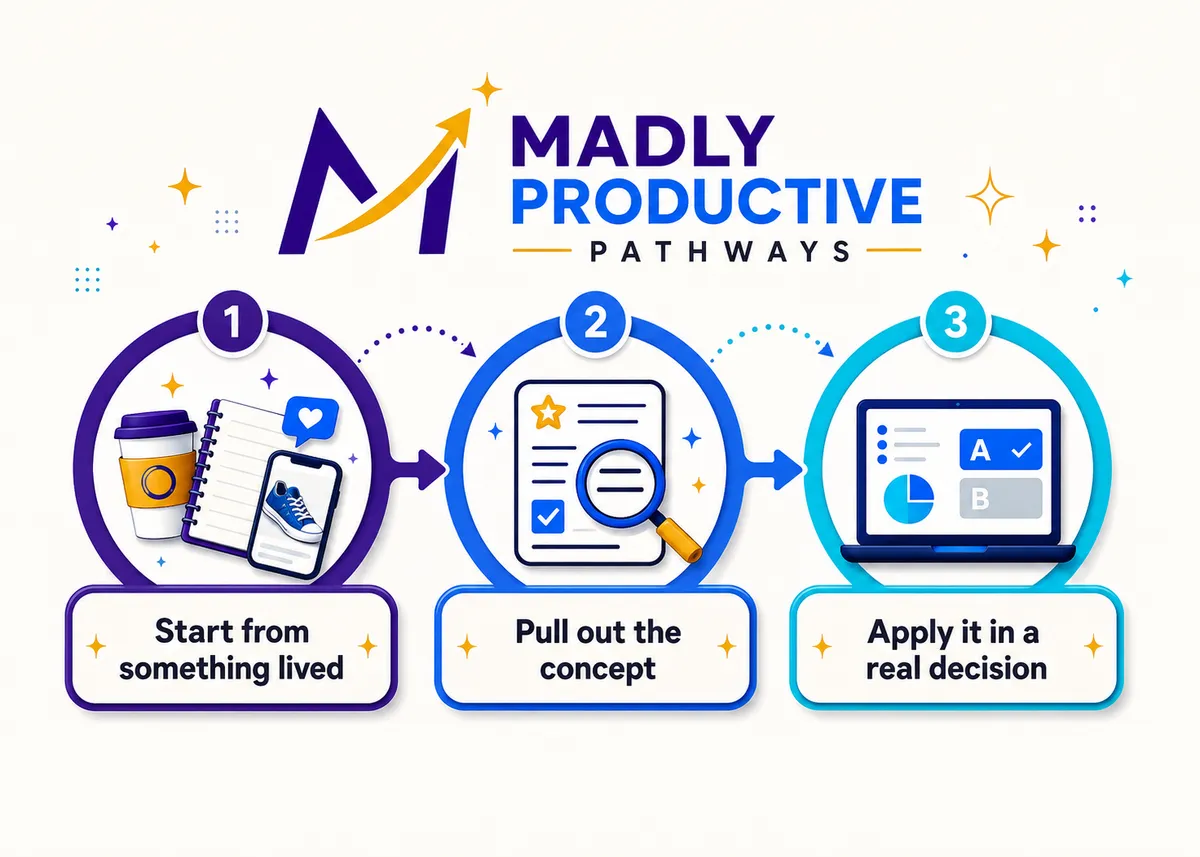
The strongest business lessons start from something the student has already lived and pull the concept out of it. Not “today we define the four Ps,” but “here’s a brand you’re weirdly loyal to: figure out what they actually did to earn that, and we’ll give it names as we go.” The content gets learned in service of a real decision, which happens to be exactly how working professionals use it.
That backward-from-a-decision design is the engine behind all of CTE, and it’s worth understanding in its own right (the full method is in How to Teach CTE and the deep dive on Project-Based Learning in CTE). For business specifically, the advantage is that the lived experience is everywhere: every student has bought something, regretted something, and been marketed to. You rarely have to manufacture relevance. You just have to point at it.
How does each business subject teach best?
Here’s the thing that makes business preps manageable: each subject has a signature project, the one that turns the abstract idea into a decision a student can defend. Teach toward that project and the content has somewhere to go.
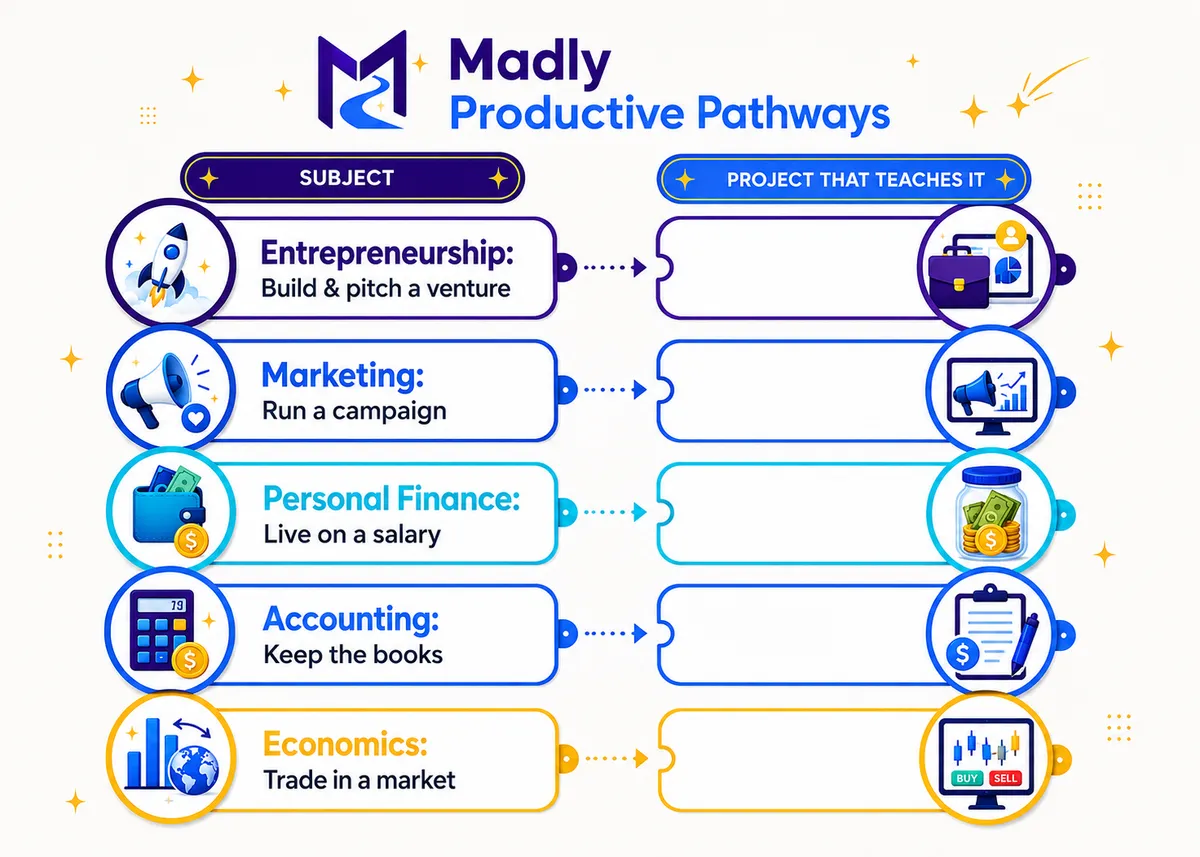
- Entrepreneurship teaches best when students build and pitch something real (a mini-venture, a Shark Tank-style pitch with actual numbers behind it). Start with the money basics they’ll need to sound credible (revenue versus profit, cost of goods), then turn them loose. See How to Teach Entrepreneurship to High School Students and the scaffolded Business Plan Project.
- Marketing comes alive as a campaign: pick a product, define the target customer, and build the pitch across channels with a measurable goal. Walkthrough in How to Teach Marketing to High School Students, with the capstone in Marketing Campaign Project for High School Students.
- Personal finance lands when it’s a simulation of a real life: a salary, a budget, the curveballs (a car repair, a rent hike) that force tradeoffs. See Personal Finance Activities for High School and the budgeting deep dive in Budgeting Activities for High School Students.
- Accounting stops being intimidating when students run the books of one tiny business: record real transactions, watch the accounting equation stay balanced, produce a statement that means something. See Accounting Activities for High School Beginners.
- Economics clicks through simulation: a classroom market, a scarcity auction, a news-article hunt where students spot supply and demand in the wild. See Economics Activities for High School Students. If you teach the AP courses, our editable AP® Macroeconomics and AP® Microeconomics curricula are built the same simulation-first way.
Here’s the same idea as a quick reference, the part students resist in each subject and the project that gets them past it:
When you’re stocking a unit with options, Business Class Project Ideas for High School collects ready-to-run projects across all five subjects.
How do you keep a mixed-level business class engaged?
Business electives almost never have a clean prerequisite chain, so you’ll get the senior who already runs a reselling side hustle sitting next to the sophomore who signed up because it fit their schedule. The fix is the same one that works across CTE: relevance plus a little autonomy.
When students pick their own product to market, their own venture to pitch, or their own budget scenario to survive, the room levels itself. The kid with the side hustle goes deeper, the kid who wandered in finds a way in, and you’re not trying to hit one imaginary average that doesn’t actually exist in your room. Give the assignment a real decision and a few open lanes, and engagement mostly takes care of itself.
Why is everyone suddenly teaching personal finance?
Because the law changed under everyone’s feet. As of April 2026, 30 states guarantee a standalone personal finance course to graduate, up from a small handful a few years ago, and once those laws fully roll out, the large majority of U.S. public high school students will be required to take one. Translation: a lot of business teachers (and a lot of teachers who never expected to teach business) are suddenly staring down a required finance course with no materials.
If that’s you, the good news is that personal finance is genuinely fun to teach because the stakes are real and immediate to a 16-year-old. Free curriculum from Next Gen Personal Finance and games like the SIFMA Foundation’s Stock Market Game give you a strong starting point, and we map out hands-on lessons in Personal Finance Activities for High School and Budgeting Activities for High School Students. And when you want the course itself ready on day one, our editable Personal Finance curriculum runs nine units from consumer basics through taxes, credit, and investing.
Should you start an FBLA chapter?
If you teach business, a Career and Technical Student Organization (CTSO) is one of the highest-leverage things you can add, and for business the big one is FBLA (Future Business Leaders of America), with more than 187,000 high school members nationally. A chapter turns the abstract “career readiness” goal into something concrete: competitive events, real deadlines, leadership roles, and a reason for students to care about the content beyond a grade.
It’s also real work, and you don’t have to launch one in your first semester. But if your program is going to grow, a CTSO is usually the spine it grows around. (Other strong fits depending on your courses: DECA for marketing, and various business and IT events under broader CTSOs.)
What about AP Business with Personal Finance?
If you teach (or are about to teach) AP Business with Personal Finance, you’re part of College Board’s newer AP Career Kickstart initiative, which launches nationally in the 2026-27 school year. These courses are built around applied, project-based work and pair the usual college-credit signal with an industry-recognized credential, which is a very CTE way to run an AP course. If you already think like a business teacher, you’re most of the way there.
The planning specifics (what to set up before day one, how the course is structured, how to survive a first-year rollout) live in What Is AP Career Kickstart?. If you want the course built for you, our editable AP Business with Personal Finance curriculum is organized around exactly the project-and-decision model these courses reward.
Free resources to get you started
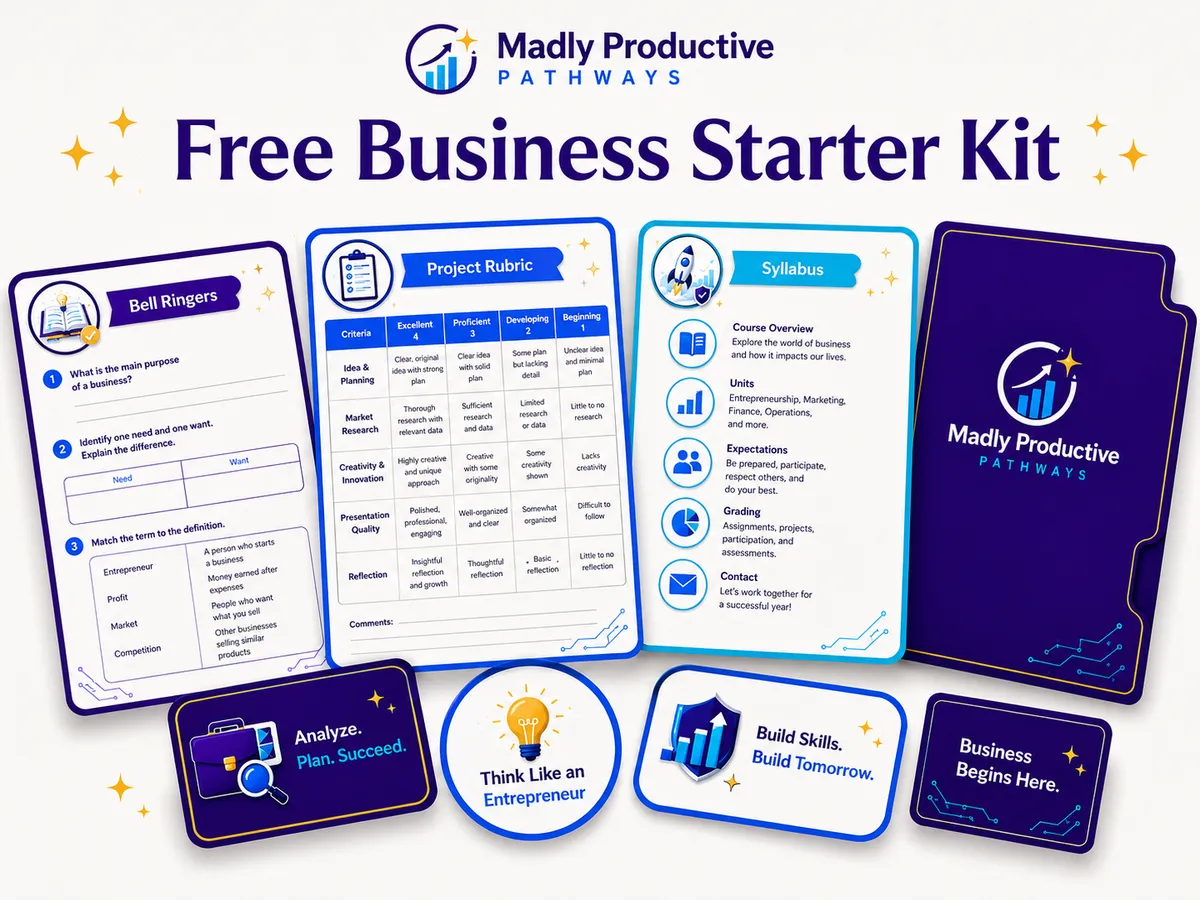
You don’t have to build the whole program from scratch, and you shouldn’t have to buy your way in just to test the waters. The Free Library has no-prep business starting points (bell ringers, a project rubric, first-week activities, a pacing planner) that work across intro, finance, marketing, and entrepreneurship. Grab what’s useful, see if the style fits how you teach, and go from there.
Want the planning done for you? Browse the editable, full-year business and AP Career Kickstart curriculum: AP® Business with Personal Finance, a standalone Personal Finance course, and both AP® Macroeconomics and AP® Microeconomics. Every course is built around real projects and real decisions, organized so you can teach it on Monday instead of building it on Sunday.
Frequently asked questions
What subjects are included in high school business? Most programs cover five: entrepreneurship, marketing, personal finance, accounting, and economics, usually with an Intro to Business course that samples all of them before upper-level electives go deep on one.
Do you need a business degree to teach high school business? Often no. Many states have an alternative or industry route that values real-world business experience over an education degree, and a business background maps cleanly onto a business or marketing CTE endorsement. Rules vary by state, so check your own state Department of Education. (See How to Become a CTE Teacher.)
What should I teach first in business class? Start with a decision students already care about: a personal budget, a “would you fund this” vote, or an ad teardown. Leading with a real choice previews the course and sets the tone faster than a syllabus read-through.
How do you make business class engaging? Tie each topic to a decision students can picture making, and give them some choice in how they tackle it (their own product, venture, or scenario). Relevance plus a little autonomy beats a flashy one-off activity and lets a mixed-level room each find a way in.
How many states require personal finance to graduate? As of April 2026, 30 states require a standalone personal finance course for graduation, and that number has been climbing fast, which is why demand for finance teachers and materials is so high right now.
What is FBLA, and do I need it? FBLA (Future Business Leaders of America) is the main Career and Technical Student Organization for business, with competitive events and leadership roles that make career readiness concrete. It’s valuable but optional; you don’t have to start a chapter your first year.
AP® is a trademark registered by the College Board, which is not affiliated with, and does not endorse, this product.