AP Computer Science A: Full-Year Course
$170
Two AP computer science courses, four Java units and five CSP units, written as the paper layer that sits over whatever coding platform your school already runs. Guided notes students can write on, applied tasks with keys, and a unit test you did not have to assemble. It still works on the day the lab is down.
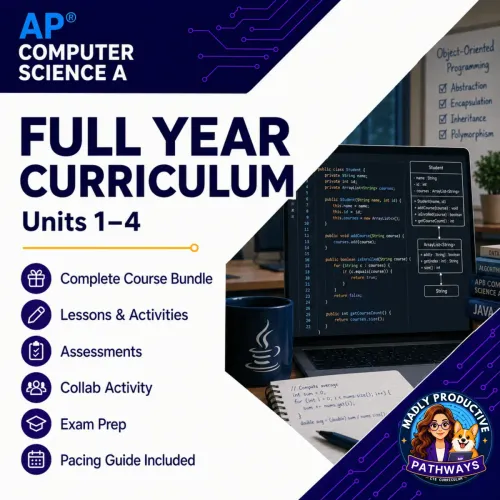
The complete year in one purchase: every unit, every lesson, all assessments and answer keys.
Code.org is free, CodeHS has a free plan, and both are College Board endorsed providers. If your school already runs one, keep it: the coding environment and the pre-approved syllabus are handled there. What tends to be thin is everything away from the screen, and that is what this supplies.
Every topic ships editable slides, guided notes with a full answer key, an applied scenario with a Teacher Key, a hands-on Applied Task, AP-style multiple choice with written rationales, and an FRQ with a scoring guide. Each topic also comes with a self-grading Google Form, so the paper version and the digital version are the same assignment.
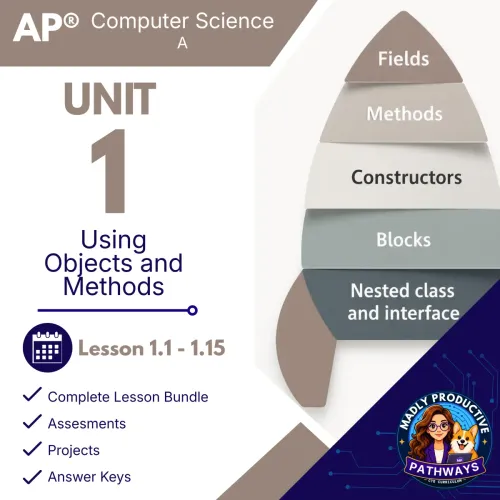
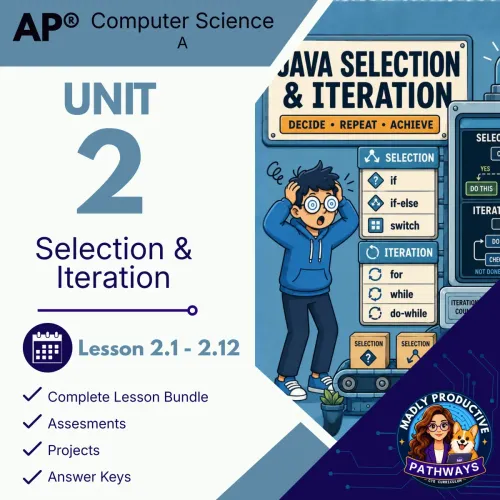
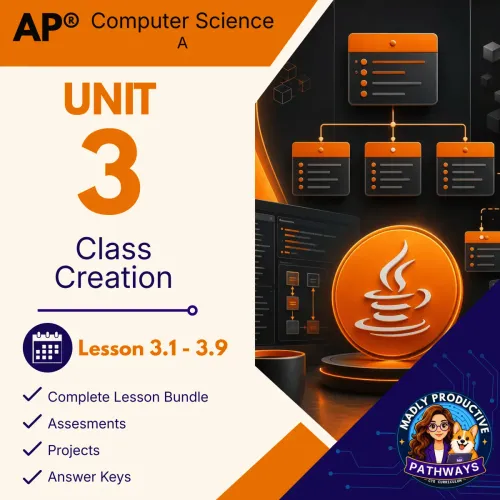
College Board consolidated AP CSA into four units and dropped the old standalone inheritance unit. This course follows that shape: Using Objects and Methods (15 topics), Selection and Iteration (12), Class Creation (9), and Data Collections (17). That is 53 topic packets and roughly 106 class periods, with a review and test for every unit plus a full-year pacing calendar.
Because the exam leans on free response as well as multiple choice, every topic carries AP-style items with rationales, and the course-wide bonus folder adds question banks by unit and separate FRQ practice with scoring.
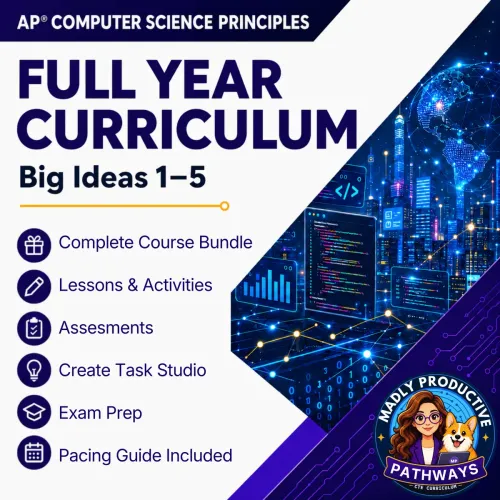
CSP is closer to a first-semester college computing survey than a programming course, and the five units follow the five big ideas: Creative Development, Data, Algorithms and Programming, Computer Systems and Networks, and Impact of Computing. The weighting is deliberately uneven. Algorithms and Programming is 18 of the 35 topics; Computer Systems and Networks is three. About 93 class periods in all, and every unit ships its own review and test.
The Create performance task is not covered here. Students still build that program and their Personalized Project Reference during the in-class hours College Board allots for it. These packets carry the course content and the multiple-choice section, which is 70% of the exam score, so plan the Create window separately in whatever environment your students already use.
If you are picking one, CSP is usually the easier first course: students need no prior computer science experience, and the reading and writing load suits a mixed class. CSA is a real Java year and works better as a second course, or for students who have already built something. Both need a college-level textbook on file for the Course Audit.
You do not have to commit to a year to find out. Each unit sells as its own bundle, so you can run Selection and Iteration or the Data unit on its own, and there is a free Topic 1.1 packet for each course. Everything is independently aligned to the publicly available Course and Exam Descriptions, and College Board does not endorse it.
One unit at a time, for less than its lessons cost separately. Each includes a unit review and unit test.
Every course opens with a complete free lesson: the real slides, notes, and activity, not a preview.