


The fastest way to kill a good business plan project is to hand students a real business plan. The kind a bank wants runs 30 pages, assumes a finance background, and buries a 16-year-old before they’ve written a sentence. So they stall, they pad, and you end up grading a document nobody learned anything building.
The fix is to scaffold it down to the parts that actually teach something, give students a template they can finish in a few class periods, and grade the thinking instead of the formatting. Here’s how we’d run it.
What are the parts of a student business plan?
A professional plan has a dozen sections. A student plan needs six, and each one maps to a question the student has to answer about their idea. That’s the whole point: every section forces a decision, and the plan is just the place those decisions get written down.
- Executive summary: the one-paragraph version of the whole idea. What’s the business, who’s it for, why would it work. (Students write this last, even though it comes first.)
- The problem and the customer: what problem does this solve, and for whom specifically. “Everyone” is not a customer. This is the section that separates a real idea from a wish.
- The product or service: what they’re actually selling, and what makes it worth choosing over what already exists.
- A simple market analysis: who else is doing this, and how the student’s version is different or better. Two or three competitors is plenty.
- Basic financials: what it costs to make or deliver, what they’d charge, and whether there’s any profit in the gap. Real numbers, kept small.
- The ask: what they need to start (money, space, equipment) and what they’d do with it. This is where the pitch lands.
That’s it. Six sections, six decisions. Anything past this is complexity students will drown in without learning more.
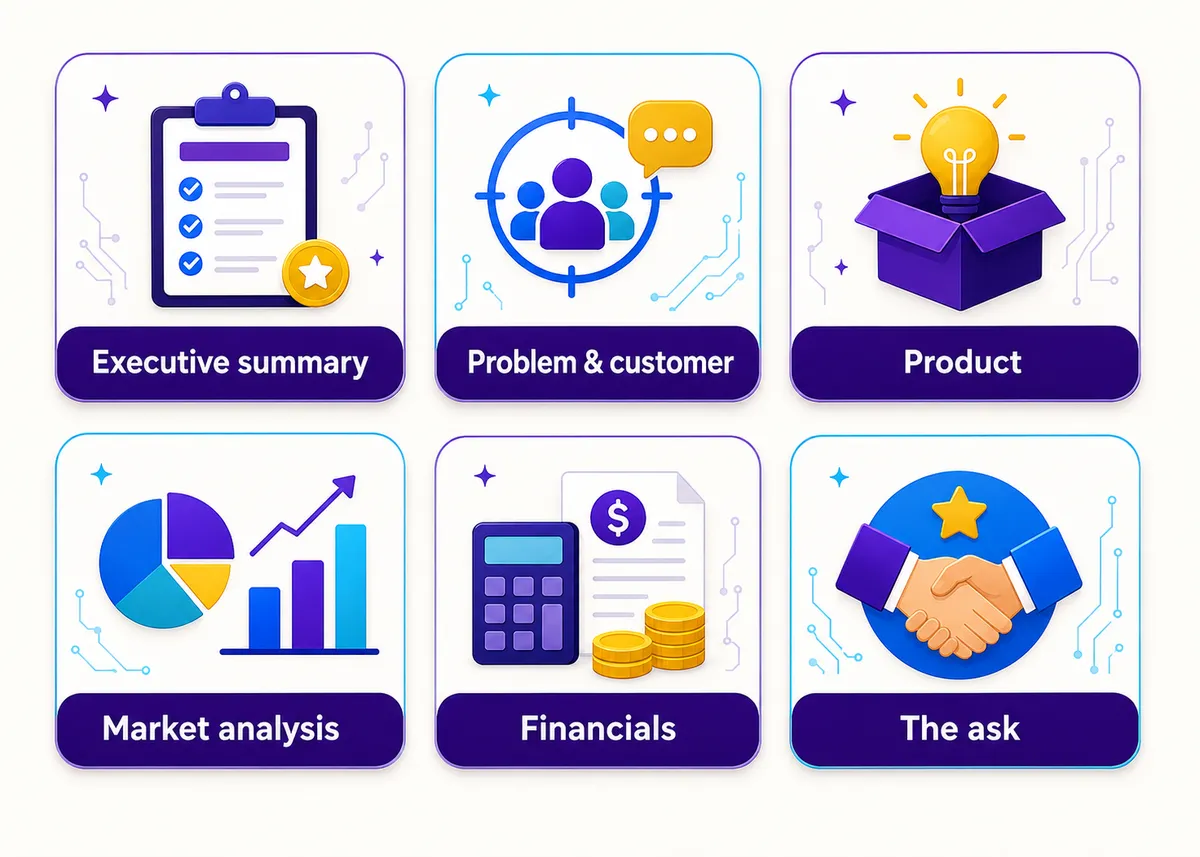
A simple business-plan template students can actually finish
The template is just those six sections turned into prompts, with a sentence or two telling the student exactly what goes in each box. When students know what a section is for, the blank page stops being scary.
Here’s the mapping. You can hand this table to students as-is, or build it into a fill-in document.
| Section | What goes here |
|---|---|
| Executive summary | One paragraph: the business, the customer, and why it works. Write this last. |
| Problem and customer | The specific problem you solve and exactly who has it (age, situation, what they currently do instead). |
| Product or service | What you sell and the one reason someone picks you over the alternative. |
| Market analysis | Two or three competitors and how you’re different or better than each. |
| Basic financials | Cost per unit, your price, and the profit in between. Plus rough monthly startup costs. |
| The ask | What you need to launch and exactly how you’d spend it. |
A few scaffolding moves that keep students moving:
- Give them the financials structure, not a blank. A tiny table with “cost to make,” “price I charge,” and “profit per sale” already filled with one worked example removes most of the panic. Students copy the structure, swap in their own numbers.
- Cap the customer section to one named person. Have them describe one real customer (“a parent of a toddler who works full time and forgets to pack snacks”), not a demographic. Specific is easier than broad, and it’s better thinking.
- Require exactly three competitors. Not zero (every idea has competition, even if it’s “doing nothing”), not ten. Three forces real comparison without the research spiraling.
How long should it be?
Shorter than students expect, and shorter than they’ll try to make it. Padding is the enemy here.
A strong high school business plan is two to four pages, or one slide per section if you’d rather run it as a pitch deck. The executive summary is one paragraph. Each remaining section is a few sentences to a short paragraph. The financials are a small table, not a spreadsheet model.
Length is not the goal, and saying so out loud changes the work. When a student asks “how long does this have to be,” the honest answer is: long enough to answer the six questions and not one word longer. A tight two-page plan that makes a defensible case beats a padded eight-page one every time, and the rubric should make that obvious.
How do you grade a business plan? (a rubric that rewards reasoning)
Here’s the trap: it’s easy to grade a business plan on whether it looks finished. Did they fill every box, is it neat, is it spelled right. But a plan can be complete and still be nonsense, and a plan can be rough and still show real thinking. You want to reward the thinking.
So the rubric grades the reasoning behind the decisions, not the polish. The core question for every section is the same: did the student justify the call they made, or did they just assert it?
A rubric we’d actually use has four criteria. Full marks on each looks like this:
- Customer clarity (25%). Full marks: the customer is a specific, believable person with a real problem, not “everyone” or “people who like coffee.” The student can explain why this person would care.
- Viability of the idea (25%). Full marks: the product clearly solves the stated problem, and the student names a real reason someone would choose it over alternatives. The logic holds together.
- Financial reasoning (25%). Full marks: the numbers are present, internally consistent, and the student can explain where the profit comes from. Exact accuracy matters less than sound reasoning (a student who explains a wrong number well is closer to the point than one who guesses a right one).
- Communication and the ask (25%). Full marks: the plan is clear and organized, the executive summary actually summarizes, and the ask is specific and tied to the plan. A reader gets it without help.
Two things make this rubric do its job. First, weight reasoning over correctness, so a student with an ambitious idea and a small math error still scores well if their thinking is sound. Second, write the “full marks” language as something a student can do (explain, justify, name a reason), not something fuzzy like “shows understanding.” That’s the same principle that holds across CTE assessment: grade the defensible decision, not the right answer.
Example angles students can pick
The blank “start a business” prompt is where projects stall, because most students freeze on the idea. Giving them a few angles to choose from gets past that without doing the thinking for them.
- A business that solves a problem at your school. The pickup-line chaos, the vending machine that’s always empty, the lost-and-found nobody runs. Constraints are real and the customer is right there.
- A side hustle a teenager could actually start this summer. Lawn care, tutoring, reselling, a small food cart. Low startup cost forces realistic financials.
- A product for one specific group you belong to. Athletes, gamers, commuters, parents of young kids. Belonging to the group makes the customer section honest.
- A digital or app idea, costed honestly. Fine to pick, as long as the financials reckon with what building and running it actually costs (this one quietly teaches a lot about why ideas are cheap and execution isn’t).
The angle matters less than the constraint. Every one of these forces a real customer and a real number, which is exactly what keeps the project from becoming a poster about a dream.
Frequently asked questions
How many sections should a high school business plan have? Six: executive summary, the problem and customer, the product or service, a simple market analysis, basic financials, and the ask. That’s enough to force real decisions without burying students in the complexity of a professional plan.
How long should a high school business plan be? Two to four pages, or one slide per section as a pitch deck. The executive summary is a single paragraph and the financials are a small table. Reward a tight, well-reasoned plan over a long, padded one.
How do you grade a business plan fairly? Use a rubric that scores reasoning over polish: customer clarity, viability of the idea, financial reasoning, and communication. Full marks go to students who justify their decisions, not just to the neatest document.
Can students do this as a pitch instead of a written plan? Yes. The same six sections work as a short pitch deck (one slide each) with a live presentation, which adds a communication element and works well as a capstone.
What if a full business plan is too much for my timeline? Run a lighter venture project instead. A Shark Tank pitch or a two-week mini-venture teaches the same decisions in less time, and Business Class Project Ideas for High School lists shorter alternatives you can swap in.
How do I help students who freeze on picking a business idea? Hand them a few angles to choose from rather than a blank prompt: a problem at their school, a summer side hustle, a product for a group they belong to, or an honestly costed app idea. The constraint matters more than the idea, since each one forces a real customer and a real number.
This project is one piece of a bigger business program. For the wider map (where the business plan fits and what each course needs), start with How to Teach High School Business. If you’re running a full unit around venture-building, How to Teach Entrepreneurship to High School Students sets up the lessons that lead into this plan, and Business Class Project Ideas for High School gives you alternatives if a full plan is more than your timeline allows.
Want the template and rubric ready to print? The Free Library has a fill-in business plan template and the grading rubric described above, no prep required. And if you’d rather have the whole venture arc built around it, the AP® Business with Personal Finance curriculum opens with this exact work: the Businesses, Competition & New Ideas unit takes students from first idea to a defended plan.