


Entrepreneurship is the business subject students show up most excited about and least prepared for. They have ideas (a snack stand, an app, a custom-hoodie business), and most of those ideas fall apart the second you ask “okay, what would it cost?” That gap is the whole opportunity. Your job isn’t to hand them a great idea. It’s to walk them from a half-baked one to a pitch they can actually defend, and to teach the thinking that gets them there.
This is the practical version: how to teach the mindset, the money basics students need before they pitch, how to run a Shark Tank day that doesn’t dissolve into chaos, and a few projects you could start next week. It’s a spoke off the bigger How to Teach High School Business guide, so if you want the whole-program view, start there.
What is an entrepreneurial mindset (and how do you teach it)?
An entrepreneurial mindset is mostly a set of habits: noticing problems other people walk past, treating “I don’t know” as a thing you can go find out, and being willing to be wrong cheaply before you’re wrong expensively. You don’t teach that with a definition slide. You teach it by making students practice the habits in low stakes.
The fastest on-ramp is a problem hunt. Give students 48 hours and one prompt: write down ten things that annoyed you, wasted your time, or cost you money this week. No solutions yet, just problems. The next day they pick the three that bug them most and the room realizes something useful: every business is a problem somebody decided to solve. The kid who couldn’t think of an idea suddenly has ten.
The mindset also needs reframing failure, because most teenagers think a failed idea means they’re bad at this. Normalize it early. When a pitch has a hole, name the hole and move on (no drama). Students who learn that being wrong is just information they didn’t have yet take bigger, better swings later.
What financial basics do students need first? (revenue vs. profit, cost of goods, pricing)
Here’s where most classroom ventures quietly fall apart: students pitch a business that loses money on every sale and nobody in the room can tell, because nobody learned the three numbers that matter first. Teach these before anyone builds a pitch.
- Revenue versus profit. Revenue is what comes in. Profit is what’s left after you pay for everything. Students conflate the two constantly (“I’d sell 100 at $5, so I’d make $500”), and untangling it is the single most useful thing you teach in the unit.
- Cost of goods sold. What each unit actually costs you to make or buy. If a bracelet costs $1.40 in materials, that’s your floor, and pricing below it means you lose money faster the more you sell.
- Pricing. Price has to cover the cost of goods, contribute to your other costs (your time, your booth fee), and still leave profit. Students love to price at “whatever feels fair,” which is usually too low.
Keep it concrete with one tiny worked example the whole class runs together:
| Lemonade stand | |
|---|---|
| Price per cup | $2.00 |
| Cost of goods per cup | $0.70 |
| Profit per cup | $1.30 |
| Cups sold | 40 |
| Revenue | $80.00 |
| Total profit | $52.00 |
Once they can build that little table for a lemonade stand, they can build it for their own idea, and that’s the move that makes a pitch credible instead of cute.
How do you run a Shark Tank pitch in class?
Shark Tank day is the payoff, and it works because students are pitching to a decision, not reciting a report. A few things keep it from going sideways.
Set a hard time limit. Two minutes to pitch, two minutes for questions. The constraint forces students to lead with what matters and cut the fluff.
Make the sharks ask real questions. If you’re judging solo, you’re the only shark, which is fine. If you can pull in a few colleagues, an administrator, or a local business owner, even better. Give the sharks two required questions: “what does each unit cost you, and how did you land on your price?” and “who exactly is your customer?” Those two questions expose nearly every weak pitch.
Grade the reasoning, not the charisma. The confident kid with no numbers should not beat the quiet kid whose numbers are airtight. A rubric is what protects that, and it’s what keeps the day fair. Here’s a simple one:
| Criteria | What you’re looking for | Points |
|---|---|---|
| Problem and solution | A real problem, clearly solved | 25 |
| The numbers | Cost of goods, price, and profit that hold up | 30 |
| Customer | A specific target, not “everybody” | 20 |
| Pitch and delivery | Clear, within time, well organized | 15 |
| Handling questions | Defends choices, adjusts when pushed | 10 |
Notice the numbers carry the most weight. That’s deliberate. It tells students before they ever pitch that “I have a cool idea” isn’t the bar.
Entrepreneurship project ideas (mini-startup challenge)
The strongest unit runs as one connected arc: spot a problem, sketch a solution, work the basic numbers, build a simple pitch, then present and defend it. Each step is its own short activity, and by the end every student has a venture they built from nothing.
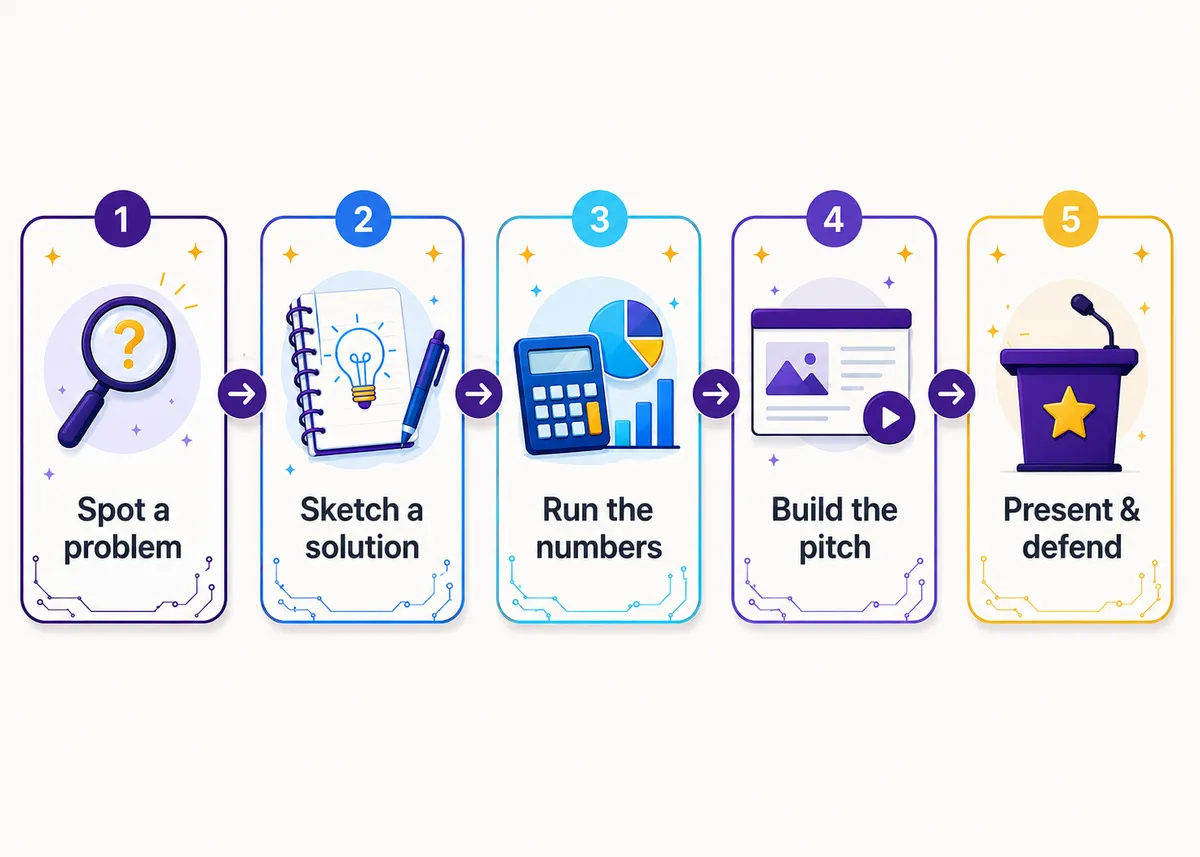
- The problem hunt (day one). The ten-annoyances list above. Output: three problems worth solving.
- The solution sketch. Students draw or describe their fix on a single sheet. No polish, just the idea and who it’s for. This is where you push “who exactly is this for?” until “everybody” turns into “high schoolers who forget their chargers.”
- The $20 challenge. Give every student (or team) an imaginary $20 in startup money. They have to source their product or materials, set a price, and project profit on a realistic number of sales, all within that budget. The constraint is the teacher: it kills the “I’ll just spend $5,000 on ads” fantasy and forces real tradeoffs. Real money is optional and powerful if your program allows it, but the imaginary version works fine.
- The one-page pitch. Everything on a single page: the problem, the solution, the customer, the numbers (cost of goods, price, profit), and the ask. Forcing it onto one page is the point. It makes students decide what actually matters.
- Shark Tank day. Pitch and defend, graded on the rubric above.
If you want a longer, more scaffolded version of this, the Business Plan Project for High School stretches the same arc into a full multi-week capstone with a written plan behind the pitch. And once students have a venture, the natural next move is figuring out how to reach customers, which is exactly what the Marketing Campaign Project for High School Students walks through.
Free tools and curriculum
You don’t need a budget to teach this well. A few starting points worth knowing:
- The Network for Teaching Entrepreneurship (NFTE) offers free lessons and a well-known business plan framework built for exactly this age group.
- Junior Achievement has free, ready-to-run entrepreneurship programs, often with volunteer business mentors who’ll come run a session.
- Our Free Library has no-prep starting points (a project rubric, bell ringers, first-week activities) you can pull straight into this unit.

And if you’d rather not build the whole arc from scratch, the Businesses, Competition & New Ideas unit of AP® Business with Personal Finance packages the concept-to-pitch sequence, the financial-basics lessons, and a pitch rubric as one editable unit. The rest of the course runs marketing, finance, and management on the same build-and-defend model.
Frequently asked questions
How do you teach entrepreneurship to students who say they have no ideas? Start with problems, not ideas. Run a problem hunt where students list things that annoyed or cost them this week, then pick a few to solve. Ideas come easily once they’re hunting for problems instead of waiting for inspiration.
What financial concepts should I teach before the pitch? Three: revenue versus profit, cost of goods sold, and pricing. If students can build a small table showing price, cost per unit, and profit per sale, their pitches stop losing money on paper.
How long should an entrepreneurship unit take? The full concept-to-pitch arc runs comfortably in two to three weeks: a day or two on mindset and the problem hunt, a few days on the money basics, then the solution sketch, the one-page pitch, and Shark Tank day.
Do I need real money for the mini-startup challenge? No. An imaginary $20 budget works fine and teaches the same tradeoffs. Real money raises the stakes if your program allows it, but it isn’t required.
How do you run a Shark Tank pitch day without it turning into chaos? Set a hard time limit (two minutes to pitch, two for questions), give your judges two required questions about unit cost and customer, and grade on a rubric that weights the numbers most so the confident kid with no math doesn’t beat the quiet kid whose figures hold up. For a longer, written-plan version of the same arc, see the Business Plan Project for High School.