


Ask a room of teenagers to fill out a blank budget worksheet and watch what happens: they write down numbers that make the math work, hand it in, and forget it by lunch. They didn’t learn anything about money. They learned how to make a spreadsheet stop yelling at them.
Budgeting only sticks when there’s something on the line. A student has to want the apartment, want the car, want to keep eating something other than rice, and then hit the wall where the money runs out before the month does. That collision is the lesson, and everything below is built to engineer it.
This is the budgeting deep dive under Personal Finance Activities for High School. For the full finance picture (credit, saving, investing, taxes), start there and come back here for budgeting specifically.
Why teach budgeting with simulations (not worksheets)?
A worksheet asks a student to budget a salary that isn’t theirs for a life they aren’t living. There’s no tension, so there’s no learning. A simulation flips that: the student gets a paycheck, a set of real costs, and a constraint they can’t math their way out of.
The difference shows up in what students say. Worksheet budgeting produces “I put $400 for food, I guess.” Simulation budgeting produces “wait, I can’t afford this apartment if I keep the car,” which is the exact sentence you want: now they’re deciding instead of filling a box.
Three things make a budgeting activity work:
- Real numbers. Pull rent, car payments, and grocery costs from your actual area (or a city students know). Fantasy numbers teach fantasy budgeting.
- A forced tradeoff. The income should not comfortably cover everything they want. Scarcity is the whole point.
- A curveball. Real budgets get wrecked by the thing nobody planned for. Build that in.
Hands-on budgeting activities and games
Here’s a stack of activities you can run from a single class period up to a multi-day unit. Each one is a different angle on the same idea: money runs out, so you have to choose.
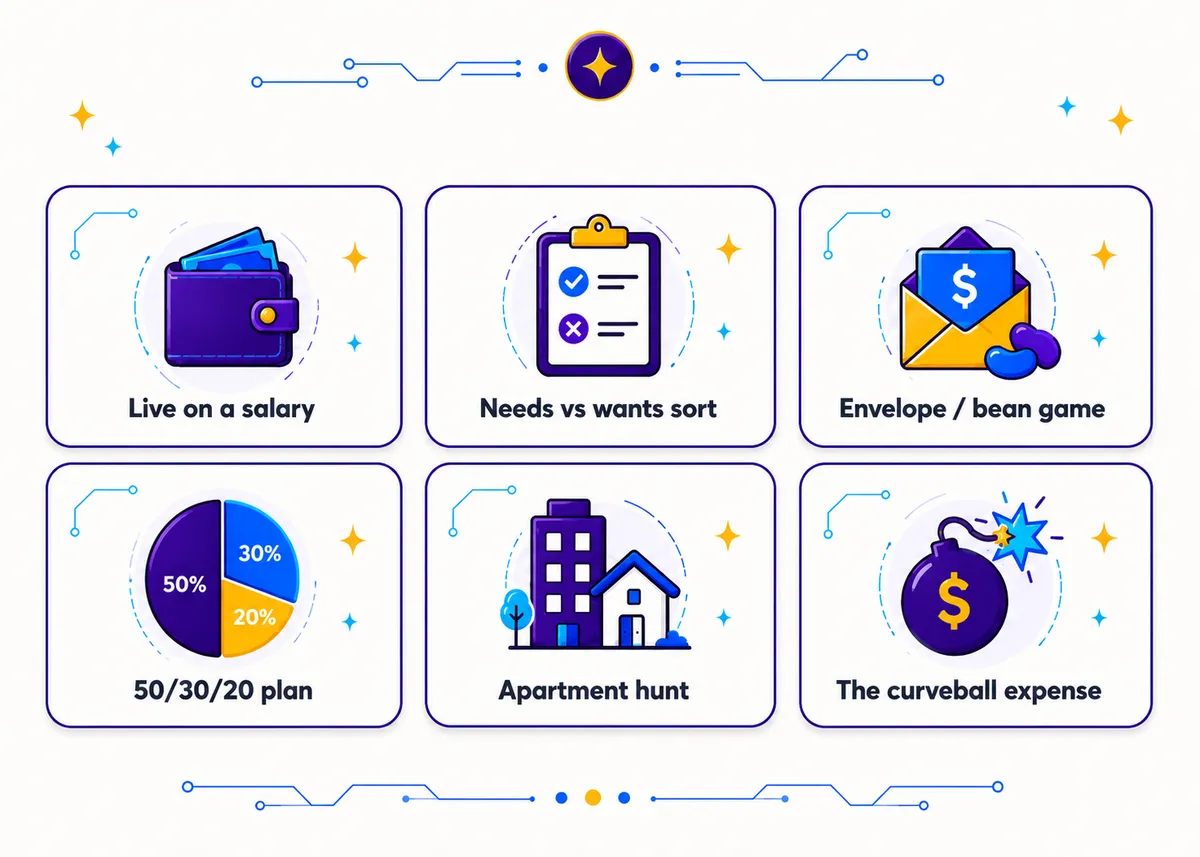
- Needs-versus-wants sort. Hand students a stack of 25 spending items (rent, phone, streaming, gym, gas, takeout, new shoes) and have them sort into needs, wants, and “it depends.” The fights over “it depends” are the lesson. A phone is a want until it’s how you get to your job.
- The envelope (bean) game. Give each student a fixed number of dried beans as their monthly income, plus labeled cups for rent, food, transportation, and fun. They physically drop beans into each cup. When the beans are gone, they’re gone, and watching the “fun” cup sit empty lands harder than any worksheet total.
- Dream-versus-reality apartment hunt. Students browse real listings on a rental site, pick the apartment they actually want, then check it against a realistic monthly take-home pay. Most pick something they can’t afford on the first try. The assignment is to get to a budget that works, which means downgrading, getting a roommate, or cutting somewhere that hurts.
- The lifestyle creep scenario. Give a student a budget that balances, then hand them a raise and watch them spend it. The next month, hit them with a surprise expense, and most discover the raise vanished into a nicer apartment and more takeout. The point clicks fast: more money does not equal more margin unless you decide it does.
- Salary reveal draw. Before the big simulation, have students draw a career and salary at random instead of picking. The student who wanted to be a vet draws “retail manager, $42,000,” and the conversation shifts to living on what you actually earn, not what you wish you earned.
How do you run a real-life budget simulation?
This is the centerpiece, the “live on this salary for a month” simulation. It’s worth two to four class days and it’s the activity students still mention at the end of the year. Here’s the structure.
1. Assign a salary. Give each student a monthly take-home number (post-tax, so the gap between salary and paycheck is its own quiet lesson). Draw from real entry-level wages in your area, and don’t let students pick: a random draw forces the “live on what you earn” problem you’re trying to teach.
2. Force the big tradeoffs. Students build a monthly budget covering the non-negotiables and the choices:
| Category | The decision they have to make |
|---|---|
| Housing | Studio alone, or split a two-bedroom with a roommate? |
| Transportation | Car payment plus gas and insurance, or transit and a longer commute? |
| Food | Groceries and cook, or convenience and eat out? |
| Everything else | Phone, savings, fun, and the stuff they forgot until it’s due |
The income should be tight enough that they cannot say yes to everything. That’s not cruelty, that’s accuracy.
3. Throw a curveball. Partway through, hit the room with a surprise expense card: a $600 car repair, a medical bill, a rent increase, a friend’s wedding three states away. The students who left no savings buffer feel it immediately. This is the moment the abstract idea of an emergency fund becomes a thing they wish they’d had.
4. Debrief the decisions. The grade lives here, not in the spreadsheet. Ask each student to defend two tradeoffs and explain what the curveball cost them. A budget that balanced only because they ignored the curveball is a worse answer than one that broke but had a plan. You’re grading reasoning, not arithmetic.
To stretch it, run a second month where students adjust after the curveball. The kids who got burned start building a buffer without you telling them to, which is the whole game.
The 50/30/20 lesson
Once students have felt scarcity in the simulation, they’re ready for a framework, and 50/30/20 is the cleanest one to hand a teenager:
- 50% needs: housing, food, transportation, the bills you can’t skip.
- 30% wants: the stuff that makes life not miserable.
- 20% savings and debt: future-you’s money.
Run it as a build, not a lecture. Give students a take-home pay, have them split it into the three buckets, then drop their real (or simulated) costs into the needs bucket. Almost everyone blows past 50% on needs, usually because of rent, and that’s the productive part: now they decide whether to find cheaper housing, shrink wants, or accept a smaller savings rate. The framework stops being a rule and becomes a set of levers they can pull.
One honest caveat worth telling them: 50/30/20 is a starting point, not a law. In a high-rent city, needs eat more than half, and the useful skill is knowing which dial you’re choosing to turn.
Free budgeting tools
You don’t need to build all of this from a blank page. A few starting points:
- The budgeting starter set has no-prep budgeting starters: a needs-versus-wants card sort, a simple budget template, and a salary-simulation handout you can run on a Monday with zero setup.
- Real rental sites and grocery-store websites are free, current, and exactly the data the apartment hunt and salary simulation need. Local numbers beat any made-up textbook figure.
If you want the simulation, curveball cards, 50/30/20 build, and debrief rubric already assembled and editable, the Smart Money Decisions unit of our Personal Finance curriculum is built around this exact decision-and-tradeoff model. The full Personal Finance course carries that approach through the rest of the year: credit, taxes, insurance, saving, and investing.
Where budgeting fits in the bigger course
Budgeting is one piece of a finance class, which is one piece of a business program. If you’re mapping the whole thing, here’s the path up and out:
- Up a level: Personal Finance Activities for High School covers credit, saving, investing, and taxes alongside budgeting.
- Sideways: Economics Activities for High School Students brings the same simulation-first approach to markets, scarcity, and incentives.
- The wide view: How to Teach High School Business is the start-here guide for the entire business program, finance included.
Frequently asked questions
What’s the best budgeting activity for high school students? The “live on this salary for a month” simulation, because it forces real tradeoffs and a surprise expense rather than letting students fill in tidy numbers. A needs-versus-wants sort is the fastest low-prep option if you only have one class period.
How do you make budgeting fun to teach? Add stakes and a curveball. Let students chase the apartment or car they actually want, then run them into the wall where the money runs out. The tension is what makes it stick, and it’s also what makes it fun.
What is the 50/30/20 rule for high schoolers? Split take-home pay into 50% needs, 30% wants, and 20% savings and debt. Teach it as a build students fill in with real costs (not a lecture), so they see where their own spending breaks the rule.
How long does a budget simulation take? A solid one runs two to four class days: a day to assign salaries and build budgets, a day for the curveball and adjustments, and time to debrief the decisions, which is where the real grading happens.
How do you grade a budgeting simulation? Grade the reasoning, not the arithmetic. Ask each student to defend two tradeoffs they made and explain what the curveball cost them. A budget that broke but had a plan is a better answer than one that balanced only because the student ignored the surprise expense.
Where does budgeting fit in a personal finance course? Budgeting is one piece of a finance class that also covers credit, saving, investing, and taxes. Teach it first, since the scarcity students feel in a budget simulation makes every other money topic land harder. See Personal Finance Activities for High School for the full picture.