

Thirty states now require a standalone personal finance course to graduate (as of 2026), which means a lot of teachers opened their rosters this year and found a finance class they never asked to teach. If that’s you, here’s the good news: personal finance is the easiest subject in the building to make real, because every student already has a stake in it. I teach personal finance full time, and the lessons that land are never the ones where I talk. They’re the ones where students decide.
This post is a working list of activities you can pull straight into a unit: ten hands-on lessons across saving, credit, taxes, investing, smart spending, and insurance, plus the free games worth knowing. Budgeting gets its own deep dive (it’s the backbone of the course), so we keep it short here and send you to it.
Why teach personal finance through activities (not lecture)?
Money is abstract until it isn’t. A 16-year-old can nod along to a definition of “interest” and still have no felt sense of what it costs them. The fix isn’t a better slide. It’s a decision they have to make and then defend.
Activities do three things a lecture can’t:
- They make the stakes visible. A number on the board is theory. The same number as “this is what your paycheck actually shrank to” is personal.
- They let mistakes be cheap. Maxing out a simulated credit card teaches more than a warning ever will, and nobody’s credit gets hurt.
- They meet a mixed room where it is. The senior with a part-time job and the sophomore who’s never seen a pay stub can both find a way into the same scenario at their own level.
The throughline for all of it: lead with the choice, let the vocabulary follow.
Hands-on personal finance activities
Here are ten you can run with little more than a worksheet, a spreadsheet, or a deck of role cards. Mix and match by unit.
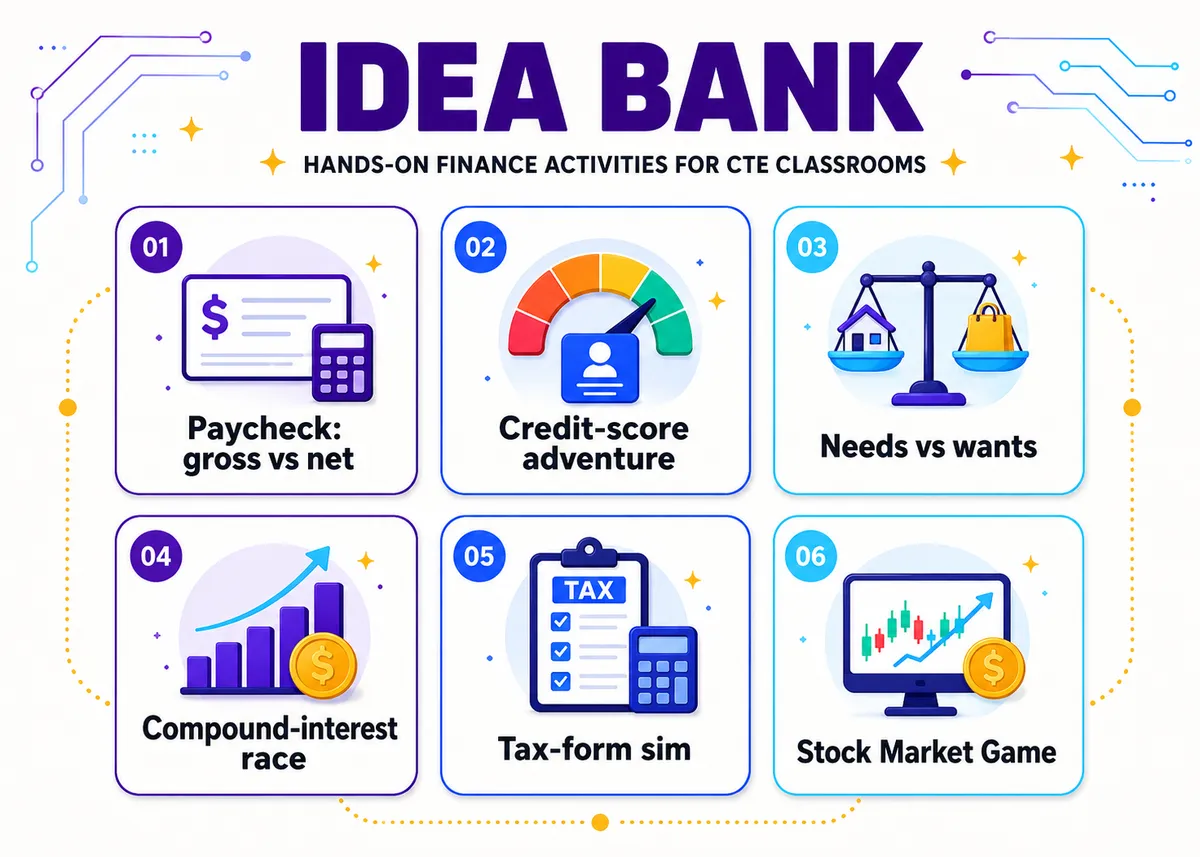
- Your first paycheck (gross vs. net). Hand each student a job and a salary, then make them work down from gross pay to take-home: federal withholding, FICA, state tax, maybe health insurance. The reveal (that a “$40,000 job” lands closer to $32,000 in the bank) does more for tax literacy than a chapter ever will. This is the single best day-one hook I know.
- Needs vs. wants sort. Give students 25 to 30 spending cards (rent, phone plan, concert tickets, groceries, streaming, gas) and have them sort into needs, wants, and the messy middle. The argument over where “phone” goes is the lesson. It previews budgeting without being a budget.
- The compound-interest race. Two savers: one starts at 22 and stops at 32, the other starts at 32 and never stops. Have students run both forward to age 65 in a spreadsheet. When the early starter wins despite saving for fewer years, the room goes quiet. Compound interest stops being a formula and becomes a reason to start now.
- Credit-score choose-your-own-adventure. Build a branching scenario: pay the card in full or carry a balance, open a store card for the discount or skip it, miss one payment or scramble to cover it. Each choice nudges a running credit score up or down. Students see, in real time, that a score is the sum of a hundred small decisions.
- A tax-form simulation. Give students a W-2 (real numbers, fake person) and a blank 1040, and walk them through filing a simple return. Most teenagers think taxes are a black box. One guided pass through the form turns “I’ll deal with it later” into “oh, that’s it?”
- The Stock Market Game portfolio. Stake each student or team a virtual $100,000 and let them invest it over several weeks (more on the free version below). The weekly check-ins, the bragging, the panic when a stock drops: that’s the lesson teaching itself.
- The “big purchase” comparison. A student needs a $1,200 laptop. Have them compare three paths: save and pay cash, finance at 0% for 12 months, or put it on a credit card at 24% APR. Make them compute the true cost of each and pick one. This is where smart spending and credit collide in a single, concrete choice.
- Insurance risk pool. Run a quick simulation: everyone “pays a premium” into a pot, then you draw random events (a fender bender, a broken phone, a hospital visit). The pot covers the unlucky few. Students feel why insurance exists (spreading risk) instead of memorizing a definition of “deductible.”
- The subscription audit. Have students list every recurring charge a typical young adult racks up (streaming, music, gaming, apps, the gym they don’t go to) and total the annual cost. The “$14.99 a month is $180 a year” math reframes smart spending without a single lecture on willpower.
- Saving with a goal and a timeline. Pick a real goal (a used car, a first apartment’s deposit, a trip) and have students reverse-engineer the monthly savings to get there by a date. It turns “I should save” into a number with a deadline, which is the only version that ever works.
A quick map of which activity hits which standard:
| Activity | Topic it teaches |
|---|---|
| First paycheck | Paying taxes, gross vs. net |
| Compound-interest race | Saving, investing |
| Credit-score adventure | Credit |
| Tax-form simulation | Paying taxes |
| Stock Market Game | Investing |
| Big-purchase comparison | Smart spending, credit |
| Insurance risk pool | Insurance |
| Subscription audit | Smart spending |
A note on budgeting: it’s the load-bearing skill in the whole course, so it gets its own post rather than one bullet here. When you’re ready to build that unit, Budgeting Activities for High School Students has the simulations (a month on a salary, a surprise-expense curveball) that make it stick.
Free games and lessons
You do not need a budget to teach this well. A few genuinely good tools are free:
- Next Gen Personal Finance (NGPF). A complete, free curriculum (full units, lesson plans, projects, and assessments) plus the free game Payback, where students make spending-and-borrowing choices through a simulated four years of college. For a newly assigned teacher with no materials, NGPF is the place to start.
- The SIFMA Foundation’s Stock Market Game. A free, long-running classroom investing simulation that pairs perfectly with the portfolio activity above. Teams manage a virtual $100,000 and learn how markets actually move.
- Visa’s Financial Football. A free, fast-paced trivia game (football-themed) that drills financial-literacy questions. It’s a solid Friday review or sub-day activity that students will actually play.
Start with one. Most teachers anchor on NGPF for the curriculum and bolt on a game or two for variety.
How do you make a required finance course feel real?
When a course is a graduation requirement, some students show up assuming it’s a box to check. The way to beat that isn’t to insist the content matters. It’s to make the content theirs.
A few moves that work:
- Use their real numbers when you safely can. A part-time paycheck, a phone plan, the price of the sneakers they want. The closer the figures sit to their actual life, the less the class feels like a worksheet.
- Give them the curveballs adults get. A car repair the week rent is due, hours cut at work, a surprise medical bill. Real money is mostly about handling the thing you didn’t plan for.
- Let them choose the stakes. Their own savings goal, their own product to compare, their own venture’s first budget. Choice is what turns a required class into one they lean into.
- Tell the truth about the boring parts. Taxes and insurance aren’t thrilling, but they’re the parts that quietly wreck adults who never learned them. Students respect being treated like the future adults they are.
This is the same engine that runs every business course: a real decision, a few open lanes, and a grade on the reasoning. For the wider view of where finance sits in the program, head up to How to Teach High School Business. And if you teach economics in the same room (a lot of us do), Economics Activities for High School Students runs the same play for supply, demand, and markets.
Frequently asked questions
What are good hands-on personal finance activities for high school? Start with a first-paycheck gross-vs-net breakdown, a needs-vs-wants sort, a compound-interest race, a credit-score scenario, and a stock-market simulation. Each turns an abstract concept into a decision students make and defend.
What free personal finance curriculum can I use? Next Gen Personal Finance (NGPF) offers a complete free curriculum plus the free game Payback. The SIFMA Foundation’s Stock Market Game and Visa’s Financial Football are free supplements worth adding.
How do I teach personal finance if I’ve never taught it before? Anchor on a free, ready-made curriculum (NGPF is the standard), lead each topic with an activity instead of a lecture, and keep the numbers close to your students’ real lives. You don’t have to build it all from scratch.
Where does budgeting fit? Budgeting is the backbone of the course and deserves its own unit. See Budgeting Activities for High School Students for the simulations that teach it best.
How do you make a required finance course feel real to students? Use their own numbers (a part-time paycheck, a phone plan, the sneakers they want), throw in the curveballs adults actually get (a car repair the week rent is due), and let them choose the stakes. When the figures sit close to a student’s real life, a graduation-requirement class stops feeling like a box to check.
Free resources and done-for-you units
You don’t have to build this from scratch, and you shouldn’t have to pay just to test the waters. The budgeting starter set in the Free Library gives you a no-prep head start on the backbone unit, and our editable Personal Finance curriculum is organized around exactly these kinds of decisions, with complete Taxes and Saving and Investing units ready to teach. And if you’re building toward AP®, the same skills carry straight into AP® Business with Personal Finance.