


The first week of business class sets the rule for the whole semester: this is a place where you do things, not just define them. If day one is a syllabus read-aloud and a seating chart, you’ve quietly told the room business is a lecture class, and that’s a hard tone to walk back in October.
So we’re going to lead with decisions instead of definitions. Below are concrete activities for the first few days: openers that preview the whole course, ways to build culture without putting the room to sleep, and the honest answer to whether you should teach real content in week one. Pick a few, not all. You only get one first week.
What should you do on day one of business class?
Open with a decision, not a definition. You want students talking, choosing, and defending a position inside the first 20 minutes, before anyone decides this class is going to be boring.
Two openers that do that work fast:
- The one-dollar decision. Put a single hypothetical dollar on the board and ask: spend it, save it, or invest it, and defend the call out loud. It surfaces every student’s money instinct in 10 minutes and gives you a clean hook into opportunity cost (a word you don’t say until after they’ve argued about it).
- Would you fund this business? Show three real, slightly weird products (a $400 juicer, a smart water bottle, a sock subscription box) and have the room vote fund or pass, then say why. You learn who thinks about customers versus features, and you’ve previewed entrepreneurship without the word.
Both tell you more about your students than any first-day survey, because you’re watching how they reason.
First-week activities that preview the whole course
The best first-week activities are trailers for the units coming later. Each lets a student touch a real business idea before you name it. Here are six to choose from.
-
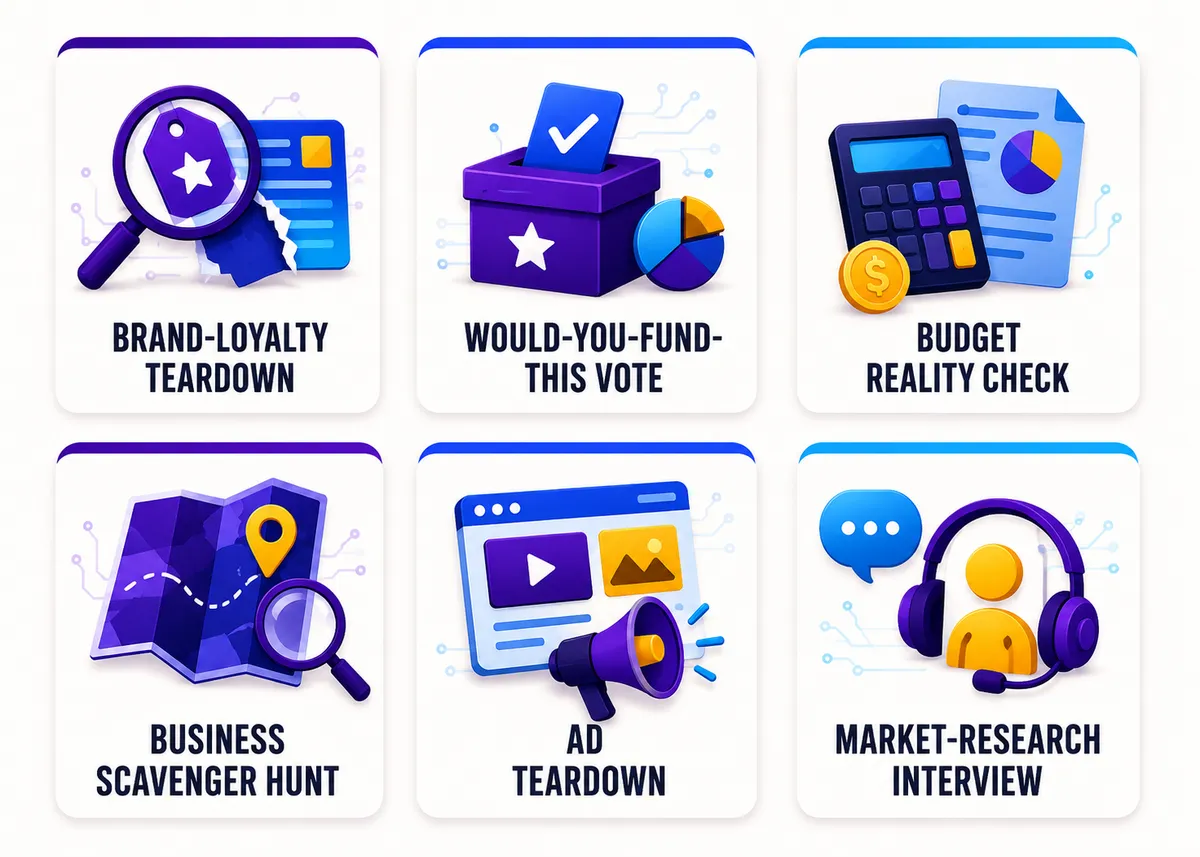
The “brands you’re weirdly loyal to” teardown. Each student names one brand they’d defend in a fight (a shoe, a snack, a phone, a coffee chain) and lists three things that brand did to earn that loyalty. Collect them on the board and group them: price, identity, habit, quality. The room just built the foundations of marketing and branding without notes.
-
A personal-budget reality check. Hand out a realistic monthly take-home pay for an entry-level job in your area (look up a real number) and a list of fixed costs (rent, phone, car, food). Students try to make the month balance. The point isn’t the math: it’s the face they make when the money runs out before the wants do. That moment is your whole personal finance unit in miniature.
-
A business-around-you scavenger hunt. Send students (in pairs, on phones or paper) to find a real example of each concept near them: a business with an obvious target customer, a price that ends in .99, a loss leader, a local monopoly, an ad aimed at teenagers. It turns the strip mall by the school into a textbook and previews economics, marketing, and operations at once.
-
A quick market-research interview. Pair students up for five minutes to interview each other as if the partner were a customer: What did you last buy with your own money? What made you pick it? What almost stopped you? Then each student pitches one product their partner would actually buy. It’s market research, sales, and listening, disguised as an icebreaker.
-
The receipt autopsy. Have students bring (or recall) a recent receipt and break down where the money went: the product’s cost, the store’s markup, tax, the marketing baked into the price. Most have never thought about the layers inside a price they paid. It previews accounting and economics, and it sticks because it’s their money.
-
Rank the side hustles. List six ways a teenager could make money (reselling, dog walking, a print-on-demand shop, tutoring, mowing, content) and have small groups rank them by startup cost, risk, and likely earnings, then defend their number-one. You’ve previewed entrepreneurship, profit, and risk, and learned which students already think like founders.
How do you build culture without a boring syllabus read-through?
You still have to cover the syllabus. You just don’t have to read it aloud while 30 humans lose the will to live. Make them use it instead.
- Run a syllabus scavenger hunt. Turn the document into a 10-question hunt: What happens if you turn work in late? How many points is the final project worth? Where do you find make-up work? Pairs race to find the answers. They actually read the thing (which they never do when you read it to them), and you get to circulate and meet people.
- Set the “we do things here” norm out loud. Tell them plainly: in this room, the answer is usually a decision you can defend, not a fact you memorized. Then prove it that same week with one of the openers above. Culture is built by what you do on day two, not what you promise on day one.
- Build a norms list together. Instead of handing down rules, ask the room what a good business team needs to function (show up, pull your weight, disagree without torching people) and post their version. They follow rules they helped write, especially once group work starts.
Should you teach content in week one?
A little, and only the kind that earns its place. Week one is not the time to march into chapter one. It’s the time to plant content inside an activity students are already invested in, so the vocabulary has somewhere to land. The move is always the same: run the activity first, then name what just happened.
A rule of thumb:
| Do this in week one | Skip until later |
|---|---|
| Name concepts students already touched (opportunity cost, target customer, markup) | Formal definitions and key-term lists to copy down |
| One light, high-interest reading or video tied to an opener | A full lecture from the textbook |
| Low-stakes choices students defend out loud | A graded test or heavy worksheet |
| Vocabulary pulled out of an activity | Vocabulary pushed into a blank page |
When a student argues their dollar should be invested and then learns the phrase “opportunity cost,” that word is now theirs. Lead with the definition instead and it’s just one more term to forget by Friday.
A workable week, then, looks like this: day one is an opener plus a five-minute “here’s how this class works” instead of a syllabus read. Day two is the syllabus scavenger hunt plus one preview activity. Day three on, you add another activity and your first real mini-lesson. Lead with a decision, name the concept after, and let week one prove the promise the whole course is going to keep.
FAQ
What should I teach on the first day of a high school business class? Lead with a decision students can argue about, like the one-dollar decision or a “would you fund this business” vote. You want them reasoning out loud in the first 20 minutes, before they decide the class is a lecture. Save the syllabus for a scavenger hunt on day two.
How do I make the syllabus less boring? Don’t read it aloud. Turn it into a 10-question scavenger hunt and have pairs race to find the answers (late-work policy, the big project’s point value, where make-up work lives). They actually read it, and you circulate and learn names.
Should I jump into real content the first week? A little, but pull it out of an activity instead of pushing it onto a blank page. Run the opener first, then name the concept once students have touched it. Skip formal definitions and tests until week two.
What are good icebreakers for a high school business class? Tie the icebreaker to the subject instead of a generic “fun fact.” A quick market-research interview (students interview a partner about their last purchase, then pitch a product that partner would buy) doubles as sales and listening practice, and the “brands you’re weirdly loyal to” teardown gets the room reasoning about marketing on day one.
How many activities should I plan for the first week? Pick a few, not all of them. A workable shape is an opener plus a short “here’s how this class works” on day one, the syllabus scavenger hunt plus one preview activity on day two, then a new activity and your first mini-lesson from day three on. For projects to run after week one, see Business Class Project Ideas for High School.
Keep going
- Up a level: How to Teach High School Business is the start-here guide for the whole program.
- Need more to run after week one? Business Class Project Ideas for High School collects ready-to-go projects across every subject.
- Leaning into the founder energy from the side-hustle and fund-it activities? How to Teach Entrepreneurship to High School Students takes it further.
Want the first week done for you? The first-week activities set in the Free Library has no-prep openers you can print and run tomorrow. And when the previews have done their job, the Businesses, Competition & New Ideas unit of AP® Business with Personal Finance picks up where the fund-it votes and side-hustle rankings leave off, with the full course keeping that decision-first tone all year.