
Project-based learning is the engine room of good CTE. Everything else on this site (the lessons, the simulations, the rubrics) exists to feed one moment: a student making a real decision under real constraints and having to defend it. Get that moment right and the content sticks, the mixed-level room finds its footing, and “career readiness” stops being a poster on the wall and becomes something a kid actually did on a Tuesday.
This is the deep dive for any CTE teacher who’s tried projects and watched them go sideways (the ones that never finish, the groups where one kid does everything, the posters with lots of glitter and no thinking) and wants the version that holds up. We’ll cover what real project-based learning is, how it differs from “doing a project,” concrete examples across business and tech, how to structure a project lesson, how to keep group work fair, and how to grade it without losing your weekend.
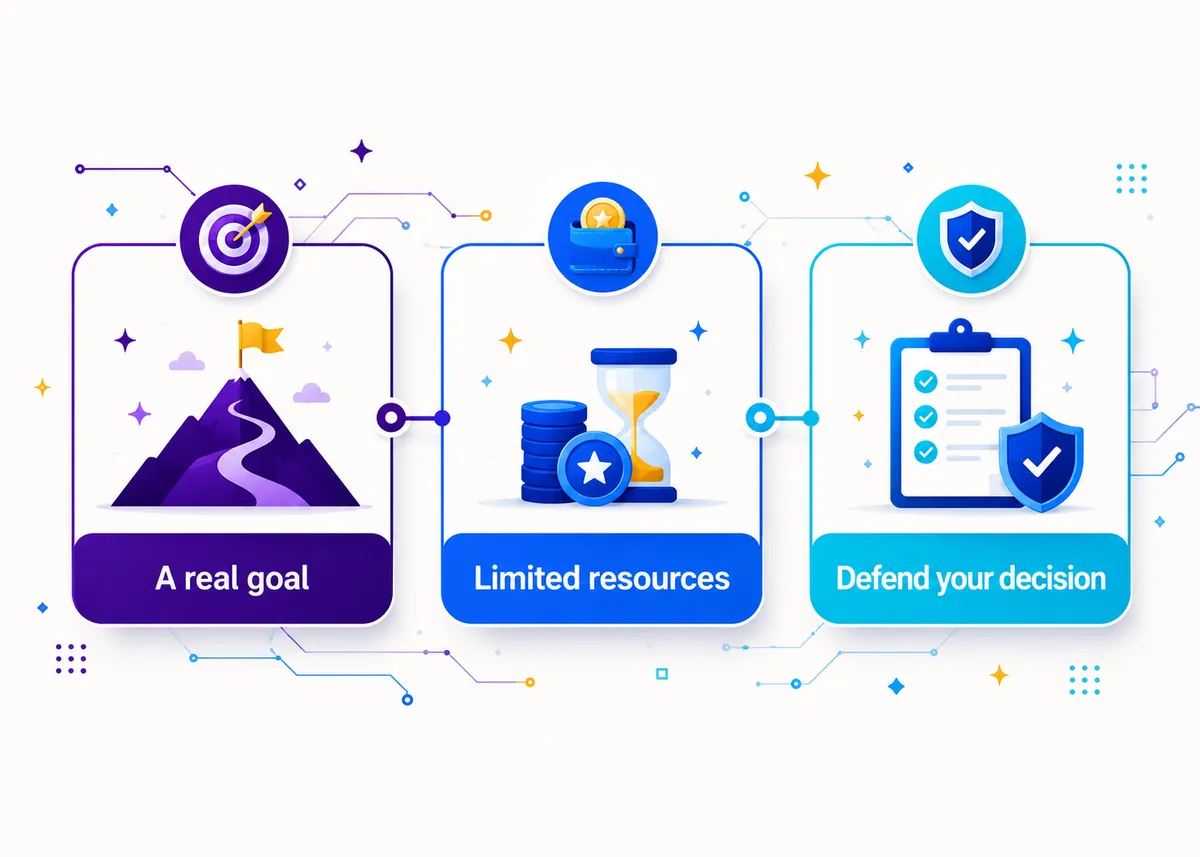
The short version: A real project isn’t defined by the topic, it’s defined by its constraints. Give students a goal, limited resources, and a “defend your decision” requirement, then build the whole thing backward from the decision they have to make. That single shift (constraints plus a defense) is what separates a CTE project from a poster project, and it’s what quietly builds the Career Ready Practices everyone wants and nobody can pin down.
What is project-based learning in CTE?
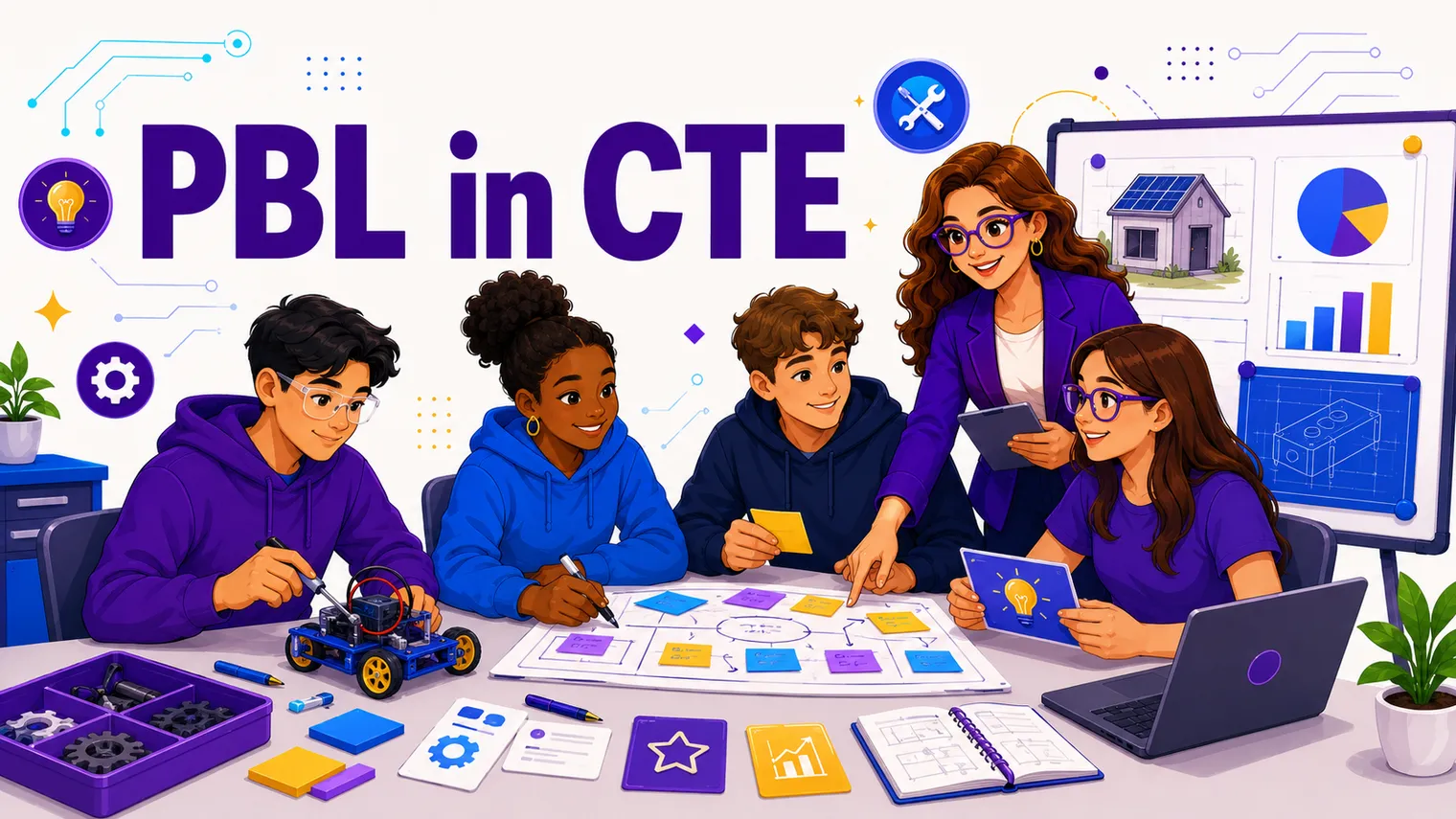
Project-based learning (PBL) is teaching where students learn the content by using it to make and defend a real decision, instead of learning the content first and maybe applying it later if there’s time. In CTE that’s not a nice-to-have, it’s the whole point: the field exists to produce people who can do the work, and you don’t learn to do the work by listening to someone describe it.
Here’s the part that trips people up. PBL is not “we did an activity,” and it’s not “students made something.” Plenty of busywork involves making something. Real PBL is built backward from a decision a professional would actually have to make, and the project is just the container that forces the student into that decision. The marketing brief, the budget, the network diagram: those are the byproducts. The reasoning is the lesson.
Done well, this is also how you build the 12 Career Ready Practices (the soft, durable skills like communicating clearly, working as a team, reasoning through tradeoffs, and acting with initiative) without ever running a separate “soft skills unit.” Those practices don’t transfer from a lecture. They show up when a student has to make a call, live with the constraints, and explain themselves.
How is real PBL different from just “doing a project”?
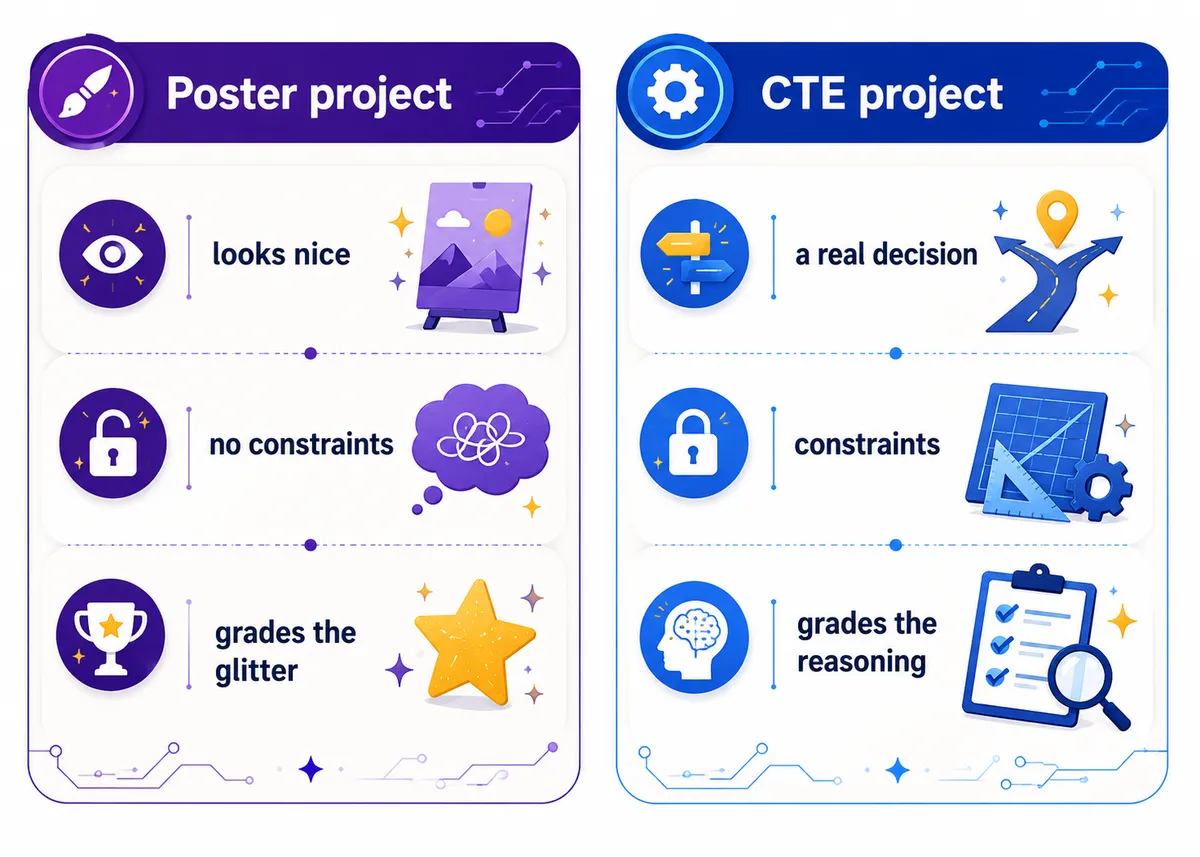
The difference is constraints. A poster project hands students a topic and a deadline. A real project hands them a goal, a hard limit, and a requirement to justify their choices. That one change reorganizes the whole assignment.
Think about the most common “project” in the building: research a topic and make a slideshow about it. Nothing is at stake. There’s no decision, no scarcity, no reason one student’s answer should differ from the next. Everyone can find the same facts and arrange them on the same five slides. The thinking is nowhere, which is why these projects feel busy but hollow.
Now add three things and watch it change:
- A goal: a specific outcome the student is trying to hit (launch the product, secure the network, end the month in the black).
- Limited resources: a budget, a time box, a fixed headcount, a set of tools they can’t exceed. Scarcity is what forces a decision, because if you can do everything, you don’t have to choose.
- A “defend your decision” requirement: the student has to explain why they made the call they made, the way they’d have to in a real job.
Constraints are the missing ingredient. The moment resources are limited, students stop collecting facts and start making tradeoffs, and tradeoffs are where the real learning lives. (This is also why the best projects have more than one defensible answer. If there’s a single right answer, you’ve written a worksheet wearing a costume.)
Here’s the contrast in full:
What are examples of CTE PBL projects?
The fastest way to feel the difference is to see real ones. None of these need fancy tools, and every one of them is built backward from a decision. Notice that the constraint, not the topic, is what makes each one work.
Business:
- The $500 marketing-budget call. Students get a brand-new product and exactly $500 to launch it. They have to allocate the budget across channels (social, flyers, an influencer, a sample giveaway) and defend why each dollar went where it did. The constraint (only $500) is the entire lesson: with unlimited money there’s no marketing strategy, just a wish list. Full walkthrough in Marketing Campaign Project for High School Students.
- The startup pitch with real numbers. Students build a small venture and pitch it Shark Tank-style, but the catch is the numbers have to hold up: revenue versus profit, cost of goods, a realistic price. The defense is the assessment. Anyone can have an idea; the project is making the idea survive a question. See Business Plan Project for High School.
- The personal-budget simulation. Each student gets a salary, fixed bills, and a month to survive, then you drop in the curveballs (a car repair, a rent hike, a medical bill) that force a tradeoff. They have to decide what gives and explain it. The stakes feel real because to a 16-year-old, they basically are.
Technology:
- The network-hardening scenario. Students get a small fictional company’s network with known weak points and a limited budget of time and tools. They decide what to lock down first and defend the priority order (you can’t fix everything, so what matters most and why). No exploits required: this is reasoning about risk, defense, and tradeoffs, which is exactly how cybersecurity actually teaches. See Computer Science Project Ideas for High School.
- The “ship something small” build. Students get a tight spec and a short window to build a working thing (an app, a script, a page) that does one job well, then explain the choices they made and what they’d refactor with more time. The constraint (small and working beats big and broken) is the whole point.
For a deeper bank of ready-to-run options, Business Class Project Ideas for High School and Computer Science Project Ideas for High School collect leveled projects you could assign next week.
How do you structure a project lesson?
A project is not a week where you stop teaching. It’s a structured arc with clear stages, and the structure is what keeps it from drifting into chaos. We run it in four steps.
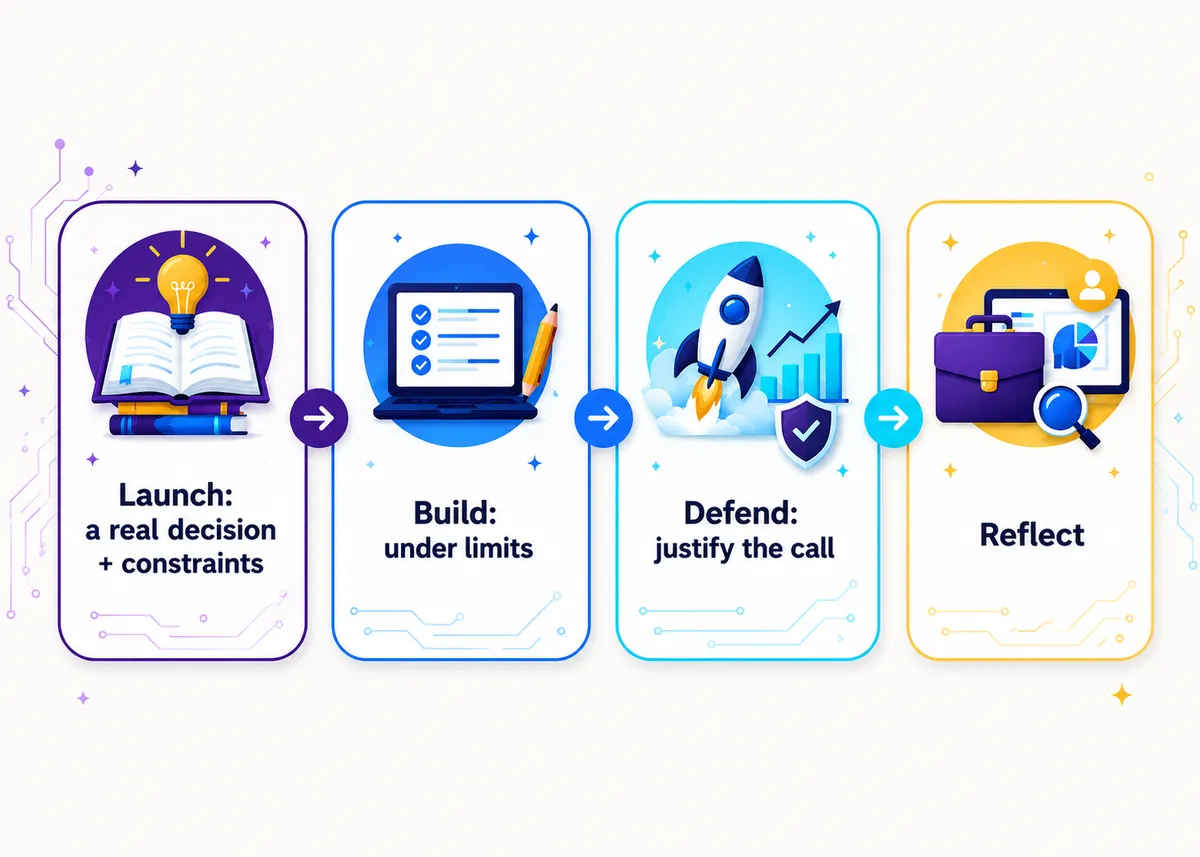
- Launch. Open with the decision and the constraints, not a definition. Hand students the goal, the limited resources, and the rules of the game in the first few minutes. The launch should make them want to argue about it.
- Build. Students do the work under the constraints, and you circulate as a coach, not a lecturer. This is where you teach content in short, just-in-time chunks: the mini-lesson on cost of goods lands the day they need it for the pitch, not three weeks earlier when it had nowhere to go.
- Defend. Students justify their call the way a professional would, out loud in a pitch, on paper in a brief, or in a quick one-on-one. This stage is non-negotiable, because the defense is the part you’re actually grading.
- Reflect. Close with what worked, what they’d do differently, and what they learned. Five honest minutes of reflection turns a one-time grade into a transferable skill.
If you want the unit-level version of this (where the project sits inside a week of content and practice), the three-move balance in How to Teach CTE shows how the project earns its place in the back half of the unit.
How do you keep group work from going sideways (one kid doing everything)?
The “one kid does all the work” problem is real, and it’s almost never a character flaw in the kids. It’s a design flaw in the project. If the assignment can be completed by one motivated student, it will be, and the others will happily let it happen. The fix is to design so it can’t.
A few moves do most of the work:
- Give every role a real decision. Don’t split a project into “researcher, writer, presenter” (jobs that let people hide). Split it into decisions only that person can make and has to defend: the budget owner, the design lead, the risk analyst. When the defense is individual, the free ride disappears.
- Make the defense personal. Even on a team product, each student answers for their piece. A two-minute individual checkpoint (“walk me through your call”) tells you instantly who did the thinking, and students know it’s coming.
- Build in visible checkpoints. Short, dated milestones (the budget by Wednesday, the draft pitch by Friday) keep one kid from quietly rescuing the whole thing at 11pm the night before.
- Keep groups small. Three is usually the ceiling. Four becomes a place to hide, and two can work beautifully.
The throughline: when the grade rewards an individual’s reasoning, not just the group’s artifact, the incentive to coast evaporates. We get specific about scoring this kind of work in How to Assess CTE Skills.
How do you grade a project fairly?
The honest tension in CTE is that the things worth measuring (judgment, communication, reasoning under constraints) are exactly the things a multiple-choice key can’t catch. So you stop trying to grade the artifact and start grading the reasoning, with a rubric.
A strong project rubric does three things:
- It rewards the defensible call, not your preferred answer. A student who made a clear, well-justified decision you wouldn’t have made should score well. The rubric measures the quality of the reasoning, not agreement with the teacher.
- It separates the thinking from the polish. A gorgeous slideshow with no logic underneath should not outscore a plain one with a sharp, well-defended decision. Give the reasoning its own row, and weight it heaviest.
- It makes the fuzzy stuff visible. The Career Ready Practices (collaboration, communication, initiative) turn into named rows with real criteria, so “good teamwork” becomes something a student can see and aim at instead of a vibe you assign at the end.
Hand the rubric out at launch, not at the end. When students can see exactly what “defends the decision” looks like before they start, the rubric stops being a grading tool and becomes a teaching one. The full method for building these is in How to Assess CTE Skills.
Free resources for project-based teaching
You don’t have to build the rubric from scratch to find out whether this approach fits your room. The Free Library has a no-prep project rubric (the same reasoning-first structure described above) plus bell ringers, first-week activities, and a pacing planner that work across business and tech classes. Grab the rubric, run one real project with it, and see how the conversation in the room changes.
Want the projects built for you? Browse editable, full-year business and technology curriculum, built backward from real decisions and packaged with the rubrics, constraints, and defense prompts already written. For a worked example of the whole method, the Marketing unit of AP® Business with Personal Finance is this approach in one package: constrained budgets, real campaign decisions, and a defense at the end.
Frequently asked questions
What is project-based learning in CTE? It’s teaching where students learn the content by using it to make and defend a real decision under constraints, rather than learning the content first and applying it later. In CTE it’s the core method, because the goal is to produce people who can actually do the work.
What makes a project “real” instead of just busywork? Constraints and a defense. A real project gives students a goal, limited resources, and a requirement to justify their choices. A poster project just gives them a topic and a due date. The constraints are what force genuine decisions.
What are some good CTE project examples? A $500 marketing-budget allocation, a startup pitch with real numbers, a month-long personal-budget simulation, a network-hardening scenario, or a tight-spec “ship something small” build. Each one is built backward from a decision the student has to defend.
How do you stop one student from doing all the group work? Design it out. Give every member a decision only they can defend, make each student answer for their own piece in a short individual checkpoint, build in dated milestones, and keep groups to three or fewer. When the grade rewards individual reasoning, coasting stops paying off.
How do you grade a project fairly? Grade the reasoning, not the artifact, with a rubric you hand out at launch. Reward the well-justified call (even one you wouldn’t have made), separate the thinking from the polish, and give the Career Ready Practices their own named rows. See How to Assess CTE Skills.
How is PBL different from a regular hands-on activity? A hands-on activity can still be busywork if there’s no decision and no defense. PBL is specifically built backward from a choice a professional would have to make, under constraints that force tradeoffs, with the student accountable for justifying the result.