


Marketing is the easiest business subject to start and the easiest to teach badly. Easy to start because every student walks in pre-loaded: they’ve been marketed to since birth, they have brands they’re weirdly loyal to, they can tell you why an ad is “cringe.” Easy to botch because if you open with a definition (“the process of creating, communicating, and delivering value”), the room decides marketing is just vocabulary and tunes out.
The fix is to start from ads they already know and pull the concepts out. Below are the things students resist, how to teach each so it sticks, and the activities that do the heavy lifting. Most run in a single class period.
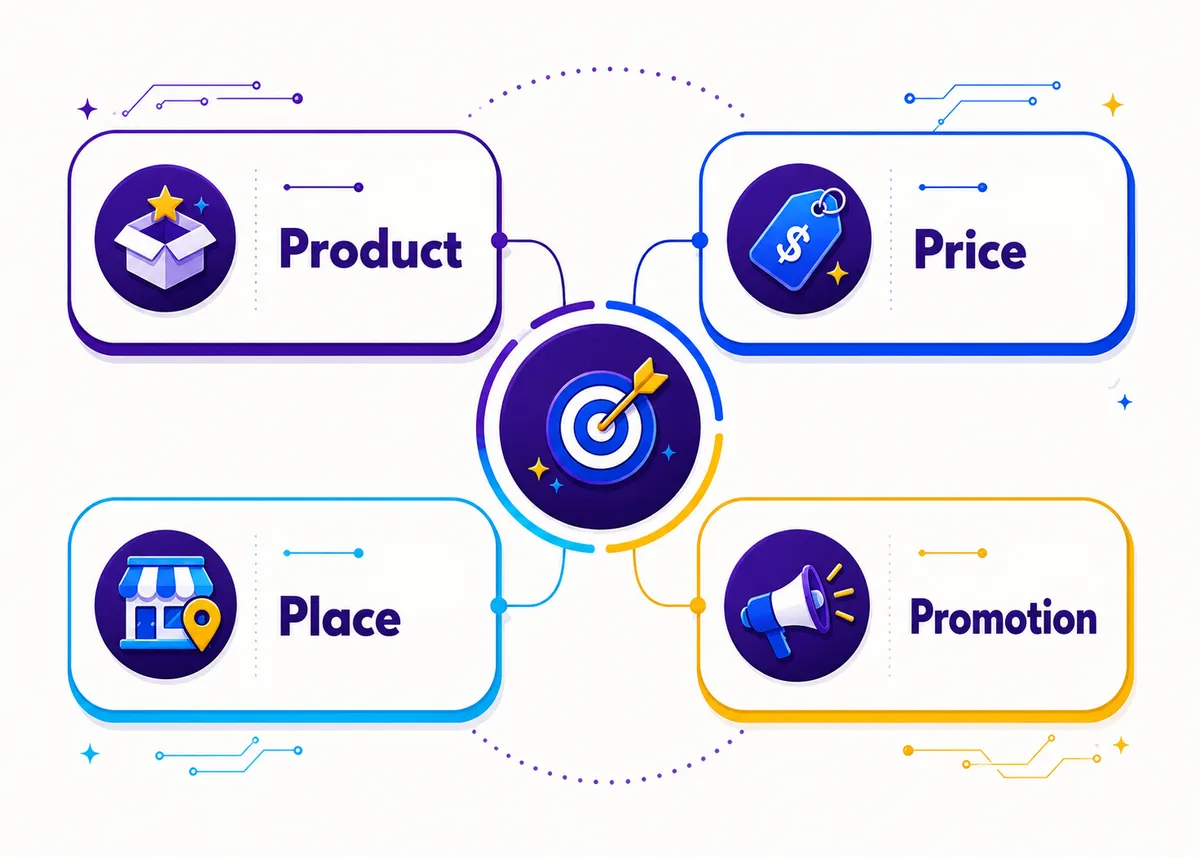
How do you teach the 4 Ps so it sticks?
The marketing mix (Product, Price, Place, Promotion) is the backbone of the course, and it dies on a slide. Students nod, copy the four words, and forget them by Friday. The 4 Ps stick when students use them as a lens on something real, not when they memorize them as a list.
Teach it backward from a brand they already love:
- Put up a brand the room is loyal to (a sneaker, an energy drink, a phone, a fast-food chain).
- Have them reverse-engineer all four Ps from what they already know. What’s the actual product (and the feeling around it)? Is the price high or low, and why on purpose? Where do you buy it (Place)? How did they hear about it (Promotion)?
- Give the four Ps names after they’ve done the thinking, not before.
Activity: the 4 Ps audit of a real local business. Pick a business everyone knows (the pizza place by school, a local coffee shop, the nail salon in the strip mall). In pairs, students audit all four Ps from a customer’s seat, then write one recommendation for each P that would win more business. The constraint that makes it work: every recommendation has to be defensible, not just “lower the price.” Why would lowering it help or hurt? That’s a defensible decision, not a right answer, which is the move at the heart of good CTE.
How do you teach target market (demographics vs. psychographics)?
Students get demographics fast (age, income, location, gender) because it’s countable. They stall on psychographics (values, interests, lifestyle, what someone is afraid of or aspires to), which is where the actual marketing lives. The trick is to make them feel the difference instead of defining it.
Run it as a sorting problem. Two products that share demographics but split on psychographics make the point instantly:
| Both target | Demographics (same) | Psychographics (different) | |
|---|---|---|---|
| A budget gym vs. a boutique studio | 25-40 year olds, mid income | Same age, same money | ”Get it done cheap” vs. “this is my identity” |
| A minivan vs. a sports sedan | Parents, suburban | Same family, same driveway | ”Keep everyone safe” vs. “I’m not done being me” |
Once they see that two people with identical demographics can want opposite things, psychographics stops being a vocab word.
Activity: brand-persona build. Each student (or pair) picks a real product and builds one fictional ideal customer: a name, a day in their life, what they’re scared of, what they brag about, where they spend time online. Then one sentence: “We win this person because ______.” A persona forces the psychographic thinking a demographic chart lets them skip, and it becomes the foundation for the marketing campaign project later.
How do you teach digital and social media marketing?
This is the part students think they already own, and the part where the gap between “I use TikTok” and “I can market on TikTok” is widest. They scroll fluently and have never thought about why a post was built the way it was. Your job is to flip them from consumers to builders. Start with a teardown, then have them build.
Activity: the social-media-post workshop. Pull three real posts from brands students follow: one that worked, one that flopped, one that’s a clumsy ad. As a class, name what each was trying to do (awareness? clicks? a sale?), who it was aimed at, and the one move that made it land or flop. Then students build their own post for the persona they created: platform, hook, visual, caption, and call to action, plus one line explaining the choice. Grade the reasoning, not the design polish.
A few things worth teaching explicitly, because students absorb them passively but can’t name them:
- The platform is part of the message. The same product needs a different post on TikTok than on a flyer or an email.
- One goal per post. Awareness, engagement, or conversion. Trying to do all three usually does none.
- The hook does the heavy lifting. Most of the work happens in the first three seconds (or the first line).
- Organic vs. paid. A quick, honest distinction so they understand why some posts reach far and others don’t.
Fun marketing activities and games
Marketing is the most playable subject in the business program. A few that earn their class time:
- Ad teardown (the everyday warm-up). Project an ad they know. Three questions: who’s the target, what’s the one feeling it’s selling, and which P is doing the work. Five minutes, repeatable all semester, and it trains the marketing eye better than any lecture.
- “Market this weird product” challenge. Hand each group a deliberately strange or boring product (a left-handed spatula, socks with individual toes, a pet rock, pickle-flavored toothpaste). They find a real target market, name it, and pitch one campaign angle. The absurd product is the point: it kills the “I don’t have a good idea” excuse and forces real marketing thinking, because nothing about it sells itself.
- Pizza-shop pricing sim. Give them a pizza shop (or a lemonade stand) with real costs: ingredients, rent, labor. They set a price, you reveal demand at that price, and they see the profit (or the lack of it). Run two or three rounds so they feel the tradeoff between margin and volume. This is where Price stops being a word on a slide and becomes a decision with consequences.
- Brand-persona build. Covered above, and it doubles as a game when teams present their personas and the class guesses the product.
If you want a stack of ready-to-run options across the whole program, business class project ideas for high school collects them by subject.
How do you make it real?
The difference between a marketing class students remember and one they don’t is whether the work ever leaves the worksheet. Three ways to do it without a huge lift:
- Use real local businesses. The 4 Ps audit lands harder when the subject is a place students walk past. A few teachers even let students share recommendations with a willing owner, which raises the stakes overnight.
- Use real ads and real platforms. Students already live here. Bring their actual feed into the room instead of textbook examples from a decade ago.
- Build toward a campaign. Every activity above (persona, 4 Ps, pricing, social posts) is a piece of one capstone: a full campaign for a product with a target customer and a measurable goal. That’s the marketing campaign project, the natural home for everything in this post.
One more nudge: if you teach marketing, DECA is the Career and Technical Student Organization built for it (competitive role-plays and marketing events that turn this content into something students compete on). Optional, but a strong fit.
Marketing is one of five subjects in the business program, and it teaches best as a campaign rather than a textbook march. For the wider map, see the umbrella guide, How to Teach High School Business. When you’re stocking a unit, Business Class Project Ideas for High School has options across all five subjects.
Free resources to get you started
You don’t have to build the marketing unit from scratch. The Free Library has no-prep starting points (bell ringers, a project rubric, first-week activities, and the marketing campaign project freebie) that work for marketing and the rest of the business program. Grab what’s useful and see if the style fits how you teach.

Want the planning done for you? The Marketing unit of AP® Business with Personal Finance is the built-out version of this whole post: the 4 Ps, target market, and the campaign capstone as one editable unit. The full course brings that same activity-first approach to every business subject.
Frequently asked questions
How do you make marketing engaging for high school students? Start from ads and brands they already know and pull the concepts out, instead of opening with definitions. Lead with a teardown or a persona build, and let the vocabulary follow.
What’s the best first marketing activity? An ad teardown: project a familiar ad and ask who it targets, what feeling it sells, and which of the 4 Ps is doing the work. It previews the course in five minutes and trains the marketing eye from day one.
How do you teach the difference between demographics and psychographics? Use two products that share demographics but split on psychographics (a budget gym vs. a boutique studio). When students see that identical customers can want opposite things, psychographics stops being a vocab word.
What are the 4 Ps of marketing, and how do you teach them? The 4 Ps are Product, Price, Place, and Promotion, the marketing mix at the backbone of the course. Teach them backward from a brand students already love by having them reverse-engineer all four Ps from what they know, then name the concepts after they have done the thinking.
Do you need a marketing degree to teach high school marketing? Often no. Marketing is one of five subjects inside high school business, and many states have an industry or alternative route that values real-world experience over an education degree. Check your own state Department of Education, and see How to Teach High School Business for where marketing fits in the wider program.
What is a good capstone project for a marketing unit? A full campaign for a single product: a target customer, a message across channels, and a measurable goal. Every smaller activity (persona, 4 Ps audit, pricing sim, social posts) feeds it, which is why the marketing campaign project is the natural home for everything in the unit.