

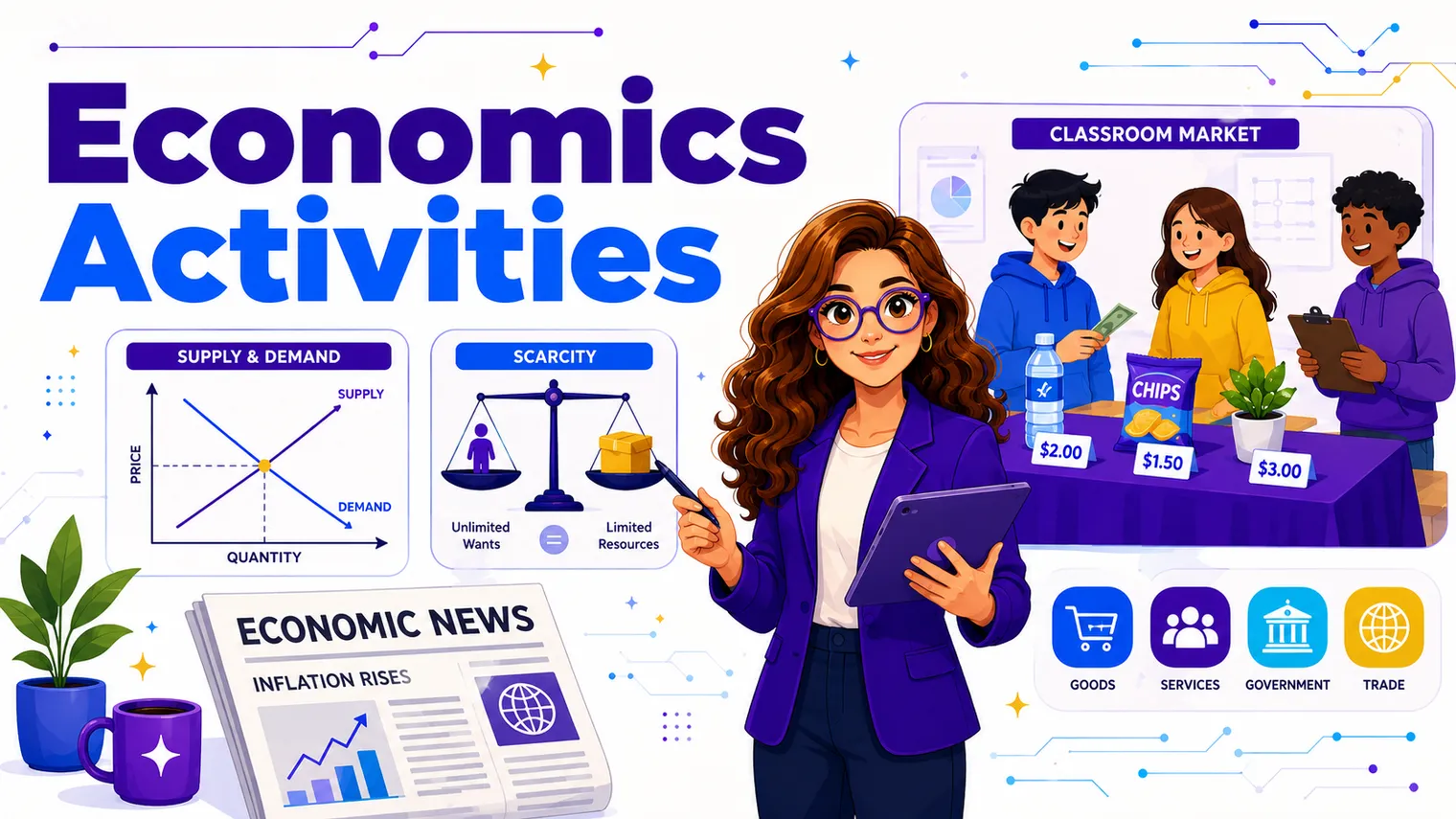
Economics is the subject students walk in already braced to hate. They’ve heard it’s dry, they’ve heard it’s math-y, and the textbook does them no favors by opening with a graph on page one. The fix isn’t a better lecture on supply and demand. It’s letting students feel the prices move, trade for something they actually want, and watch scarcity push a number up in real time. Do that first, and the curves come easy.
This is a working list of economics activities you can run next week, each one built to turn an abstract idea into something a student can touch. We’ll cover supply and demand, scarcity and opportunity cost, a full market simulation, a news hunt, market failure, and inflation, plus the free tools worth knowing about. For the wider business program this lives under, How to Teach High School Business is the start-here map.
How do you make supply and demand tangible?
Supply and demand is the concept students think they understand and then can’t explain. The cure is a price that moves in front of them, set by their own behavior.
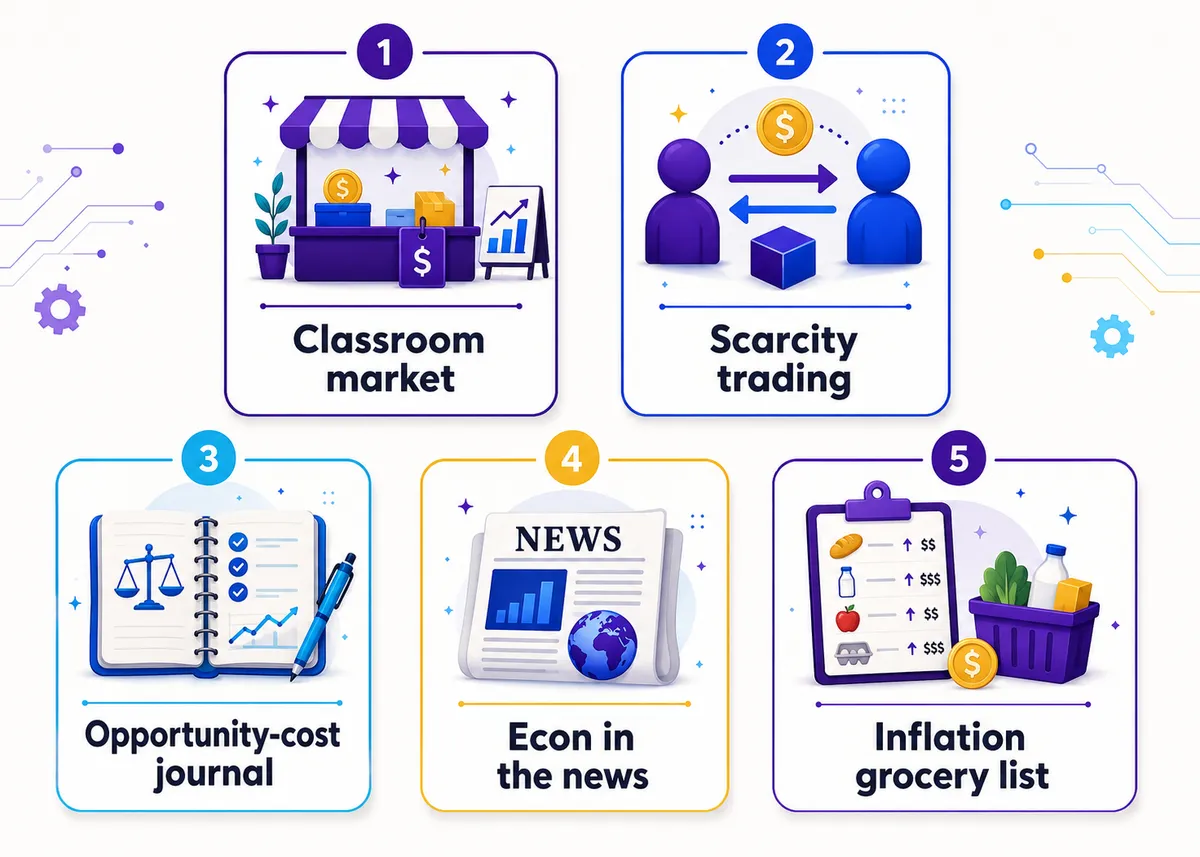
The candy auction. Bring a bag of something everyone wants (the good candy, not the leftover Halloween stuff) and auction off pieces one at a time. Hand out fake money or just track bids on the board. Watch what happens: the first few pieces go cheap, then prices climb as students realize supply is short, then they crash again when you reveal you’ve got a second (secret) bag. That second bag is a supply shock, and you didn’t have to define it for them to feel it. Afterward, plot the winning bids and let students name what they just lived: scarcity, willingness to pay, what a surplus does to price.
The two-sided card game. Split the room into buyers and sellers. Each buyer gets a card with the most they’ll pay; each seller gets a card with the least they’ll accept. Turn them loose to make deals for five minutes, then write every agreed price on the board. The trades cluster around the equilibrium price almost every time, which is genuinely a little spooky to watch, and it’s the cleanest demonstration of a market clearing that I’ve ever run.
The payoff in both: students stop memorizing “the curves cross here” and start understanding why.
Scarcity and opportunity cost activities
Scarcity is the whole foundation of the subject, and it’s invisible until you manufacture it.
The scarcity trading round. Give every student a random small object (a pencil, a sticker, a snack, a sticky note pad). Do a quick survey: how happy are you with what you got, one to ten? Then open the floor to trading for three minutes. Survey again. Satisfaction goes up across the room even though nothing new entered it, which is voluntary exchange creating value out of thin air. Then introduce scarcity directly: announce that only five students can have the most-wanted item, and watch how they decide who. That’s allocation under scarcity, and students will argue about whether the method was fair (which is exactly the conversation you want).
The opportunity-cost decision journal. This one runs all unit, not just one period. Students keep a short log of real decisions they make (spent Saturday working instead of sleeping in, bought the shoes instead of saving, took the easy class instead of the interesting one) and write the one best alternative they gave up. Not a list of everything, just the single next-best thing, because that’s what opportunity cost actually is. By week two they catch themselves narrating it in the hallway. The journal makes the most abstract term in the course into a habit of thought.
How do you run a classroom market simulation?
A full market simulation is the centerpiece activity, the one students remember. The setup is simpler than it sounds.
Here’s a bare-bones version you can run in two class periods:
| Step | What happens | The concept it lands |
|---|---|---|
| 1. Hand out roles | Students become producers or consumers, each with starting “cash” | Scarcity, budgets |
| 2. Producers make goods | Paper airplanes, origami, drawings, anything with a quality range | Production, cost |
| 3. Open the market | Free trading; prices are negotiated, not set by you | Price discovery |
| 4. Shock it | Mid-round, tax a good, ban one, or subsidize another | Policy effects |
| 5. Debrief | Chart prices, ask who won and why | Incentives, winners and losers |
The magic is in step four. Once students have a working market, change one rule and let them feel the ripple. Slap a “tax” on the most popular good and watch demand shift to substitutes. Cap a price and watch a shortage appear (and a black market spring up in the back corner, every single time). You don’t lecture on price controls after that. You just point at what happened.
Keep the debrief tight and concrete: which role made out best, what they’d do differently, and which rule change hurt the most people. That last question quietly teaches the difference between efficiency and fairness without ever putting those words on a slide.
Real-world economics: a news-article hunt
Economics is everywhere in the news, but students don’t see it until you train their eye. The “spot the economics in the news” hunt does that.
Give students a current article (or let them find one) and a short checklist of concepts to hunt for: a supply change, a demand change, a price effect, an incentive, a tradeoff, a government policy. Their job is to highlight where each one shows up and explain it in a sentence. A story about egg prices, a new tariff, a concert that sold out in minutes, a city raising its minimum wage: each one is loaded with the vocabulary you’ve been teaching.
Run it as a recurring warm-up. Five minutes, one article, one concept spotted. By the end of the unit students are sending you headlines unprompted because they can’t unsee it anymore, which is the whole goal.
A market-failure scenario
Once students believe markets work, show them where markets break. This is the activity that makes them sound genuinely sharp.
Hand out a short scenario and a decision: a factory that can dump waste in the river for free (pollution as a negative externality), a fireworks show nobody can be charged to watch (a public good nobody wants to pay for), a used-car lot where the seller knows more than the buyer (asymmetric information). Ask: what goes wrong if we just let the market run, and what could fix it? Students propose taxes, regulations, subsidies, and rules, then argue about the side effects of each. There’s rarely one right answer, which is the point. They’re reasoning about tradeoffs the way an economist actually does, not bubbling in a definition.
An inflation grocery-list-over-time activity
Inflation is a number students hear constantly and feel almost not at all. Make them feel it.
Build a small “market basket” of ten everyday items (a gallon of milk, a movie ticket, a candy bar, a tank of gas, a pair of jeans). Have students find prices from a few decades back (older relatives are a great source, and the Bureau of Labor Statistics has historical data) and compare them to today. Then calculate how much the same basket costs now. The jump is always bigger than they expect, and the follow-up question lands hard: did wages keep up? Suddenly inflation isn’t a news word. It’s why their parents say things used to be cheaper, and whether that’s actually true.
Free econ lessons and tools
You don’t have to build all of this from scratch. A few genuinely free, genuinely good sources:
- EconEdLink (from the Council for Economic Education): free, standards-aligned lessons and interactives sorted by grade and topic. The single best starting point for a teacher handed econ in August.
- The Council for Economic Education more broadly: the national hub for economics and personal finance education, with free curriculum and teacher training.
- Federal Reserve education resources (the various regional Fed banks and the Fed’s own education site): free lessons, data, and explainers on money, banking, and inflation, straight from the source.
- The Foundation for Teaching Economics (FTE): free lesson plans and programs built around active, hands-on economics, which fits exactly the way these activities run.
Pull a lesson, run it, and see if the style fits your room before you build anything yourself.
Where to go next
The Free Library has no-prep starting points (bell ringers, a project rubric, first-week activities) that work across the whole business program, economics included. Grab what’s useful and see if the style fits how you teach.
Want the unit built for you? Our editable AP® Microeconomics and AP® Macroeconomics curricula run on this same activity-first model, unit by unit. If the candy auction hooked your room, the Supply and Demand unit of AP® Microeconomics picks up exactly where it and the buyer-seller card game leave off.
These activities pair naturally with the rest of the money side of business. For the personal side of all this, see Personal Finance Activities for High School and the budgeting deep dive in Budgeting Activities for High School Students.
Frequently asked questions
How do you make economics fun for high school students? Lead with an activity, not a definition. Run a candy auction or a classroom market first, let students feel prices move and scarcity bite, then name the concept. The curves and vocabulary land much faster once students have lived the idea.
What is the best activity for teaching supply and demand? A candy auction or a two-sided buyer-seller card game. Both make a price emerge from student behavior in real time, so the equilibrium isn’t a point on a graph, it’s something the room actually produced.
How do you teach opportunity cost to teenagers? Make it a habit, not a definition. An opportunity-cost decision journal, where students log real choices and the single next-best thing they gave up, turns the most abstract term in the course into something they catch themselves noticing.
Where can I find free economics lessons? EconEdLink and the Council for Economic Education are the strongest starting points, with Federal Reserve education resources and the Foundation for Teaching Economics close behind. All four are free and built for classroom use.
How do you run a classroom market simulation? Hand out producer and consumer roles with starting cash, let students make goods and trade at negotiated prices, then shock the market mid-round (tax a good, cap a price, add a subsidy) and chart what happens. The whole thing fits in two class periods, and the shock is where price controls and policy effects teach themselves.
How do these activities connect to teaching personal finance? The same lead-with-a-decision approach carries straight over. Once students feel scarcity and tradeoffs in an econ activity, the money side gets concrete fast, as laid out in Personal Finance Activities for High School.