AP Macroeconomics: Full-Year Course
$180
Both AP economics courses, built the way economics actually has to be taught: the graph gets drawn, labeled, and shifted in front of students, then they do it themselves. Every topic includes editable slides, guided notes with the graphs already scaffolded, practice, and answer keys. Buy the full year, a single unit, or one lesson when you just need Thursday covered.
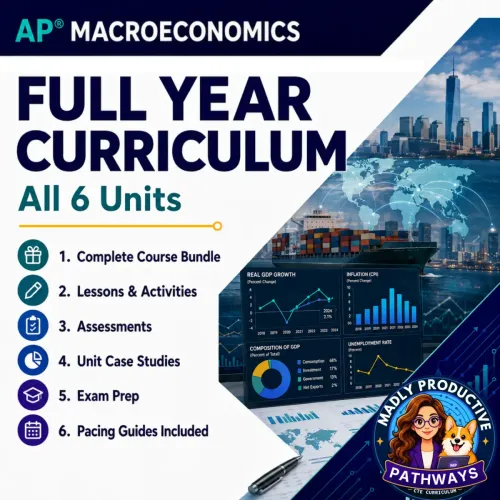
The complete year in one purchase: every unit, every lesson, all assessments and answer keys.
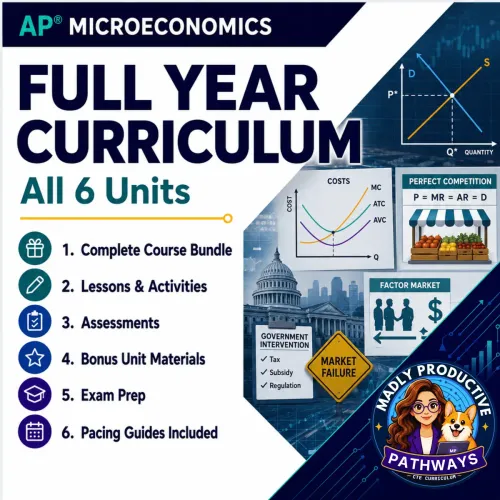
If your school runs only one, micro is usually the better single semester: the concepts start closer to a student's own life (prices, choices, firms) and the math stays lighter. Macro tends to land better after students have seen supply and demand, because so much of it is that same tool applied to a whole economy.
If you teach both, the two courses open the same way: scarcity, the production possibilities curve, and comparative advantage all appear in Unit 1 of each, so the opening weeks reuse the same explanations even though the two units then diverge.
In most states economics is a graduation requirement taught as a one-semester on-level course rather than an AP section: 28 states require some study of economics to graduate. These lessons work there too. The scaffolded notes and the applied scenarios do the heavy lifting, and you can skip the AP-style free response items without leaving a hole in the sequence.
A lot of states now pair a semester of economics with a semester of personal finance, sometimes in the same course code. The economics units cover the market side, and the standalone Personal Finance course covers the household side: paychecks, banking, credit, taxes, and investing.
One unit at a time, for less than its lessons cost separately. Each includes a unit review and unit test.

Every course opens with a complete free lesson: the real slides, notes, and activity, not a preview.