

If you just got assigned AP® Business with Personal Finance or AP® Cybersecurity for next year, you might be wondering what exactly you signed up for, because these don’t look like the AP courses you remember. They’re the first courses in College Board’s AP Career Kickstart program, and they’re built to behave more like a strong CTE class than a lecture-and-recall AP class. That’s good news if you already think like a CTE teacher, and a real adjustment if you’re coming from traditional AP.
This is the start-here guide for both courses: what AP Career Kickstart actually is, what’s in it, how it’s different, what students earn, when it launches, and what to set up before day one. We’ll link out to the planning deep dives as we go, so you can come back and go deeper on your specific course.
The short version: AP Career Kickstart is College Board’s applied, career-focused branch of AP. The two launch courses (AP Business with Personal Finance and AP Cybersecurity) go national in 2026-27, with first exams in May 2027 and AP Networking following in 2027-28. The big shift: these courses run on hands-on, project-based work grounded in real scenarios, and a qualifying exam score earns both college credit and an industry-recognized credential. If you teach like a CTE teacher, you’re already most of the way there.
What is AP Career Kickstart?
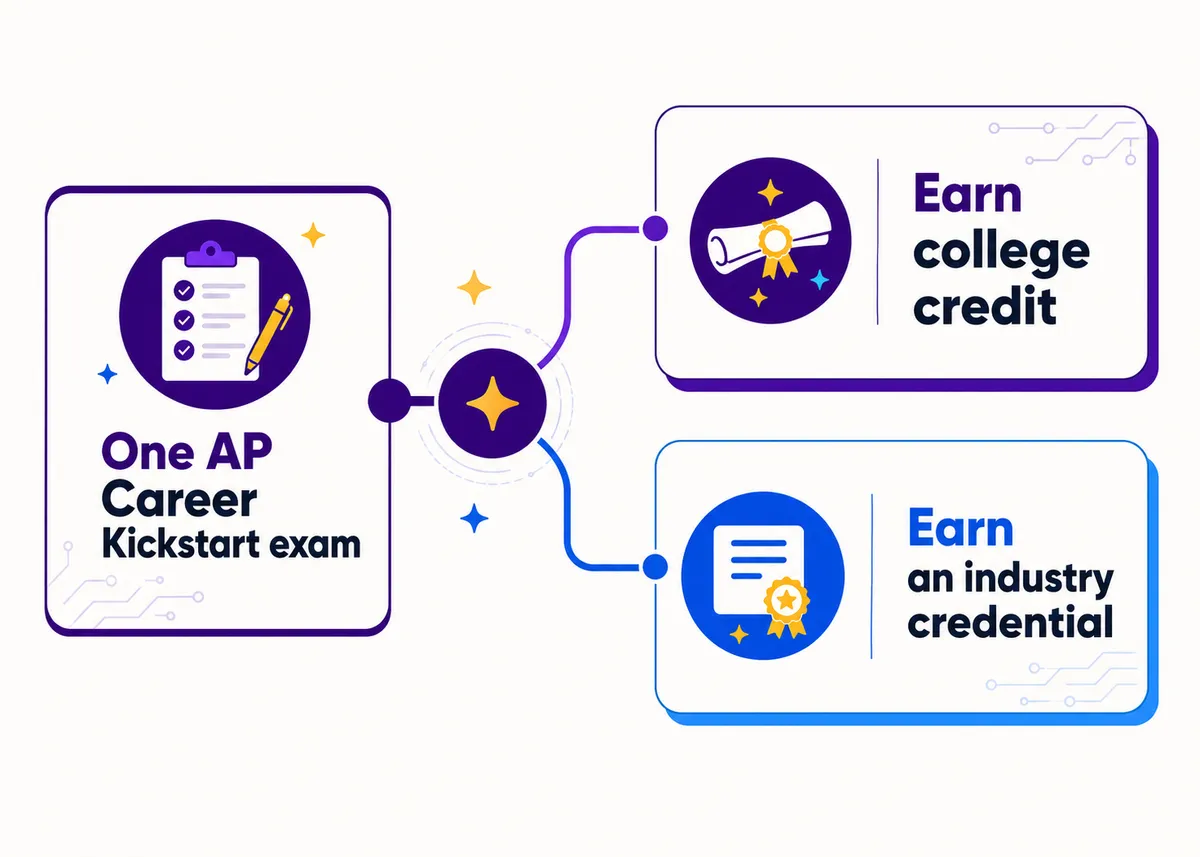
AP Career Kickstart is College Board’s newer line of AP courses designed for career fields rather than for the traditional college-admissions track. The premise is simple: keep the rigor and the college-credit payoff of AP, but teach the material the way the work actually happens, through applied projects and real-world scenarios instead of lecture and recall.
It’s College Board meeting CTE in the middle. These courses sit in high-demand fields (business, finance, cybersecurity, and soon networking), and they’re aligned to recognized workforce frameworks so the skills map onto what employers actually look for. If you’ve spent any time in a CTE classroom, the design philosophy will feel familiar: build backward from a real decision, let the content serve the project, and grade the reasoning. (That whole approach is the subject of How to Teach CTE, the umbrella guide this one lives under.)
What courses are in it?
Two courses launch nationally first, with a third on the way:
- AP Business with Personal Finance, which pairs core business concepts with the personal-finance content that more and more states now require.
- AP Cybersecurity, which teaches defensive, scenario-based security thinking (the pilot-era name “AP Cybersecurity Fundamentals” was shortened to just AP Cybersecurity).
- AP Networking, which is set to launch nationally in 2027-28, rounding out the technology side of the program.
If you teach the business course, the AP Business with Personal Finance teacher planning guide is your next stop, with a first-week game plan in First Week of AP Business with Personal Finance Activities. If you teach the security course, head to the AP Cybersecurity teacher planning guide and First Week of AP Cybersecurity Activities.
How is it different from a traditional AP class?
The headline difference is the learning model. A traditional AP course is largely built around knowing a body of content and recalling it under exam pressure. An AP Career Kickstart course is built around doing something with the content: applied, hands-on, project-based work grounded in real-world scenarios, the same engine that drives good CTE.
The second difference is what students walk away with. A traditional AP course offers possible college credit and not much else on paper. These courses pair that college credit with an industry-recognized credential aligned to workforce frameworks (for cybersecurity, that’s the NICE framework), so a strong score signals something to employers, not just to a registrar.
Here’s the contrast side by side:
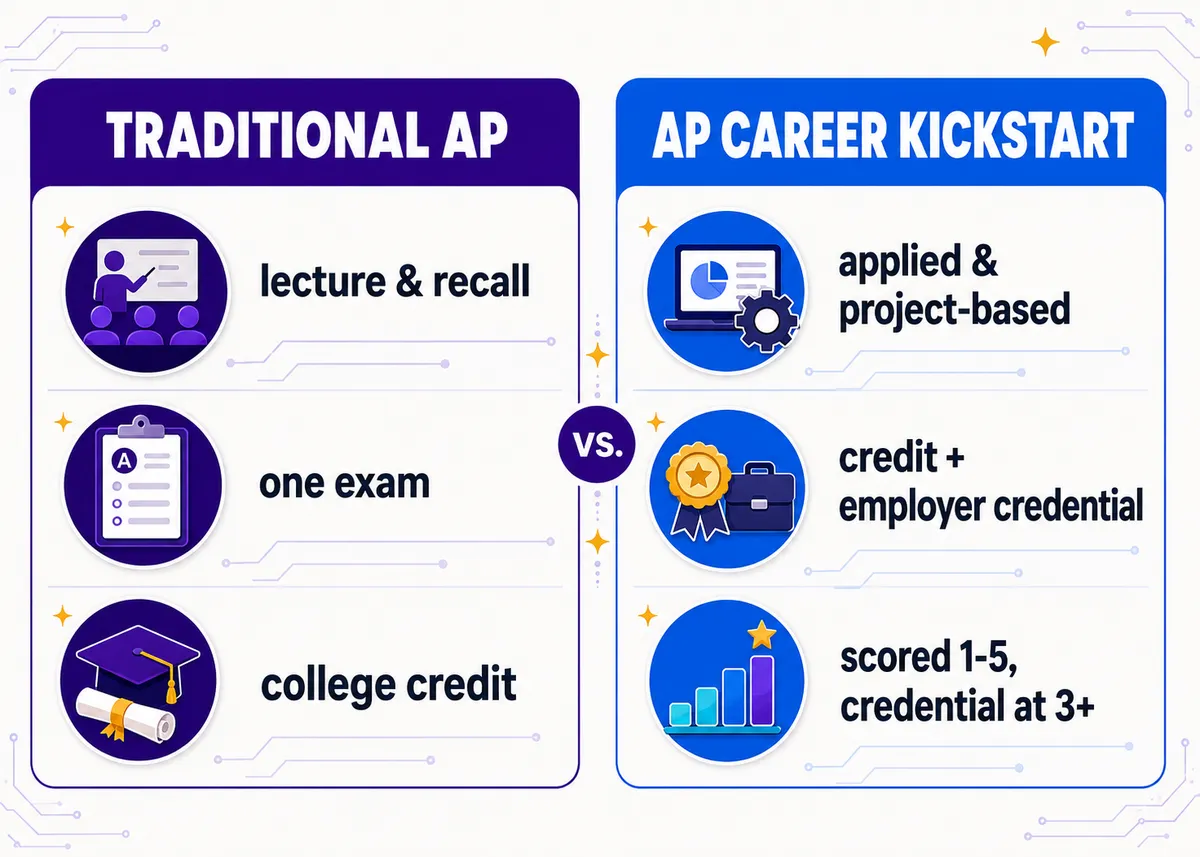
One honest caution on that table: the national exam format is not something to assume. The pilot exams were multiple-choice, but that does not confirm what the national exams will be. Before you build your assessments, check the published Course and Exam Description for your course (more on that below).
What do students walk away with?
This is the part that makes the courses an easy sell to students and parents. A qualifying score does double duty.
- College credit. Exams are scored on the familiar 1-5 AP scale, so a strong score can earn credit the same way any AP exam can.
- An employer-endorsed credential. Earn a 3 or higher and the student walks away with an industry-recognized credential, not just a transcript line. For a student weighing college, the workforce, or both, that’s a tangible, portable result.
That dual payoff is the whole pitch of AP Career Kickstart: keep your options open while building something an employer recognizes. It’s worth saying out loud to your students early, because “this counts for college and a credential” changes how seriously a lot of them take the work.
When does it launch?
Here’s the timeline, because the rollout matters for how you plan:
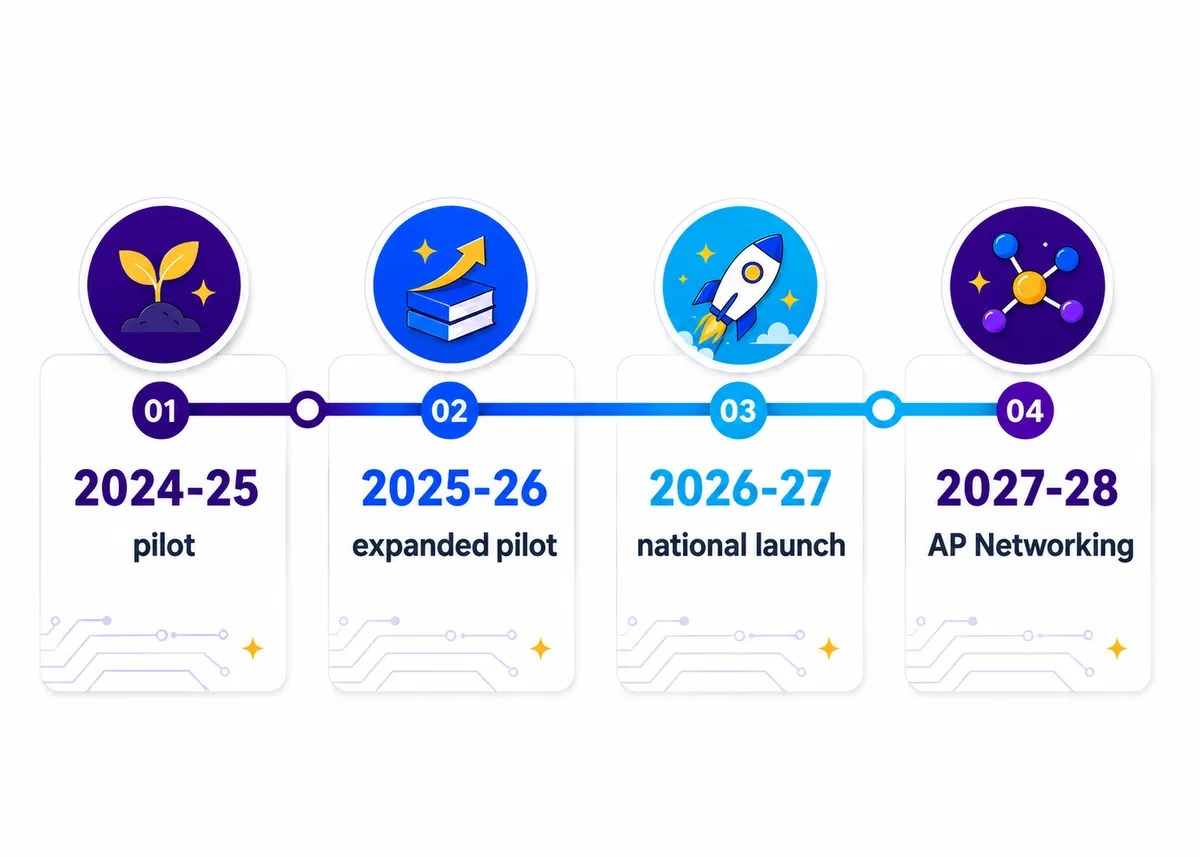
- 2024-25: a pilot ran at two San Antonio high schools.
- 2025-26: the pilot expanded to hundreds of schools.
- 2026-27 (Fall 2026): AP Business with Personal Finance and AP Cybersecurity launch nationally, with first national exams in May 2027.
- 2027-28: AP Networking launches nationally.
If you’re teaching either launch course in 2026-27, you’re in the first national cohort. That’s exciting and a little exposed: the materials are new, the community is small, and you’re partly building the plane while flying it. We’ll talk about how to survive that below.
What should you set up before day one?
The single most useful thing you can do before the year starts is read the published Course and Exam Description for your course, cover to cover. It’s the source of truth for what’s tested and how, and given that the national exam format isn’t something to assume, the CED is where you confirm it rather than guessing from the pilot.
A short before-day-one checklist:
- Read the CED and map its units onto a rough pacing calendar (a skeleton you can hang daily lessons on, not a perfect plan).
- Confirm the credential details: which workforce framework your course aligns to, and what a 3-or-higher actually earns your students (so you can pitch it correctly).
- Line up your applied materials early. These courses live or die on projects and scenarios, so you want those built or sourced before the term, not improvised in week three.
- Sort the logistics for your course’s hands-on side (lab access and accounts for cybersecurity, simulation and project tools for business).
If you’d rather not assemble all of that from scratch in a launch year, our editable AP Business with Personal Finance curriculum and AP Cybersecurity curriculum are organized around exactly the project-and-scenario model these courses reward.
How do you survive a first-year rollout?
First-year anything is messy, and a first-year national AP course is messier than most. The teachers who come through it well tend to do a few things on purpose.
- Lean on the model you already know. These are CTE courses wearing an AP badge. If you teach business or tech well, How to Teach High School Business and How to Teach High School Technology already cover most of the instincts you need.
- Don’t over-engineer the pacing. Map the year once at the unit level, leave slack for the inevitable schedule chaos, and adjust as you learn the course in real time.
- Treat the CED as your anchor and your tiebreaker. When you’re unsure whether something belongs, check what’s actually assessed instead of teaching everything you can find.
- Find the other first-cohort teachers. A small community is still a community, and the people teaching this alongside you will save you hours.
You don’t have to get year one perfect. You have to get it taught, learn what the course actually demands, and tighten it next year.
Free resources to get you started
You don’t have to build your launch year from scratch, and you shouldn’t have to buy your way in just to see if the style fits. The Free Library has no-prep starting points (bell ringers, a project rubric, first-week activities, a pacing planner) that work across both the business and cybersecurity courses. Grab what’s useful, test it against your room, and go from there.
Want the planning done for you? Browse the editable, full-year AP Business with Personal Finance curriculum and AP Cybersecurity curriculum, both built around the same project-and-scenario engine these courses run on. Every file is editable, so you can shape the units to your room instead of assembling a launch year alone.
Frequently asked questions
What is AP Career Kickstart? It’s College Board’s applied, career-focused branch of AP. The courses keep AP’s rigor and college-credit payoff but teach through hands-on, project-based work in real-world scenarios, and a qualifying exam score also earns an industry-recognized credential.
What courses are part of AP Career Kickstart? Two launch nationally first: AP Business with Personal Finance and AP Cybersecurity. A third course, AP Networking, is set to launch nationally in 2027-28.
When does AP Career Kickstart launch? National launch is the 2026-27 school year (Fall 2026), with the first national exams in May 2027. A pilot ran in 2024-25 at two San Antonio high schools and expanded to hundreds of schools in 2025-26.
What do students earn from an AP Career Kickstart course? Exams are scored 1-5. A strong score can earn college credit like any AP exam, and a 3 or higher also earns an employer-endorsed, industry-recognized credential aligned to a workforce framework (the NICE framework for cybersecurity).
How is AP Career Kickstart different from a regular AP class? The learning model is applied and project-based rather than lecture-and-recall, and students earn a credential on top of possible college credit. As for the national exam format, don’t assume it from the pilot: check your course’s published Course and Exam Description.
How do I prepare to teach an AP Career Kickstart course? Read the published Course and Exam Description first, map it onto a rough pacing calendar, confirm the credential and framework details, and line up your projects and lab or simulation tools before day one. See the AP Business with Personal Finance and AP Cybersecurity planning guides.
AP® is a trademark registered by the College Board, which is not affiliated with, and does not endorse, this product.