

The fastest way to make a business class feel real is to hand students a decision and let them defend it. Not a worksheet, not a definition march: a choice with tradeoffs and something to show at the end. Below are twelve projects that do exactly that, spread across entrepreneurship, marketing, personal finance, accounting, and economics. Some are classics (the Shark Tank pitch, the stock-market game) done in a way that actually teaches. Steal any of them for next week.
If you want the wider view of how the whole business program fits together, How to Teach High School Business is the umbrella this post lives under.
What makes a business project worth the time?
Before the list, a filter. A project earns its slot in your unit when it has three things, and most of the “fun” activities that flop are missing one of them.
- A real decision at the center. The student has to make a call a professional would recognize: where to spend the budget, which customer to chase, whether the numbers actually work. If there’s one obvious right answer, it’s a worksheet wearing a costume.
- Constraints. A budget cap, a deadline, a word limit, a fixed salary. Constraints are what turn “make a poster about marketing” into “reach this customer with $300 and prove it.”
- A defensible product. Something they hand you that shows the reasoning, not just the result: a pitch deck, a one-page plan, a portfolio with their picks explained. You grade the thinking.
That last point is where most of these live or die. Grade the justification, not the glitter. (If you want a ready-made rubric for that, the Free Library has a project rubric built for exactly this.)
12 business project ideas (by unit)
Entrepreneurship
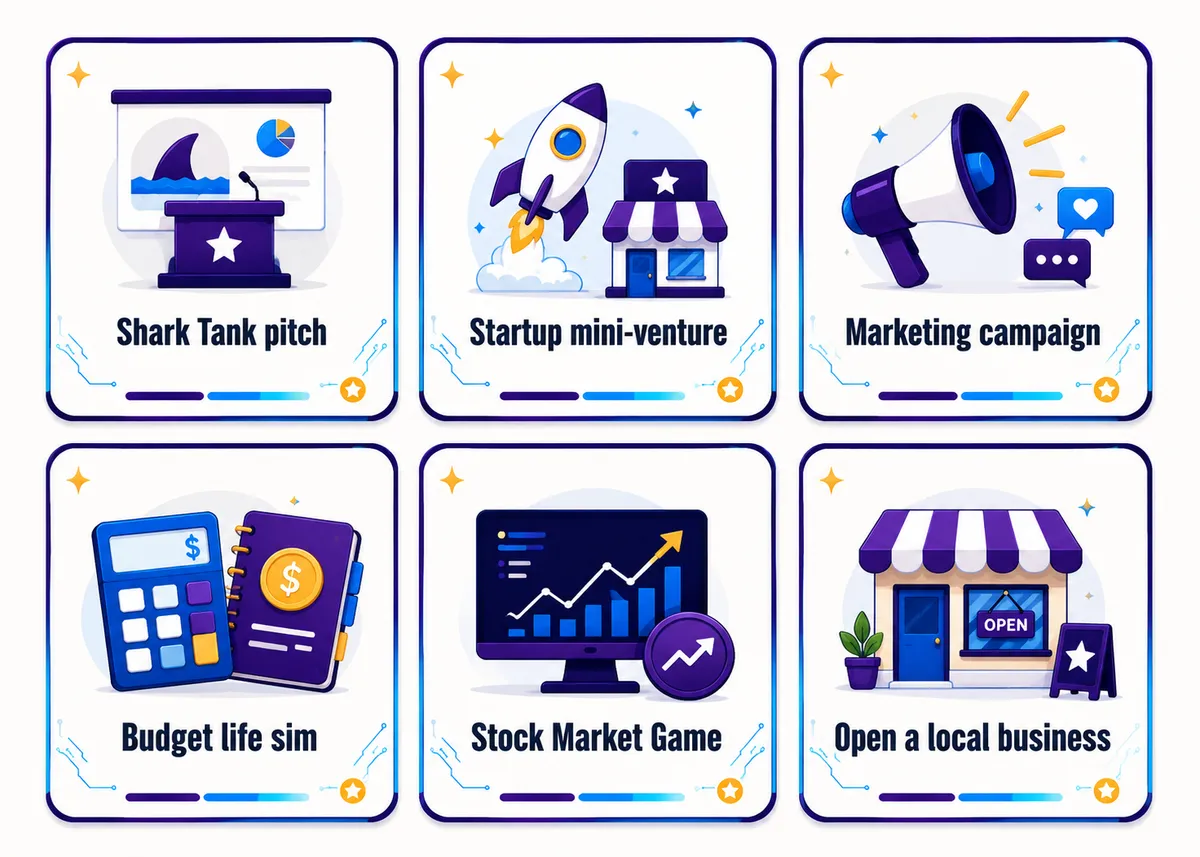
1. The Shark Tank pitch (with real numbers). Students invent a product or service, build the financials behind it (startup cost, price, projected profit), and pitch a panel of “investors” for a stake. The decision: what to charge, and what slice of the company to give away for the funding they ask for. What they produce: a five-minute pitch and a one-page financial summary that survives a “what’s your margin?” question. The trick that keeps this from being a popularity contest is requiring numbers that hold up, not just a slick delivery.
2. The startup mini-venture. Small teams run an actual tiny business for two to three weeks: a sticker shop, a study-snack stand, a custom-print service, a school-event concession. They source, price, sell, and reconcile real (or simulated) money. The decision: what to sell, what to charge, and when to cut a product that isn’t moving. What they produce: a profit-and-loss recap and a short “what we’d do differently” memo. This one teaches more about business in three weeks than a month of chapters.
3. The social-enterprise / nonprofit pitch. Students design a venture built around a cause (a problem in their own community works best) and pitch it for grant funding instead of investment. The decision: how to fund the mission and prove impact, not just turn a profit. What they produce: a pitch and a simple impact metric (“for every X dollars, we do Y”). It’s the entrepreneurship project for the kid who doesn’t care about getting rich but lights up about a cause.
For the deep, scaffolded version of the full venture build (idea to plan to pitch, with milestones), point students to the Business Plan Project for High School. This list keeps the pitch lightweight on purpose so it doesn’t swallow your whole unit.
Marketing
4. The marketing campaign. Students pick a product (real or invented), define a specific target customer, and build a campaign across two or three channels toward one measurable goal. The decision: who exactly the customer is and where to reach them on a fixed budget. What they produce: a campaign brief, sample ads, and a metric they’re aiming to move. This is the signature marketing project, and it deserves room to breathe.
The full walkthrough (target customer, channels, measurable goal, the whole capstone) is in Marketing Campaign Project for High School Students, so send students there for the detailed build and use this slot as the quick-reference version.
5. The ad teardown and rebuild. Students take a real ad they all know, dissect what it’s actually doing (target, appeal, channel, call to action), then rebuild it for a different audience. The decision: what to change when the customer changes (and what to leave alone). What they produce: an annotated teardown of the original and a redesigned version for the new audience, with the choices defended. Cheap to run, and it makes “marketing is just opinions” quietly disappear.
6. The product-pricing challenge. Give every team the same product and the same costs, then make them set a price and a positioning. The decision: premium or budget, and the story that justifies the number. What they produce: a price, a one-line positioning statement, and the math showing they’d actually make money. Watching two teams price the identical item at $8 and $40 (and both defend it) is the lesson.
Personal finance
7. The personal-budget life simulation. Students draw a career, a salary, and a city, then live a “month” on it: rent, groceries, a phone bill, and the curveballs you hand out (a car repair, a surprise medical co-pay, a rent hike). The decision: what to cut when the money runs short, and what to do with anything left over. What they produce: a balanced monthly budget and a short reflection on the tradeoff that hurt most. Nothing makes “I’ll deal with money later” evaporate faster than discovering rent eats half the paycheck.
8. The stock-market-game portfolio. Students get a virtual sum (the SIFMA Foundation’s Stock Market Game is the standard free tool) and build a portfolio they manage over weeks. The decision: what to buy, when to hold, and how much risk to stomach. What they produce: a portfolio with a written rationale for each pick and a final “what I learned” note. Grade the reasoning, not the return: the kid who explains a smart, well-diversified bet that happened to dip should beat the kid who got lucky on one meme stock.
9. The personal-finance escape room. Students work through a locked sequence of finance puzzles (decode an interest calculation, spot the predatory loan, balance a budget to unlock the next clue) against the clock. The decision: which option is the financially smart one, fast, under pressure. What they produce: a completed run and a debrief on the traps they almost fell for. It’s review disguised as a game, and it’s the rare project where the whole room is loud for the right reasons.
Economics
10. The classroom market. Run a live trading simulation: assign students as buyers and sellers with private values, let them trade, and watch a price emerge. The decision: when to accept a deal and when to hold out for better. What they produce: their trades plus a written explanation of why the price landed where it did (supply and demand, in their own words). Abstract economics becomes a thing they just watched happen.
11. The “open a business in our town” plan. Students pick a real empty storefront or gap in your actual town and plan a business to fill it: who it serves, what it competes with, why the location works. The decision: whether the local market can actually support this idea. What they produce: a location-and-market analysis and a go / no-go recommendation. Tying it to real streets they drive past makes economics concrete in a way no textbook map does.
12. The “would you fund this?” investment vote. Teams each present a short business case (real or invented), and the class allocates a fixed pool of “investment” across them, defending where their money goes. The decision: which ventures are worth backing when you can’t fund them all (scarcity, in disguise). What they produce: their pitch and a written rationale for how they spent their allocation. It doubles beautifully as an economics lesson and an entrepreneurship one.
Here’s the quick-reference version of the whole list:
| Project | Unit | The decision students make | What they produce |
|---|---|---|---|
| Shark Tank pitch | Entrepreneurship | Price and equity to offer | Pitch + financial summary |
| Startup mini-venture | Entrepreneurship | What to sell and when to cut it | P&L recap + reflection memo |
| Social-enterprise pitch | Entrepreneurship | How to fund a mission | Pitch + impact metric |
| Marketing campaign | Marketing | Who the customer is, where to reach them | Campaign brief + sample ads |
| Ad teardown and rebuild | Marketing | What to change for a new audience | Annotated teardown + redesign |
| Product-pricing challenge | Marketing | Premium or budget, and why | Price + positioning + the math |
| Personal-budget simulation | Personal finance | What to cut when money runs short | Balanced budget + reflection |
| Stock-market-game portfolio | Personal finance | What to buy and how much risk | Portfolio + written rationale |
| Personal-finance escape room | Personal finance | The smart choice, fast, under pressure | Completed run + debrief |
| Classroom market | Economics | When to accept a deal or hold out | Trades + price explanation |
| ”Open a business in our town” | Economics | Can the local market support it | Market analysis + go/no-go call |
| ”Would you fund this?” vote | Economics | Which ventures to back with scarce funds | Pitch + allocation rationale |
If you want the method behind why these work (structuring the project lesson, running simulations, grading with rubrics), the Project-Based Learning in CTE guide is the engine room.
How do you keep group projects from going sideways?
Every teacher’s nightmare version of these is the same: one kid does everything, the work is all glitter and no thinking, and nothing gets finished. Here’s how to head that off.
- Assign roles, not just groups. Give each member a real job (lead, finance, design, presenter) and grade part of the work individually. “Everyone gets the group grade” is how one student ends up carrying four.
- Build in checkpoints. Don’t collect one giant thing at the end. Collect the target customer on day two, the budget on day four, the draft on day six. Small deadlines catch the group that’s drifting before it’s too late.
- Require an individual reflection. A short “what I contributed and what I’d change” from each student tells you who actually did the work and gives the quiet contributor a place to show it.
- Keep groups small. Three is usually the ceiling. Four invites a passenger, five guarantees one.
- Make the rubric public on day one. When students can see they’re graded on reasoning and defensible choices (not on how shiny the slides are), the work shifts in the right direction on its own.
Frequently asked questions
What’s the easiest business project to start with? The ad teardown and rebuild. It needs no materials beyond ads students already know, runs in a class or two, and gets the whole room reasoning about marketing on day one.
How long should a high school business project take? Most of these run from a single class (the ad teardown, the classroom market) to two or three weeks (the mini-venture, the marketing campaign). Match the length to how central the skill is to your unit, and use checkpoints so the longer ones don’t drift.
How do I grade a business project fairly? Grade the reasoning, not the polish. A rubric that rewards a clear, well-justified decision (even one you wouldn’t have made) is fairer and harder to game than one that quietly rewards nice slides. Grab a ready-made one in the Free Library.
Can these work in a mixed-level class? Yes, and that’s part of the point. When students pick their own product, venture, or budget scenario, the advanced kid goes deeper and the beginner finds a way in, without you writing five versions of the assignment.
What’s the best business project for a full unit or capstone? A scaffolded business plan, built idea to plan to pitch over a couple of weeks. It pulls in entrepreneurship, marketing, and finance at once, and the Business Plan Project for High School post has the template and rubric to run it.
Which projects need almost no materials or prep? The ad teardown, the classroom market, the “would you fund this?” vote, and the product-pricing challenge. Each runs on things students already know or a single handout, so you can drop one in next week without buying or building anything.
Want a head start? The Free Library has a project rubric and no-prep starters to test-drive any of these. When a project earns a permanent slot, the AP® Business with Personal Finance curriculum turns this same project-and-decision model into full editable units, and its Personal Goals, Budgeting & Investing unit covers the same ground as the budget life simulation and stock-market portfolio above.