

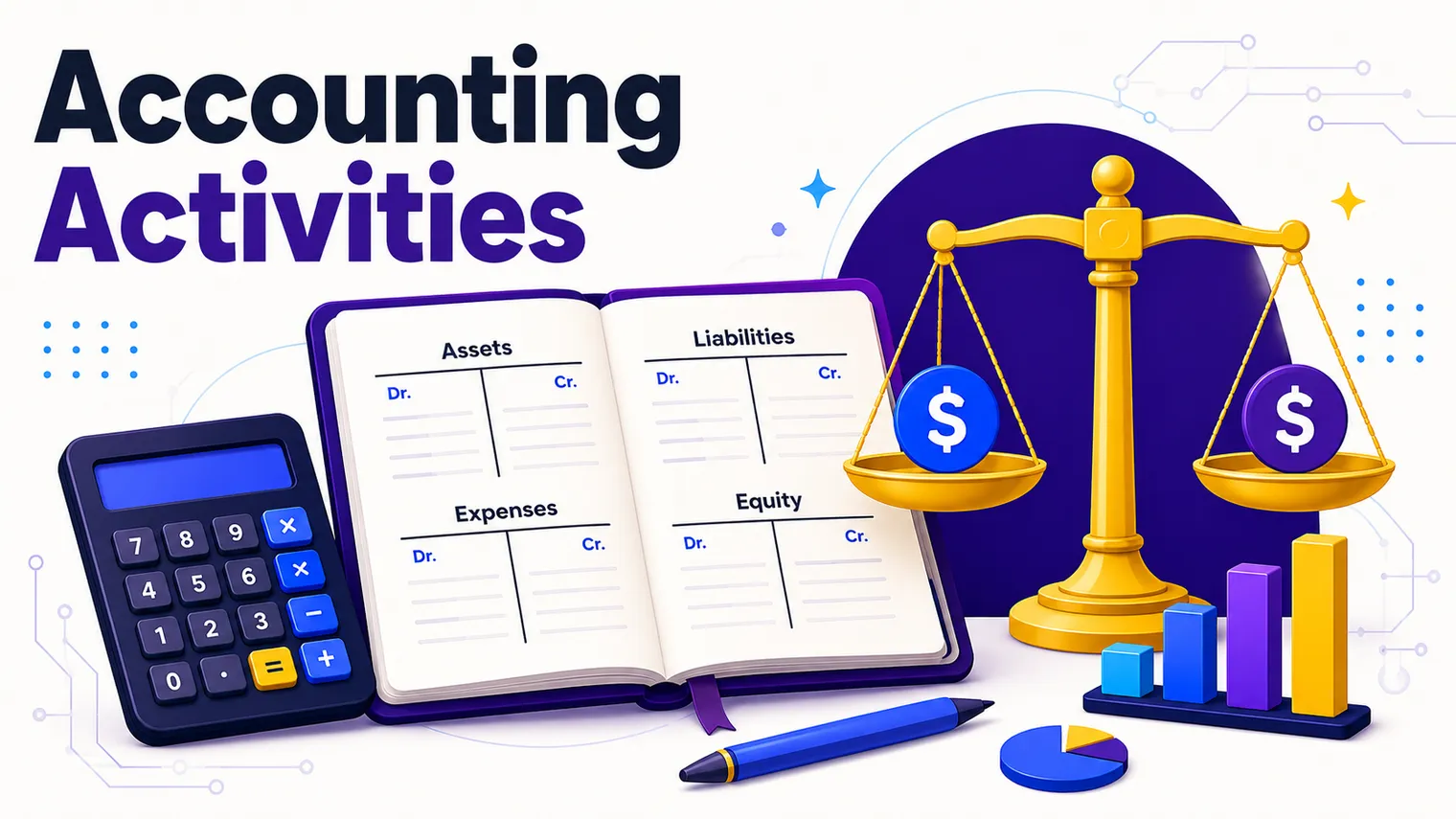
Accounting is the business subject students walk in already dreading. They’ve heard it’s math (it isn’t, really), and “debit” and “credit” mean the opposite of what their bank app trained them to think. I tutored accounting before I taught it, and the fix was always the same: stop defining and start recording. The moment a beginner has a tiny business to keep the books for, the abstract stuff turns into a story they can follow.
This post is a set of beginner-friendly activities that do exactly that. The throughline: every one starts from a real (if pretend) business, not a vocabulary list. Lead with the transactions, and the rules show up to explain what just happened.
How do you teach the accounting equation to beginners?
Start with the equation, but don’t write it on the board cold. Build it from a business students can picture.
Assets equal liabilities plus equity. That’s the whole spine of accounting, and it never breaks. The trick is making “it never breaks” something students see rather than memorize.
Try this opener: invent a tiny business together (a student-run sticker shop works great). Then walk through the first three things that happen to it, out loud:
- You put in $100 of your own money. Now the shop has $100 (an asset) and you own $100 of it (equity). Balanced.
- You borrow $50 from a friend to buy more supplies. Now the shop has $150 (assets), owes $50 (a liability), and you still own $100 (equity). Still balanced.
- You buy $40 of sticker paper with cash. Cash drops by $40, supplies go up by $40. The total didn’t move. Still balanced.
The point lands without a single definition: every transaction touches at least two things, and the two sides always match. “The accounting equation” is just the name for something they already watched happen.
How do you make debits and credits click?
This is the wall every beginner hits, almost always for the same reason: their bank told them a “credit” is money coming in, and accounting says the opposite for some accounts. Don’t fight that confusion with a definition. Reframe it.
Debits and credits are just left and right. A debit is the left side of an account, a credit is the right side. They are directions, not good news or bad news. Strip out the “credit good, debit bad” charge and the rules get a lot less slippery.
Then teach the one pattern that unlocks the rest:
- Assets and expenses go up on the left (debit to increase).
- Liabilities, equity, and revenue go up on the right (credit to increase).
A few ways to make that stick for beginners:
- The color-coded anchor. Make a permanent wall chart: left side in one color (assets, expenses), right side in another (liabilities, equity, revenue). Every time a student records something, they point to the color first. The chart does the remembering so their working memory can focus on the transaction.
- Say it out loud, every time. For the first week, narrate each entry as a sentence: “Cash went up, so I debit cash. The sale gave me revenue, so I credit sales.” Beginners who can say it can do it.
- Two sides, always. Every entry has a left and a right, and they have to be equal. If a student’s entry only touches one account, something’s missing. That single rule catches most beginner errors before they snowball.
Hands-on accounting activities
Here are the activities I’d actually run with a beginner class, lightest to meatiest. None of them require students to memorize anything first.
T-account sorting game. Draw a big T on the board (or hand out laminated ones). Give students a stack of cards, each naming an account and a change (“Cash increased $200,” “Loan balance increased $500”). They physically place each card on the debit or credit side. Fast, low-stakes, and you immediately see who’s mixed up. Run it as a warm-up for a week and watch the confusion drain out of the room.
Transaction-story card sort. Write everyday business events on cards in plain English: “Bought a laptop for the business with cash.” “Customer paid for a service they hadn’t received yet.” Students match each story to the two accounts it touches and which one gets debited. This bridges real life and the journal, which is exactly where beginners get lost.
Balance-the-equation manipulative. Use a balance scale (image or real) with the equation labeled across it. Hand students transaction cards and have them physically add or remove tokens from each side. When the scale tips, the entry is wrong. Making “out of balance” a thing they can see beats any correction in red pen.
Personal-checkbook / ledger simulation. Before students touch a business ledger, have them keep a running ledger for one fake person for a month: paycheck in, rent out, coffee out, a refund in. It builds the muscle of recording every transaction in order (the real skill underneath accounting) minus the debit/credit vocabulary that scares them.
Color-coded debits/credits anchor. The wall chart above doubles as a student activity: have each student build their own mini version on an index card for their folder. The act of making it (deciding which accounts go on which side) is the learning.
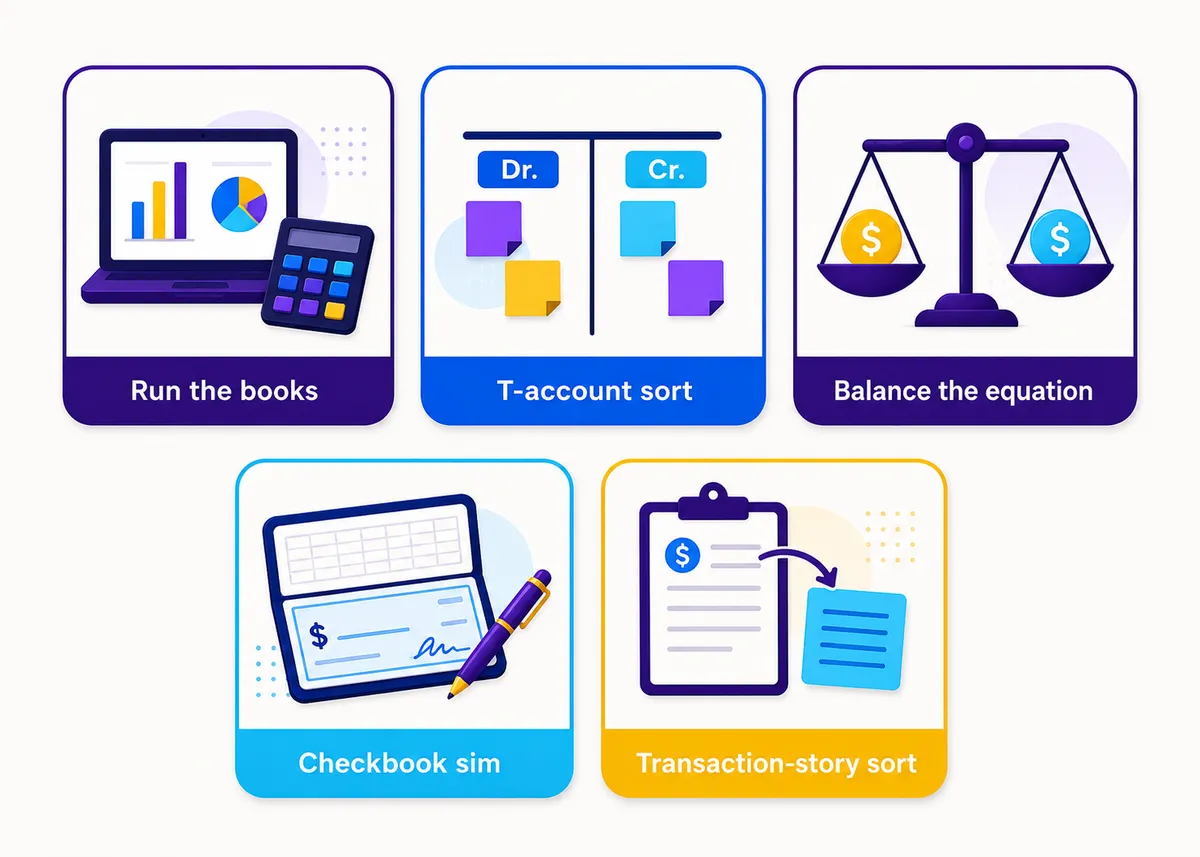
Here’s a quick map of what each activity is actually building:
| Activity | What it builds | Best used |
|---|---|---|
| T-account sorting game | Debit vs. credit instinct | Daily warm-up, week one |
| Transaction-story card sort | Reading real events as entries | After the equation clicks |
| Balance-the-equation manipulative | Seeing “in balance” | Intro to the equation |
| Checkbook / ledger simulation | Recording in order | Before any business books |
| Color-coded anchor | A reference they trust | All semester |
A simple “run the books” project
This is the one that ties it all together, and it’s the single best thing you can do for a beginner: have each student (or pair) keep the books of one tiny pretend business from start to finish. Keep it absurdly small (a weekend lemonade stand, a dog-walking side hustle, a one-person sticker shop) so there are few enough transactions that a beginner can hold the whole thing in their head.
The arc runs like this:
- Set it up. The student names the business and starts it with an owner investment ($200 of their own money). That’s their first entry, and it already balances.
- Run a week of transactions. Hand them 8 to 10 real events: buy supplies, make a sale, pay for a flyer, take a small loan, get paid by a customer. They record each as a two-sided entry, narrating out loud at first.
- Watch the equation hold. After each entry, they recheck that assets still equal liabilities plus equity. When it doesn’t, that’s the lesson, not the failure.
- Produce something real. At the end, they pull together a tiny statement: what the business owns, what it owes, and whether it made money. Suddenly the entries had a point.
A beginner who finishes this has done, in miniature, everything a first accounting course is trying to teach, without ever being asked to define a debit on a quiz first.
For a fuller spread of ready-to-run options across the program, Business Class Project Ideas for High School collects them, and the money-management cousin to this work lives in Personal Finance Activities for High School.
Free accounting practice
You don’t need to build the T-account cards and transaction stories from scratch. The accounting beginner set has warm-ups and sorting cards ready to print today, so you can see if the style fits how you teach before you commit to anything.
Want the full unit done for you? The Saving, Borrowing, Finance & Accounting unit of AP® Business with Personal Finance covers exactly this ground (the equation, debits and credits, and the records behind them) as a complete, editable unit. And if you teach a standalone finance class instead, the Personal Finance curriculum works the same money skills from the personal side.
For where accounting fits among the five business subjects (and how each teaches best), start with How to Teach High School Business.
Frequently asked questions
How do you explain debits and credits simply? Drop the “credit good, debit bad” framing entirely. A debit is just the left side of an account and a credit is the right side. They’re directions, not good or bad news. Assets and expenses go up on the left; liabilities, equity, and revenue go up on the right.
What’s the best way to start teaching accounting to beginners? Start by running the books of one tiny pretend business instead of defining terms. Record a few real transactions out loud, watch the accounting equation stay balanced, and let the vocabulary attach itself to things students have already seen happen.
What is the accounting equation in plain terms? Assets equal liabilities plus equity: what a business owns equals what it owes plus what the owner has put in. It never breaks, because every transaction touches at least two accounts and keeps both sides equal.
Why do students confuse debits and credits? Because their bank app taught them a “credit” means money coming in, and accounting uses the word the opposite way for some accounts. Fix it by reframing debit and credit as simply left and right, directions rather than good or bad news, before you teach any rules.
What’s a good first accounting project for a beginner class? Have each student keep the books of one tiny pretend business (a weekend lemonade stand or a one-person sticker shop) from an opening investment through 8 to 10 transactions to a tiny end statement. It builds every core skill without a single definition quiz. For more applied options across the program, see Business Class Project Ideas for High School.