

Whether you’re a brand-new CTE teacher with your very first class this year or a seasoned vet with 10+ years under your belt, this guide is for you. Together, we’ll walk through what CTE teaching actually is: why it doesn’t behave like a traditional academic class, why your students show up at five different skill levels, what separates a CTE lesson kids talk about for years from one that earns a collective groan, and how to plan a full year without pulling your hair out every Sunday night. Some topics deserve their own deep dive, so we’ll send you down the rabbit hole (in an order that actually makes sense) and link out to the articles that go further.
The short version: CTE isn’t about covering content, it’s about getting students to do something with it. The classes that work are built backward from a real decision, they balance quick content with hands-on projects, and they get graded on reasoning (not just the final product). Keep reading for what CTE is, why it’s different, what a strong lesson looks like, how to keep a mixed-level room engaged, and how to map a whole year.
What is CTE?
CTE stands for Career and Technical Education: the courses that prepare students for a specific career field instead of for one college entrance exam. Business, marketing, entrepreneurship, personal finance, computer science, cybersecurity, IT, health science, the trades. If a class teaches a skill a student could actually put on a résumé, it’s probably CTE.
Here’s the part worth knowing (because it shapes how funding, standards, and program design land on your desk): CTE in the U.S. is organized around the National Career Clusters Framework, stewarded by Advance CTE. That framework got modernized in 2024, its first real overhaul in over two decades, and now runs on 14 career clusters and 72 sub-clusters built around how industries actually group work (not how schools used to group courses).
One change in that update matters directly for anyone teaching tech: the old “Information Technology” cluster got expanded and renamed “Digital Technology,” and STEM as its own standalone cluster was dissolved and spread across the others. Translation: the field is officially being told to stop treating tech as a side dish and start treating it as a core pathway. If you teach business or tech CTE right now, that’s the wind at your back.
How is a CTE class different from a regular academic class?
Three things make CTE its own animal, and every planning decision flows from them.
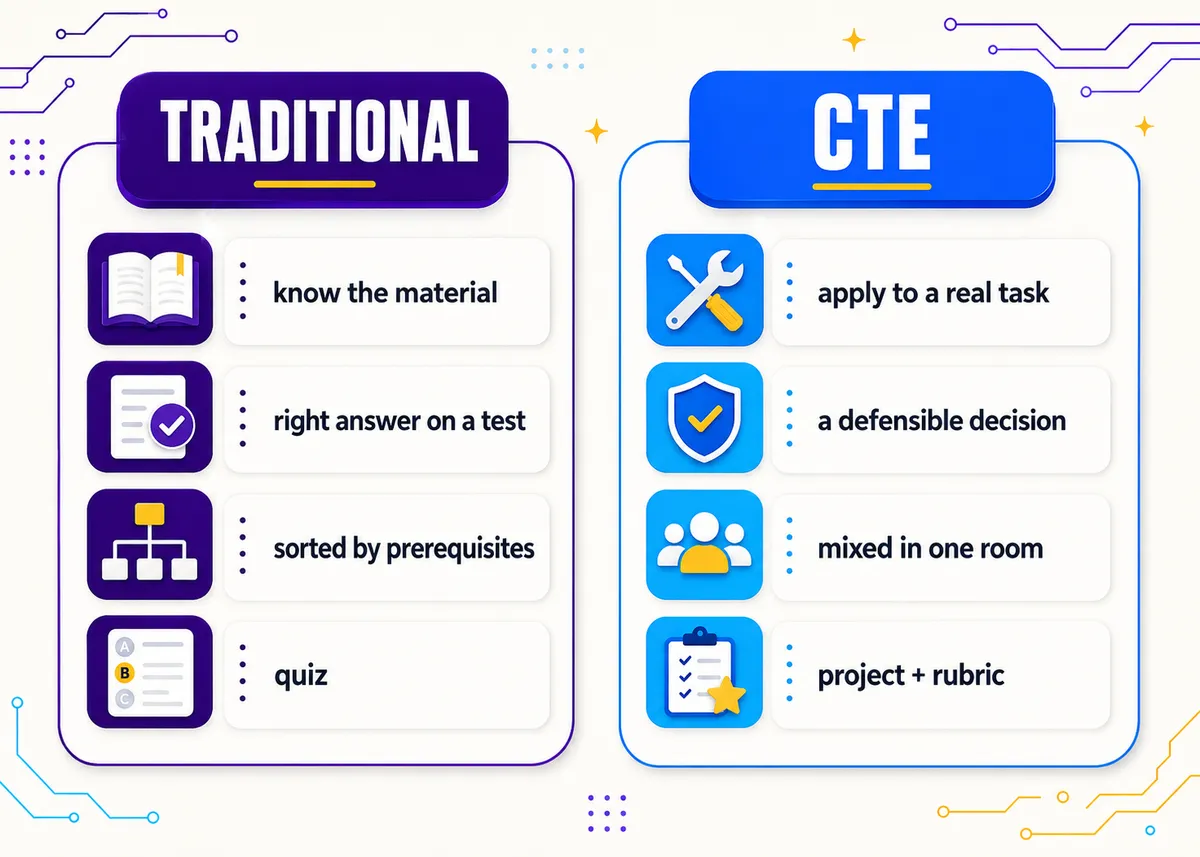
The end goal is application, not recall. In a history class, a student can succeed by knowing things. In your class, knowing things is the floor. The student has to actually do something with it: build the budget, write the marketing brief, harden the network, pitch the business.
Your students are wildly uneven. You’ll have a senior who’s been building PCs since middle school sitting right next to a sophomore who signed up because it fit their schedule. CTE rarely has the neat prerequisite chain that math does, so you plan for range (not for a tidy average that doesn’t actually exist in your room).
The content moves. Tax law changes. Marketing platforms die. A cybersecurity threat that was theoretical last year is in the headlines this year. CTE teachers can’t teach from a textbook frozen in time, which is exactly why most of us end up building our own materials (and why a well-organized, editable curriculum is worth real money to a teacher who’d otherwise rebuild it from scratch every August).
Here’s the same idea side by side:
What makes a good CTE lesson?
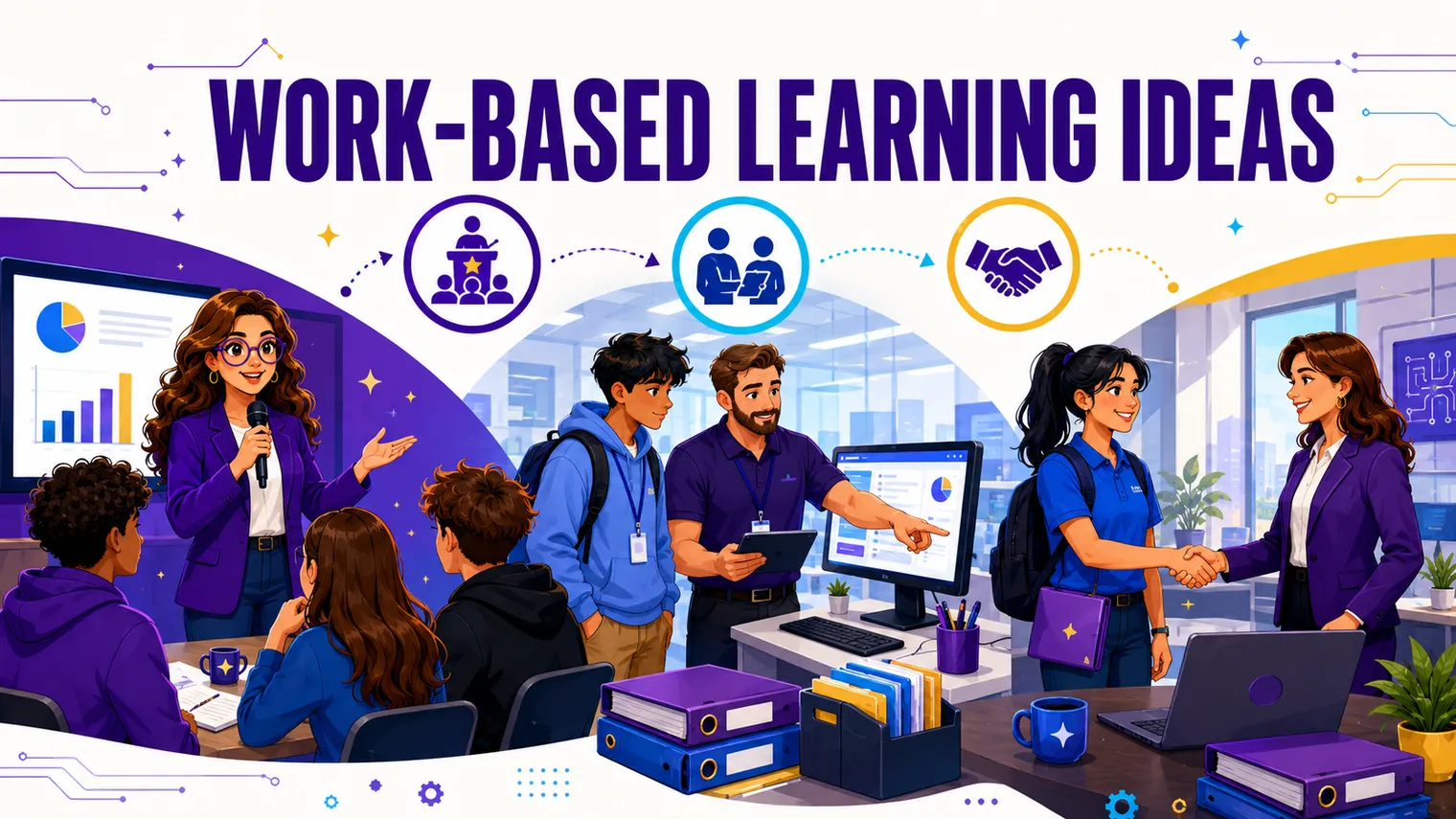
A strong CTE lesson is built backward from a decision the student has to make. Not “learn the four Ps of marketing,” but “you’ve got a $500 budget and a brand-new product: where do you spend it, and defend the call.” The vocabulary and the content get learned in service of that decision, which is exactly how working professionals use them in the first place.
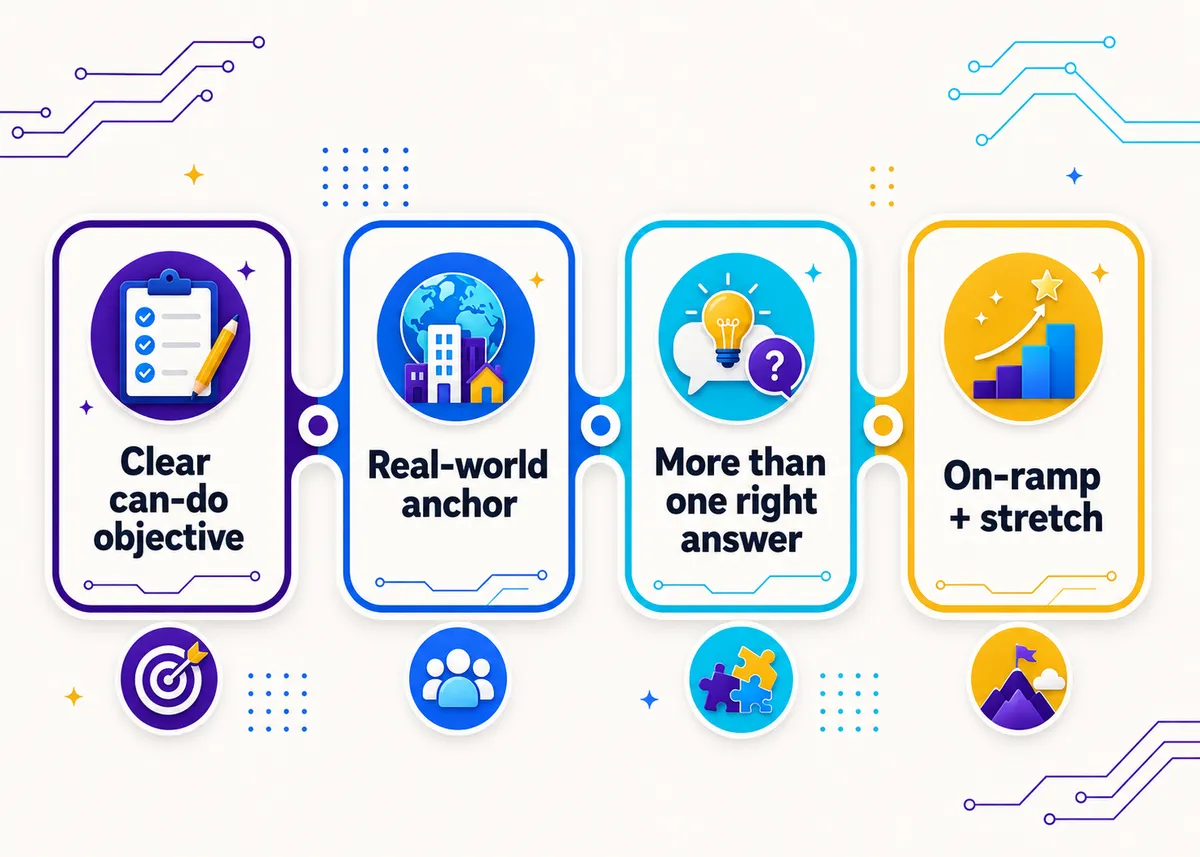
A CTE lesson that holds up usually has four things:
- A clear, single objective written as something a student can do by the end (“compare two financing options and justify a choice”), not something they’ll just be “exposed to.”
- A real-world anchor at the center: a case, a dataset, a client brief, a simulated work task.
- Room for more than one defensible answer, so students have to reason instead of guessing what’s in your head.
- A built-in on-ramp and stretch, so the fast finishers can go deeper and the kids who are stuck can still get in the door.
If you want this broken all the way down (with templates), the Project-Based Learning in CTE guide is the deep dive: it’s basically the engine room for everything else on this site.
How do you keep CTE students engaged?
Engagement is the thing every new CTE teacher quietly panics about (will they tune out, will I lose the room), and the honest fix isn’t a flashy activity. It’s relevance plus a little autonomy.
Students lean in when the work connects to a decision they can imagine actually facing, and when they get some say in how they tackle it. That’s also the quiet cure for the “mixed-ability room” problem: when students choose their angle on a real problem, the senior who builds PCs and the sophomore who wandered in can both find a way in at their own level.
The flip side is the classic CTE trap, which is leaning so hard on “hands-on” that you forget the learning. We unpack the balance next.
How to balance skills, projects, and content
The trap in CTE is going all-in on one of three things: drowning students in content they’ll never use, running so many projects that nobody actually learns the underlying skill, or drilling skills with zero context until the room mentally clocks out.
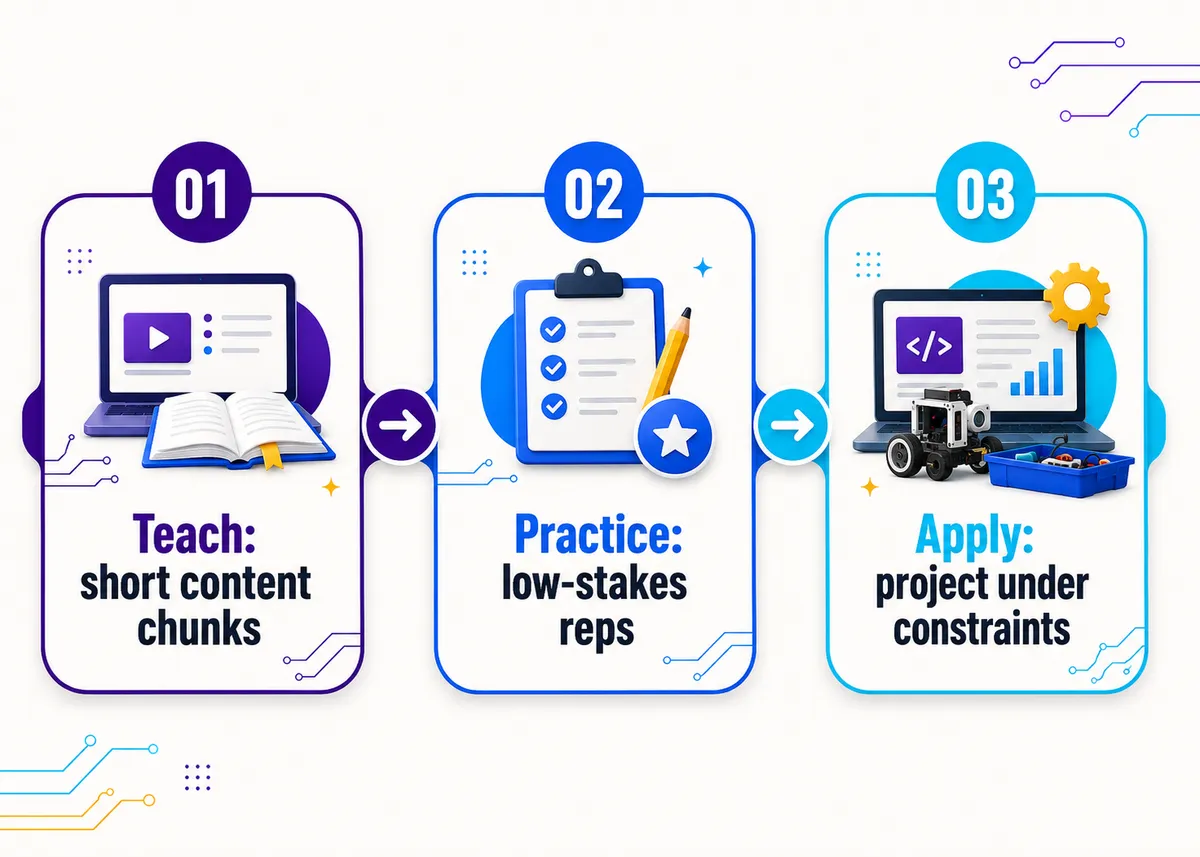
The balance we’d aim for across a unit runs in three moves:
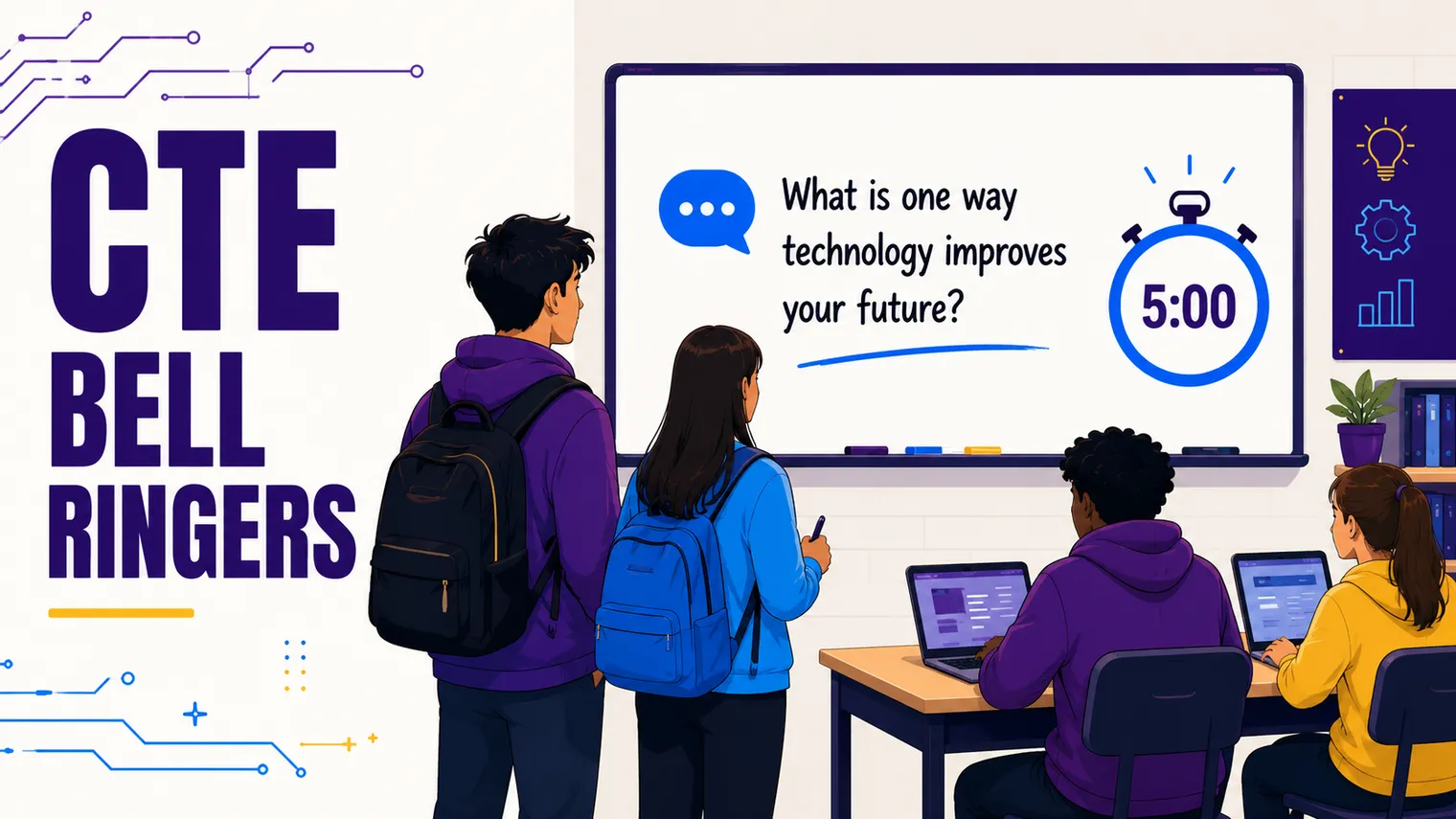
- Teach the core content in short, tight chunks (bell ringers and guided notes are perfect for this).
- Practice the skill in low-stakes reps, where being wrong is cheap.
- Apply it in a project or case under realistic constraints, in the back half of the unit.
Content earns its spot by being needed for the project, not the other way around. This is also where pacing lives or dies (a whole topic on its own), so head to How to Build a Full-Year CTE Curriculum when you’re ready to map the entire arc.
How to teach business topics
Business is the half of CTE where students think they already get it (they’ve seen ads, they’ve got a part-time job, they’ve watched Shark Tank), which is actually an advantage if you use it. Start from something they’ve lived (a purchase they regret, a paycheck that somehow vanished, a brand they’re weirdly loyal to) and pull the concept out of it.
Entrepreneurship, marketing, personal finance, accounting, economics: each one teaches best through a slightly different kind of project, and the How to Teach High School Business guide breaks down each one with project ideas you could run next week. If you’re teaching the AP-level course, the financial-decision and entrepreneurial-project framing matters even more (more on AP Career Kickstart below).
How to teach technology topics
Tech is the half where the skill gap in the room is widest and the intimidation factor is highest, for students and sometimes for the teacher who got handed the course in August. The move is to lower the cost of being wrong. Coding, cybersecurity, and digital skills all get easier to teach when students can experiment, break things safely, and see instant feedback, instead of being graded on nailing it the first time.
Cybersecurity especially teaches beautifully through scenarios and simulations (you don’t need kids writing exploits, you need them reasoning about risk, defense, and tradeoffs). The How to Teach High School Technology guide runs through computer science, cybersecurity, AI literacy, and digital tech, with classroom-management notes for the lab (which is its own special kind of chaos).
How to use project-based learning (without the chaos)
Project-based learning is the brand promise of good CTE, and it’s also the thing most likely to go sideways. The usual horror stories (projects that never get finished, groups where one kid does everything, work that’s all glitter and no thinking) almost always trace back to a missing ingredient: constraints.
A real project hands students a goal, limited resources, and a “defend your decision” requirement, then asks them to justify their choices the way a professional would. That’s the difference between a CTE project and a poster project.
The full method (how to structure a project lesson, run simulations, grade with rubrics, and keep group work from sliding into chaos) is in Project-Based Learning in CTE. It links out to nearly every product line on this site, because honestly that’s what most of them are built to support.
How to assess career-ready skills
Here’s the honest tension: the skills that matter most in CTE (judgment, communication, problem-solving under pressure) are the hardest ones to slap a number on. A multiple-choice quiz can check vocabulary, but it can’t tell you whether a student can make a defensible business decision.
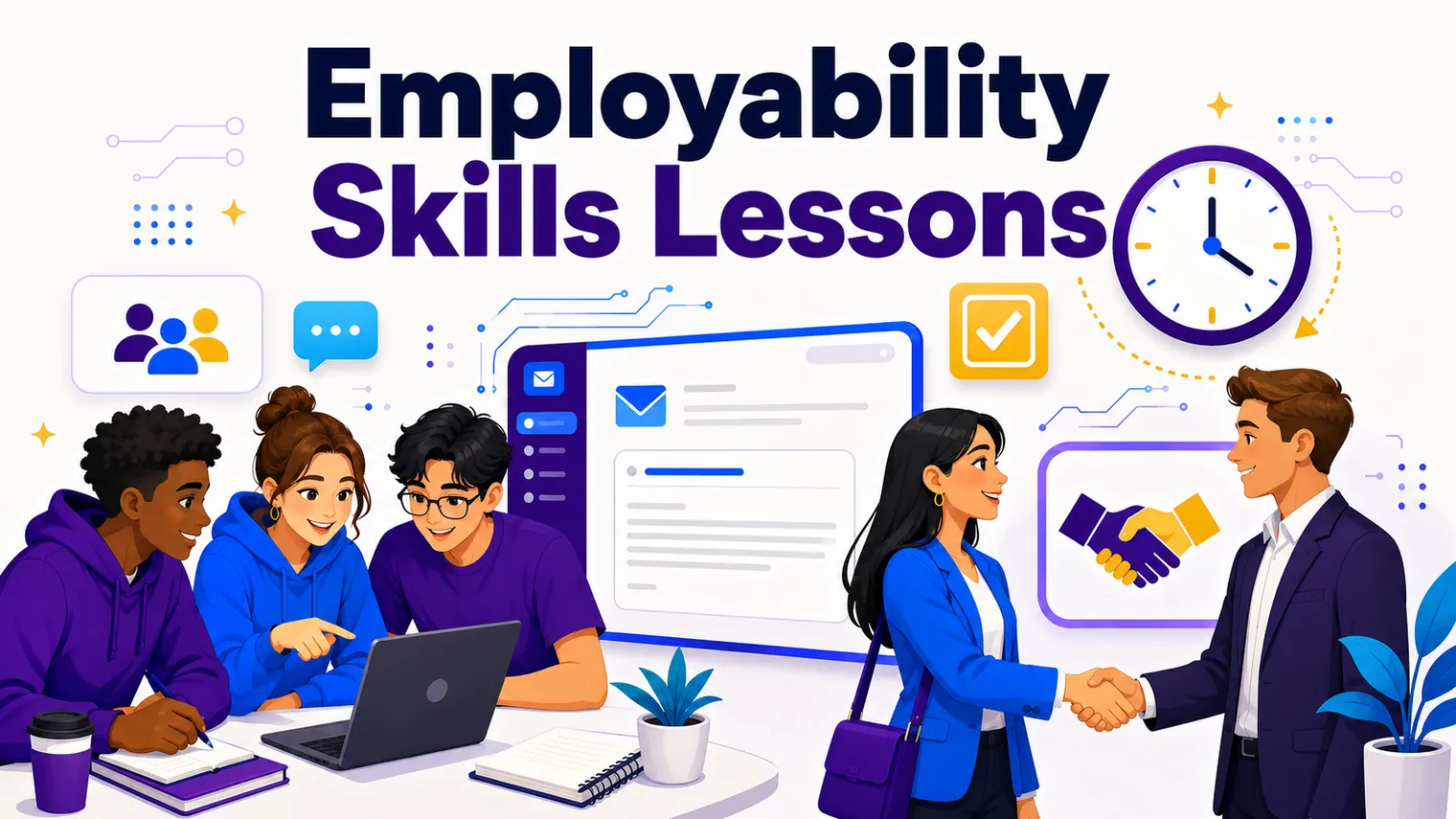
The fix is rubrics that grade the reasoning, not just the final product. A strong CTE rubric rewards the student who made a clear, well-justified call (even one you wouldn’t have made yourself), and it turns the fuzzy “career-ready practices” (initiative, collaboration, clear communication) into something visible and gradeable. How to Assess CTE Skills walks through building those rubrics, plus where quizzes and exit tickets still earn their keep.
How do you plan a full year of CTE?
Most CTE burnout isn’t from the teaching. It’s from planning the plane while you’re flying it. The fix is to map the year once, at the unit level, before the year starts:
- What the units are
- Roughly how long each one runs
- Where the big projects land
- Where you’ve deliberately left breathing room for the inevitable schedule chaos (assemblies, snow days, the fire drill that hits during your best lesson)
It doesn’t need to be perfect. It needs to be a skeleton you can hang daily lessons on, so you’re never staring down a blank week. How to Build a Full-Year CTE Curriculum gives you the mapping process, and if you’re brand new to all of this, start with the First-Year CTE Teacher Guide first (it’s written for exactly the person who got handed three preps and a closet full of outdated materials).
A note on AP Career Kickstart
If you teach AP Business with Personal Finance or AP Cybersecurity, you’re part of College Board’s newer AP Career Kickstart initiative, and you’re teaching courses built around projects and simulated work experiences instead of the lecture-and-recall model the older AP courses leaned on. Good news if you already think like a CTE teacher. What Is AP Career Kickstart? is the teacher’s guide to planning these courses, what to set up before day one, and how to actually survive a first-year AP rollout.
Free resources for CTE teachers
You don’t have to build all of this alone, and you definitely shouldn’t have to buy your way in just to test the waters. The Free Library has no-prep starting points (bell ringers, a project rubric, first-week activities, a pacing planner) that work across both business and tech classes. Grab what’s useful, see if the style fits the way you teach, and go from there.
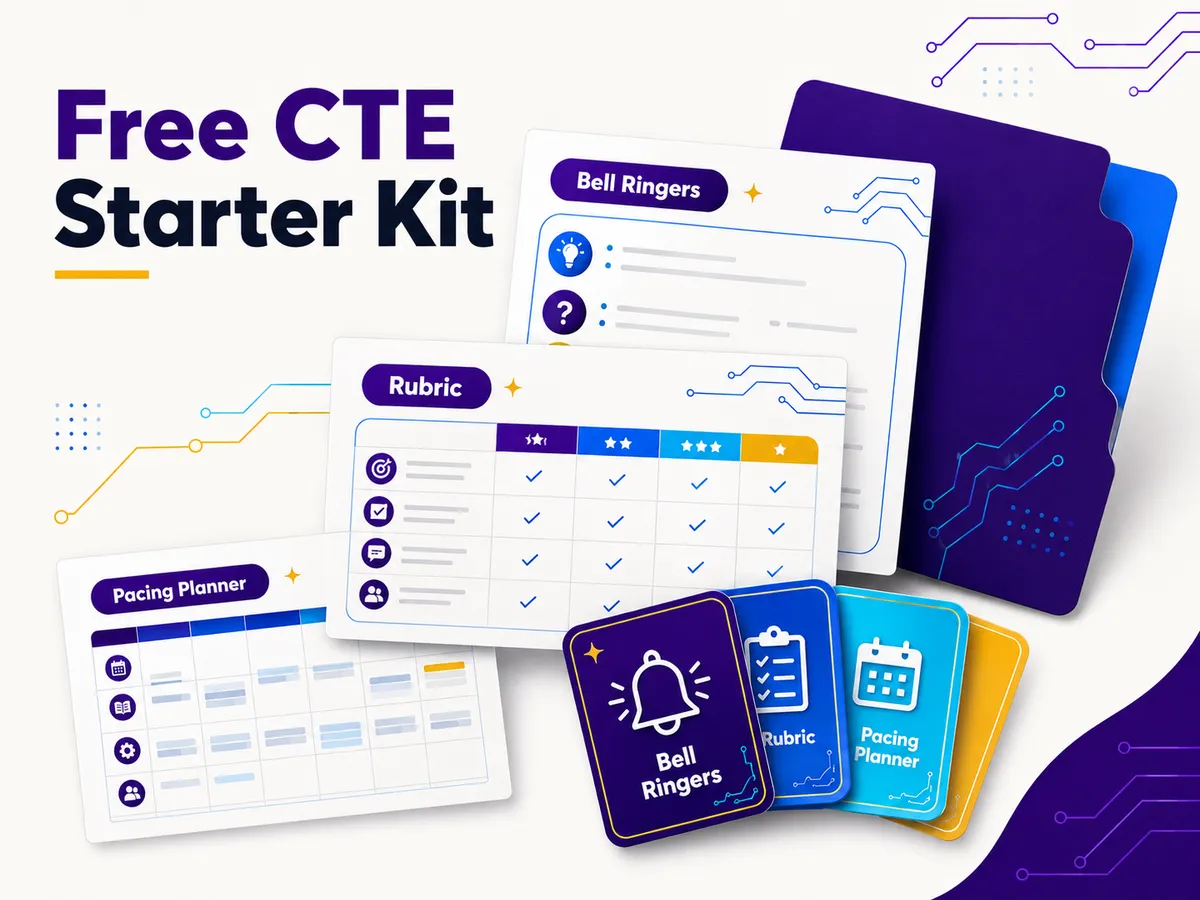
Want the planning done for you? Browse the editable, full-year business, technology, and AP Career Kickstart curriculum, built around projects and real-world decisions. Start with AP® Business with Personal Finance, AP® Cybersecurity, or Personal Finance, and teach it on Monday instead of rebuilding it on Sunday.
Frequently asked questions
What does CTE stand for in education? CTE stands for Career and Technical Education: courses that build job-ready skills in a specific field (business, tech, health science, the trades, and more) rather than prepping students for a single academic exam.
How is a CTE class different from a regular class? The goal is application, not recall. Students succeed by doing something real with the content (building, pitching, deciding) rather than just knowing it, and they usually arrive at very mixed skill levels in the same room.
How do you keep CTE students engaged? Tie the work to a decision students can imagine facing, and give them some say in how they solve it. Relevance plus a little autonomy beats a flashy one-off activity, and it lets a mixed-level room each find a way in.
What makes a good CTE lesson? One clear “can-do” objective, a real-world anchor (a case, dataset, or client brief), room for more than one defensible answer, and a built-in on-ramp for strugglers plus a stretch for fast finishers.
What is the difference between CTE and a regular elective? A regular elective often exists to explore an interest; a CTE course is built to teach a specific, job-ready skill tied to a career field (and often an industry credential). CTE also tends to run on projects and real-world tasks instead of lecture and recall.
How long does a CTE unit usually take to teach? Most CTE units run two to four weeks: a short stretch of core content, some low-stakes practice, then a project or case in the back half. The exact length follows the project, so map your units before the year starts (the process is in How to Build a Full-Year CTE Curriculum).
Do you need a teaching degree to teach CTE? It varies by state. Many states have an industry-experience pathway that lets professionals teach CTE without a traditional education degree, often on a preliminary or transitional certificate while they finish requirements. Check your own state’s rules, since the specifics differ a lot.
How do you plan a full year of CTE? Map it once at the unit level before the year starts: the units, rough timing, where the big projects land, and built-in slack for schedule chaos. See How to Build a Full-Year CTE Curriculum.
AP® is a trademark registered by the College Board, which is not affiliated with, and does not endorse, this product.