
Here is the honest tension at the center of CTE assessment: the skills that matter most are the hardest ones to put a number on. Judgment, communication, problem-solving under pressure, the ability to make a defensible call when there is no answer key: those are exactly what employers say they want, and exactly what a multiple-choice quiz cannot see. So a lot of us end up grading what is easy to grade (did the spreadsheet balance, did the code run) and quietly hoping the real learning came along for the ride.
It usually does not, and students can tell. This guide is about closing that gap: how to grade hands-on work, what separates a rubric that measures the skill from one that just measures effort, how to score the reasoning behind a decision instead of only the finished product, how to make fuzzy “career-ready” skills gradeable, and where quizzes and exit tickets still earn a spot. The goal throughout is the same: turn the skills that matter into something a student can see, aim for, and be fairly judged on.
The short version: Assess CTE skills with rubrics, not answer keys. A strong rubric grades four things (technical accuracy, the quality of the decision, communication, and process), and the most important of those is the decision: reward a clear, well-justified call even when it is not the one you would have made. Turn vague “employability skills” into named, observable criteria so they can be coached and graded. Keep quizzes and exit tickets for fast knowledge checks, but never mistake them for proof a student can do the work.
How do you grade hands-on, performance-based skills?
You grade performance by judging it against a known standard, not by collecting a product and grading it on vibes after the fact. In an academic class, the test comes at the end and the answer is right or wrong. In CTE, the assessment is built into the doing: the pitch, the build, the repair, the campaign, the live debug. What you need is a way to judge it consistently, which is what a rubric is for.
A few principles keep performance grading fair and sane:
- Define “good” before students start, not after. Hand out the rubric with the assignment. If students can see exactly what a strong job looks like, the rubric stops being a grading tool and starts being a teaching tool (which is the better use for it anyway).
- Grade the skill, not the polish. A gorgeous slide deck wrapped around a weak business decision is a weak project. Make sure your criteria reward the thing you actually taught, not the thing that happens to look impressive.
- Separate the criteria. A single 1-to-100 number tells a student nothing about what to fix. Break the grade into a handful of named dimensions (more on which ones below) so the feedback is specific.
- Make it observable. Every criterion should describe something you could point to. “Shows professionalism” is not gradeable. “Met posted deadlines and arrived to the pitch prepared” is.
This is the same backward-from-a-real-task design that runs through everything in CTE (the full method is in How to Teach CTE and the deep dive on Project-Based Learning in CTE). Assessment is just the other end of that design: if the lesson was built around a decision, the grade has to be too.
What makes a good CTE rubric?
A good CTE rubric scores the right things, in plain language, at levels a student can actually tell apart. The most common rubric mistake is loading it up with everything you can think of, which buries the two or three criteria that matter under a pile that does not. The second most common mistake is grading what is easy to see (formatting, length, neatness) instead of what is hard to see (reasoning, tradeoffs, judgment).
A strong CTE rubric scores four things. The diagram below is the short version, and we unpack each one across this guide:
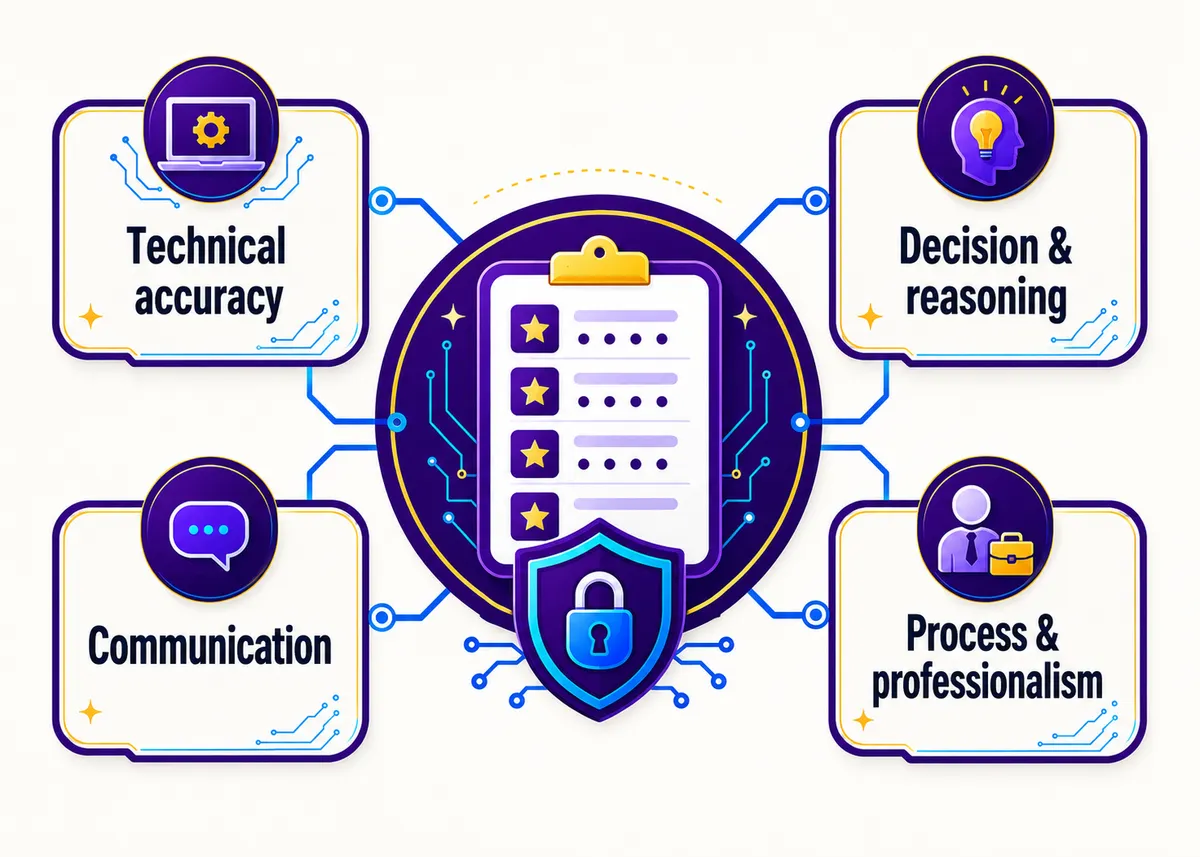
- Technical accuracy. Is the work correct and does it meet spec? The budget adds up, the code compiles, the journal entry balances, the network is configured right. This is the floor, not the ceiling, but it still has to be there.
- Quality of the decision and reasoning. Did the student make a defensible call and justify it? This is the heart of CTE assessment, and the part most rubrics skip. We give it its own section below.
- Communication. Can the student explain what they did and why, to the audience the work is for? A correct decision nobody can follow is worth less in the real job, so it should be worth less here too.
- Process and professionalism. How did they work? Deadlines met, feedback used, collaboration handled, problems escalated instead of hidden. This is where the employability skills live.
A practical rule for the levels: write the descriptors for what a student does, not how much they did. “Justifies the choice with relevant evidence and acknowledges a tradeoff” beats “excellent reasoning,” because the first one tells the student exactly what excellent looks like and the second one just tells them their grade.
How do you grade the reasoning, not just the final product?
This is the single most important move in CTE assessment, so it gets its own section. The trap is grading the artifact (the deck, the model, the program) and treating it as proof of skill. But a student can land on a fine-looking product through luck, copying, or an AI tool, while another makes a genuinely smart decision that produces a modest-looking result. If you only grade the artifact, you reward the first student and punish the second. That is backward.
The fix is to make the reasoning a graded deliverable in its own right. A few reliable ways to do it:
- Require a justification. Every project decision comes with a short written or spoken defense: why this option over the others, what tradeoff you accepted, what you would change with more time or money. Grade that against your decision criterion.
- Reward the defensible call you would not have made. The point is not that the student guessed your preferred answer. The point is that they reasoned their way to a position and can hold it up. A clear, well-supported decision you personally disagree with should still score high. This single habit is what separates a CTE rubric from an academic one.
- Assess it live. Have students explain their work, modify someone else’s, or debug a broken version out loud. Reasoning is much harder to fake in real time than on paper, which is also why this is the answer to AI doing the homework (see the AI section in How to Teach High School Technology).
- Grade the process artifacts. A planning doc, a revision history, a “what went wrong and what I did about it” reflection. These make the thinking visible even when the final product hides it.
When students learn that the grade follows the reasoning, they stop fishing for the answer in your head and start building a case for their own, which is the actual skill you are trying to teach. The project structure that sets this up (constraints, a real decision, a defend-your-choice requirement) is covered in Project-Based Learning in CTE.
How do you assess soft (employability) skills?
You assess soft skills by refusing to leave them soft. “Employability skills,” “career-ready practices,” “professionalism”: these phrases are useless on a rubric until you turn them into specific, observable behaviors. The skill is real. The vagueness is the problem. So the job is to name the behavior, decide what it looks like at each level, and grade what you can actually see.
It helps to anchor to an existing framework so you are not inventing categories from scratch. Two are widely used and worth knowing:
- The 12 Career Ready Practices (from Advance CTE) describe the habits of a career-ready person: things like acting responsibly, communicating clearly and effectively, using technology productively, and working as part of a team. They are written to span every career cluster, which makes them a useful menu to pull from.
- The Employability Skills Framework (from the U.S. Department of Education) groups workplace skills into broad areas such as applied knowledge, effective relationships, and workplace skills like communication and critical thinking. It was built specifically to help CTE programs teach and assess these competencies, so it maps cleanly onto a rubric.
You do not grade the whole framework. You pick the two or three practices a given project actually exercises and translate each into a row a student can be coached toward. For example:
| Vague “soft skill” | Observable criterion you can actually grade |
|---|---|
| ”Communicates well” | States the recommendation in one clear sentence, then supports it |
| ”Works as a team” | Took a defined role, met internal deadlines, gave usable feedback |
| ”Professional” | Met posted deadlines, came to the pitch prepared, handled questions calmly |
| ”Problem-solver” | Named the obstacle, tried a fix, adjusted when it did not work |
| ”Uses initiative” | Made a defensible call without waiting to be told the answer |
Notice that every right-hand cell describes a behavior you could point at in the room. That is the test. If you cannot imagine pointing at it, rewrite it until you can. We build full lessons around teaching these explicitly (not just grading them) in Employability Skills Lessons for High School, and the activities that give students reps are in Career Readiness Activities for High School.
Where do quizzes and exit tickets still earn their keep?
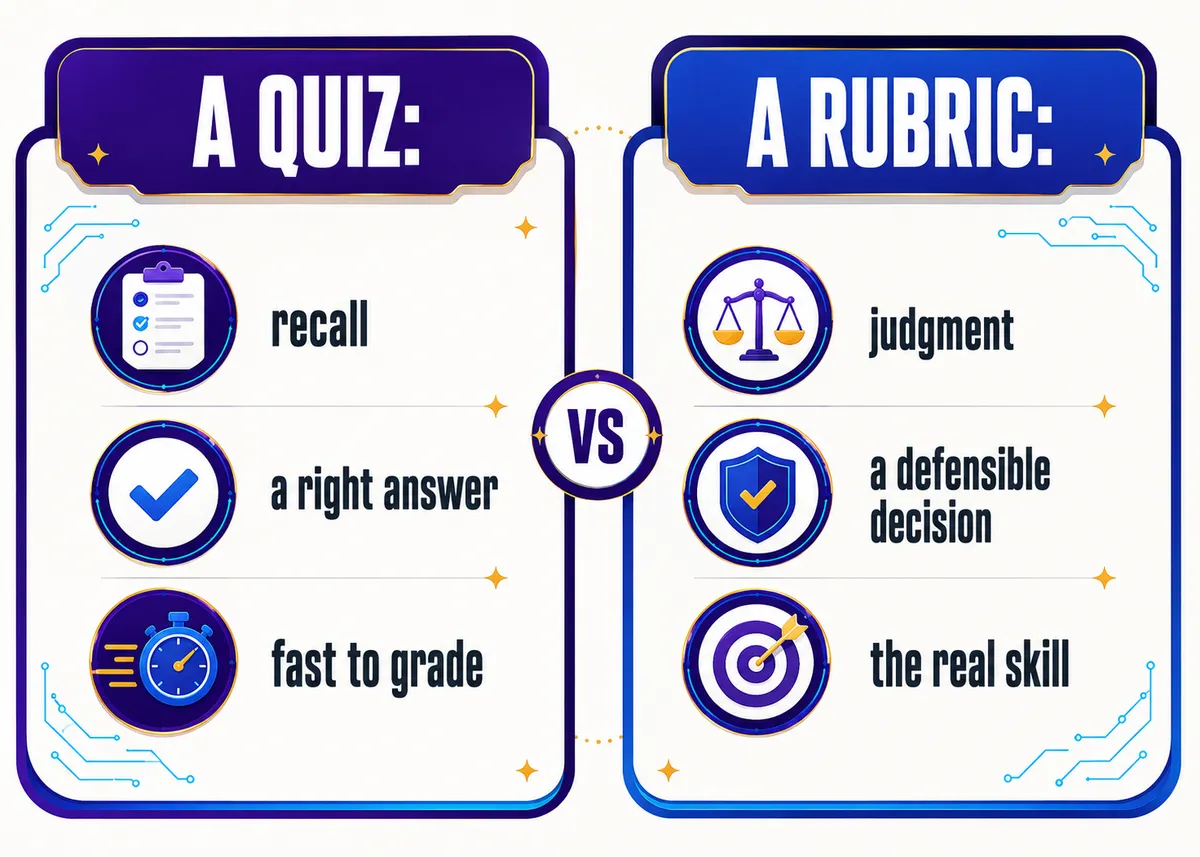
It would be easy to read all of this as “rubrics good, quizzes bad,” and that is not the message. Quizzes and exit tickets are excellent at one thing: fast, cheap checks on whether the underlying knowledge is in place before students try to apply it.
You cannot reason about a marketing budget if you do not know what a margin is. You cannot threat-model a network if you cannot name the basic attack types. Checking that with a two-minute quiz is far smarter than discovering it halfway through a failing project. Use them as instruments, not as the main event:
- Exit tickets tell you what to reteach tomorrow. One question, end of class, ungraded or low-stakes.
- Knowledge quizzes confirm the floor is in place before a project starts. Keep them short and frequent rather than rare and high-stakes.
- Self-checks and retrieval practice help the content stick so it is available when the project needs it.
The mistake is not using quizzes. The mistake is letting a quiz stand in for proof that a student can do the work, when all it ever proved was that they could recognize the right answer. The comparison below is the whole philosophy in one table.
What is competency-based assessment?
Competency-based assessment grades whether a student can demonstrate a specific, named skill (a competency) rather than how they stack up against the rest of the class or how many points they accumulated. Instead of “you earned an 84,” it says “you can build a balanced budget and defend your tradeoffs; you are not yet consistent at presenting it to a client.” The unit of measurement is the skill itself.
This fits CTE almost perfectly, because CTE is already organized around things students should be able to do. In practice it usually means a few things:
- Skills are defined up front as clear can-do statements, often drawn from industry standards or a credential’s requirements.
- Students can demonstrate mastery more than once. Because the point is the skill, not the calendar, many competency-based setups allow revision and reassessment rather than locking in a single attempt.
- The rubric is the gradebook. Each competency is tracked on its own, so a student (and a future employer) can see exactly which skills are solid and which are still developing.
You do not have to convert your whole course to borrow the best idea here: grade named skills, let students show growth, and report on what they can actually do. Even a traditional points-based class gets fairer when the rubric is built around demonstrable competencies. This really pays off across a full year, when those competencies stack into a coherent progression (the mapping process is in How to Build a Full-Year CTE Curriculum).
Free resources for CTE assessment
You do not have to build every rubric from scratch, and you should not have to buy your way in just to see if the approach fits your room. The Free Library has a ready-to-use project rubric (the four-criteria kind described above) along with other no-prep starting points that work across business and tech classes. Grab it, run it on your next project, and see whether grading the decision instead of the deck changes what your students hand in.
Want the assessment built in? Browse editable, full-year business and technology curriculum with project rubrics, performance tasks, and quick knowledge checks already aligned to each unit. Every rubric grades the decision and the reasoning first, the same way this guide does, so the hardest part of fair grading is already written for you.
Frequently asked questions
How do you grade hands-on, performance-based skills fairly? Use a rubric you hand out before students start, break the grade into a few named criteria (technical accuracy, decision quality, communication, process), and write the levels as observable behaviors. Defining “good” up front turns the rubric into a teaching tool, not just a grading one.
What should a CTE rubric measure? Four things: whether the work is technically correct, whether the student made a defensible decision and justified it, whether they can communicate it, and how they worked (deadlines, collaboration, professionalism). The decision criterion is the one most rubrics skip and the one that matters most.
How do you grade reasoning instead of just the final product? Make the reasoning a graded deliverable: require a short justification of each major choice, reward a clear, well-supported call even if it is not the one you would have made, and assess it live by having students explain, modify, or defend their work out loud. Reasoning is much harder to fake in real time.
How do you assess soft or employability skills? Turn vague phrases into observable behaviors. “Communicates well” becomes “states the recommendation in one sentence, then supports it.” Anchor to a known framework (the 12 Career Ready Practices from Advance CTE or the U.S. Department of Education’s Employability Skills Framework), pick the two or three a project actually exercises, and grade those.
Should you still give quizzes in a CTE class? Yes, for the right job. Quizzes and exit tickets are fast, cheap checks that the underlying knowledge is in place before students apply it. Keep them short and frequent. Just do not let a quiz stand in for proof a student can do the work; that is the rubric’s job.
What is competency-based assessment in CTE? It grades whether a student can demonstrate a specific named skill, rather than ranking them or totaling points. Skills are defined as can-do statements up front, students can often demonstrate mastery more than once, and the rubric effectively becomes the gradebook. It fits CTE well because CTE is already organized around things students should be able to do.