


You got handed a course title, a room, and not much else. No textbook, or a textbook from 2014 that nobody trusts, and a course code that points to a state framework you’ve skimmed once and found mostly bewildering. Somewhere around mid-August it hits you that nobody is going to hand you the year. You have to build it, and you have to build it for a real room of students who show up on the first day whether or not you’ve figured out week 23.
This guide is for that teacher: one person, one (or two, or three) preps, building a full year from a blank page. We’re not going to design a program or write a curriculum committee’s dream document. We’re going to map a year you can actually teach, in an afternoon, at a level of detail that helps instead of haunting you. Scope, sequence, pacing, and where to leave room for the fire drill that hits during your best lesson.
The short version: Map the year once, at the unit level, before it starts. Decide what the units are, roughly how many weeks each runs, where the big projects land, and where you’ve left deliberate breathing room for schedule chaos. That skeleton is the whole job. It does not need to be perfect or finished, because daily lessons hang off it all year and the plan changes the moment students arrive. Align loosely to your state framework and to whatever certification the course points at, and let content earn its spot by being needed for a project.
What is a scope and sequence, really?
Strip away the jargon and a scope and sequence answers two questions: what do you teach (the scope), and in what order (the sequence). That’s it. The scope is the list of units. The sequence is the order you run them in. A pacing guide adds a third question on top: how long does each piece get?
You do not need a fancy template to hold this. A single page, a spreadsheet, or a whiteboard photo will do. What you’re building is a skeleton you can hang daily lessons on, so you’re never staring down a blank week in February wondering what happens next. The detailed lesson plans come later, one week at a time. The map comes first and comes once.
The mistake almost every new CTE teacher makes (the one that produces those Sunday-night planning spirals) is skipping the map and planning the plane while flying it. You teach a great two weeks, look up, and have no idea whether you’re ahead or behind. The map prevents that specific dread.
How do you create a scope and sequence for a CTE course?
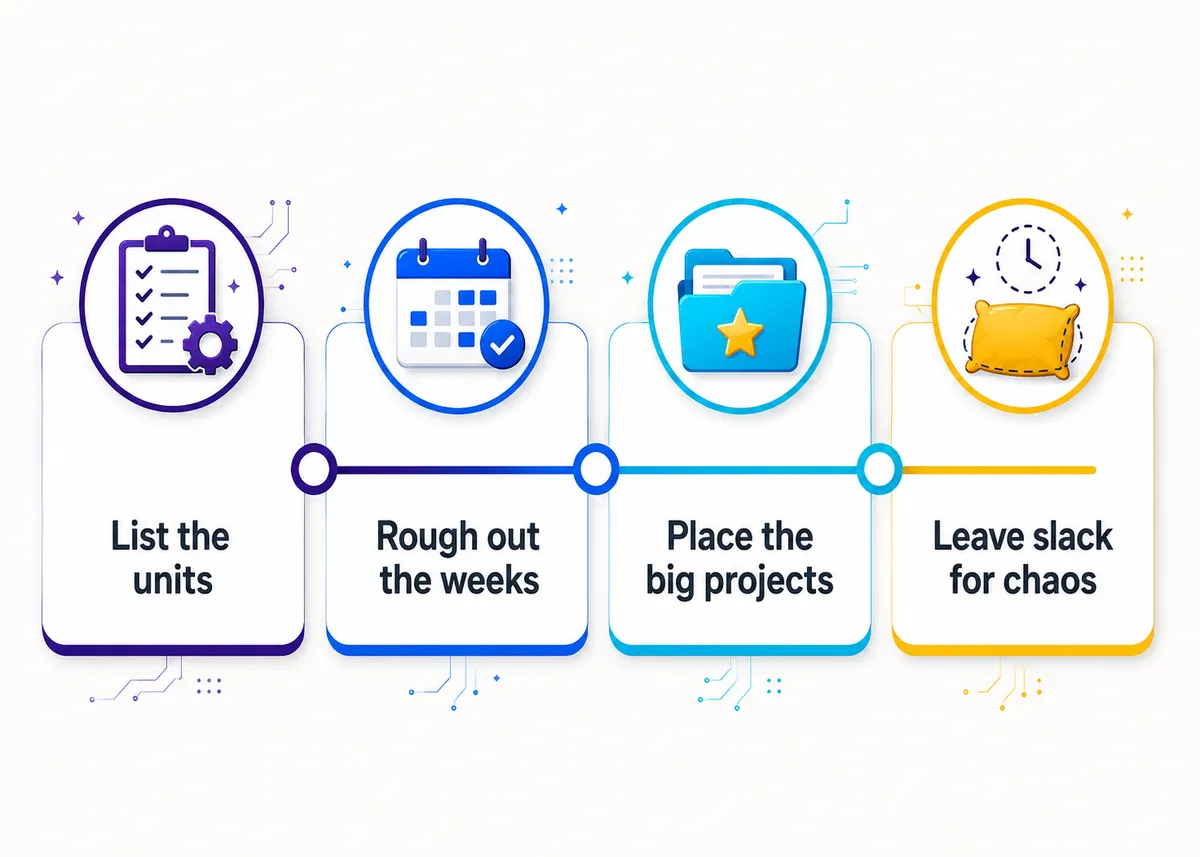
Build it backward from the projects, in four moves. This is the whole method, and you can do it in one sitting.
- List the units. Write down the chunks of the course as you understand them. For a personal finance course that might be budgeting, banking and credit, saving and investing, taxes, insurance, and a capstone. Pull the list from your state framework if you have one, or from the modernized National Career Clusters Framework, or honestly from the table of contents of any reputable course in the subject. Six to ten units for a full year is a normal range. Do not overthink the order yet.
- Rough out the weeks. Give each unit a number of weeks. Round numbers, gut feel, no precision. A full year is roughly 36 weeks, so if your units add up to 40 you’ve got a problem worth seeing now instead of in April. If they add up to 30, good, you just found your slack (more on that below).
- Place the big projects. Every unit should aim at something a student builds or decides: the budget simulation, the pitch, the campaign, the capture-the-flag. Drop those in first, then build the unit backward to land at one. The project is the destination; the content is what students need to get there.
- Leave slack. Deliberately hold back a week or two. You will need it, and we’ll get to why.
That order matters. When you place the projects before the content, content stops being a checklist to cover and starts being the stuff students actually need to pull off the project. That single shift is what separates a CTE scope and sequence from an academic one.
Here’s the same four moves as a diagram you can keep next to you while you build:
How do you pace a year (or a semester)?
Pacing is just the rough-weeks step taken seriously enough to be useful and not so seriously that it becomes a second job. The honest target is a full-year course of about 36 instructional weeks, but you never get 36 clean ones, so plan for something closer to 32 and treat the rest as buffer.
A semester course is the same exercise on a shorter board: roughly 18 weeks, so figure on 15 or 16 of real teaching. The temptation with a semester is to cram a full year’s scope into half the time. Resist it. A semester course teaches fewer units more deeply, not the same units faster. Cut scope before you compress pacing, because a course that races never lets a single project breathe.
A few pacing habits that keep the year honest:
- Anchor to the calendar, not just week numbers. Write real dates or at least “before winter break” and “after spring testing” next to your units. Breaks and testing windows reshape a year more than anything you’ll do in the room.
- Front-load nothing fragile. The first two weeks are logins, rosters, and schedule changes. Put your culture-setting and a low-stakes opener there, not a unit you’re counting on.
- Check your map monthly, not daily. Once a month, glance at where you are versus where the map said you’d be, and adjust the back half. Daily pacing anxiety is the thing the map exists to kill.
How do you align to standards and industry certifications?
This is where new CTE teachers either panic or ignore the question entirely, and neither is right. Here’s the calm version.
Your course points at a state framework (the standards), and often at an industry certification or credential the course is meant to prepare students for. You align to both, but loosely, and you do it at the unit level, not the lesson level. The goal is coverage, not a one-to-one mapping of every standard to every day. That mapping is a document for an auditor, not a tool for a teacher.
Practically: pull up your state’s framework for the course code and skim it for the big buckets. You’ll usually find your units already cover most of it, because reputable course outlines tend to converge. Mark which unit covers which cluster of standards, note the two or three nothing currently touches, and adjust. That’s the whole alignment pass, and it takes an afternoon.
For certifications, find out which credential (if any) your course points to, and get its exam outline or competency list. Treat it as a second, overlapping standards document. Where the cert emphasizes something your framework underplays, give it more room. Keep it general and keep it current, because frameworks and cert outlines both get revised: check your own state’s framework and the modernized National Career Clusters Framework rather than trusting a list someone posted three years ago. If you want the wide-angle view of how CTE fits together before you go standard-by-standard, How to Teach CTE is the umbrella guide this one lives under.
Where should the big projects land?
Projects are the spine of the year, so place them with intention. The default that works: one significant project per unit, landing in the back half of that unit, after students have built up enough content and skill to actually pull it off. The front of the unit teaches and practices; the back of the unit applies. (How to Assess CTE Skills covers grading those projects on reasoning, not just the artifact, and Project-Based Learning in CTE is the full method for running them without the chaos.)
A few placement rules of thumb:
- Space the big ones out. Two heavy, multi-week projects back to back will exhaust you and them. Alternate a heavy unit with a lighter one.
- Put a real anchor project before a break, not across it. Momentum dies over a two-week break, so either finish before it or start fresh after, but don’t stretch a project through it.
- Make the last unit a capstone. End the year on a project that pulls the threads together, not on a unit you only reached because you ran out of road. If you build toward it from week one, you protect it.
The point is that the projects come first in the planning and the content fills in around them. Content earns its spot by being needed for a project, which is the same principle that runs through every CTE class worth teaching.
How do you build in slack for schedule chaos (assemblies, snow days)?
Here’s the rule almost nobody tells a first-year teacher: a plan with no slack is a plan that’s already broken. Assemblies, snow days, fire drills, pep rallies, standardized testing that swallows a week, the day half your class is gone for a field trip, the day the network is down and your whole lesson was online. These are not exceptions. They are the year. Over 36 weeks you will lose somewhere between one and three weeks to events nobody put on the August calendar.
So build the slack in on purpose, two ways:
- Reserve whole buffer days. Plan for about 32 to 34 teaching weeks of content in a 36-week year, and leave the difference unassigned. Sprinkle a “flex day” at the end of each unit: a day you can use to catch up, go deeper, or simply absorb the Tuesday that vanished. If you don’t need it, it becomes a workday or an extension challenge, and nobody complains.
- Design units to flex, not shatter. Build each unit with a clear core and an optional layer. When a week disappears, you cut the optional layer, not the project. A unit that only works if every single day lands as planned is a unit that will break the first time reality shows up, which is week one.
The teacher who plans for 36 perfect weeks spends the year falling behind. The teacher who plans for 32 and pockets the slack stays more or less on track, because the slack was the plan. Same course, same chaos, completely different stress level.
How detailed does the plan need to be?
Less detailed than you think, and that’s the liberating part. The year-level map is units, rough weeks, projects, and slack. Full stop. It is not 180 daily lesson plans. If you try to write the whole year in lesson-level detail before September, two things happen: you burn out building a document you’ll abandon, and the document is wrong by October anyway, because real students move at a speed you can’t predict from a spreadsheet.
Here’s the contrast that matters most, the one decision that shapes your whole year:
| Unit-level map | Day-by-day plan | |
|---|---|---|
| Effort to build | An afternoon | Weeks (and never really finished) |
| When you do it | Once, before the year | Constantly, all year long |
| What it prevents | The blank-week panic and falling behind | Nothing extra; it’s the daily work either way |
| Flexibility | High: you reroute units, not 180 lessons | Low: one disruption breaks the chain |
| What it actually is | A skeleton you hang lessons on | The lessons themselves, due weekly |
The unit-level map is the planning you do once and lean on all year. The daily plans are work you do weekly no matter what, one week ahead, informed by how the last week actually went. Don’t confuse the two and don’t try to do the second one in July. Map the year at the unit level, then teach into it a week at a time. If you’re brand new to all of this, the First-Year CTE Teacher Guide covers what to set up before day one, and the high school business class syllabus template gives you a starting point for turning your map into the document students and admin actually see.
Free resources to map your year
You don’t have to build the skeleton from a blank page. The Free Library has a pacing planner (plus bell ringers, a project rubric, and first-week activities) that gives you the unit-rough-weeks-projects-slack structure already laid out, so you’re filling in your course instead of inventing the format. Grab it, map your year in an afternoon, and see if the approach fits how you plan.

Want the year built for you? Browse editable, full-year business and technology curriculum with the scope, sequence, and pacing already mapped and the projects already placed. Every course, from Personal Finance to AP® Computer Science Principles, follows the shape this guide describes, with the content taught up front and a real project landing in the back half of each unit.
Frequently asked questions
What is a scope and sequence in CTE? The scope is the list of units a course covers; the sequence is the order you teach them in. Add rough timing on top and you have a pacing guide. For one teacher building a year, it’s a single-page skeleton of units, weeks, and projects that daily lessons hang off, not a committee document.
How do you build a full-year curriculum from scratch? Map it backward in four moves: list the units, give each a rough number of weeks, place the big project in each one, then leave a week or two of slack for schedule chaos. You can do the whole year-level map in one afternoon, then teach into it a week at a time. If you are brand new to the classroom on top of this, the First-Year CTE Teacher Guide covers what to set up before day one.
How many units should a full-year CTE course have? Usually six to ten for a full year, fewer for a semester. A full year is about 36 weeks, so plan your units to total around 32 to 34 weeks of content and hold the rest back as buffer for the disruptions that always come.
How do I align my course to state standards and certifications? Loosely, at the unit level, not lesson by lesson. Skim your state framework for the course code, mark which unit covers which cluster of standards, and fix the few gaps. Treat any industry certification the course points to as a second, overlapping standards list. Always verify against your current state framework rather than an old posted list.
How detailed should a CTE pacing guide be? Just units, rough weeks, projects, and slack. The year-level map is intentionally light, because students move at a speed you can’t predict in July and a fully detailed year is wrong by October. Write the daily lessons weekly, one week ahead, informed by how the last week actually went.
How do you plan for snow days and assemblies in a pacing guide? Plan content for about 32 to 34 teaching weeks in a 36-week year and leave the difference unassigned, with a flex day at the end of each unit. Build each unit with a core and an optional layer so that when a week vanishes, you cut the optional layer instead of the project.