

The first five minutes of class set the tone for the other fifty. A good CTE bell ringer gets students working before you’ve even finished taking attendance, and it does it without a stack of prep on your part. The trick is keeping it fast, low-lift, and tied to the kind of thinking your students will actually do on the job. This is the lighter, ready-to-use companion to How to Teach CTE: grab an opener, drop it on the board, and go.
What makes a good CTE bell ringer?
Three things, and if an opener is missing one of them, it’s probably costing you more than it’s giving back.
- Fast. Students should be writing or doing within sixty seconds of walking in. No long setup, no multi-paragraph reading, no logging into anything.
- Low-prep. You should be able to build it in two minutes or pull it from a rotation you already have. If a bell ringer takes longer to make than it does to run, it isn’t a bell ringer.
- Tied to real work. A regular class can warm up with trivia. A CTE class warms up by reasoning the way a professional would: a quick decision, a spotted mistake, a small estimate. The content earns its spot by being useful, not just by being on the standards list.
One more rule: keep the stakes low. Bell ringers are reps, not assessments. The point is to get the room thinking, not to catch anyone out.
Business class bell ringers
These work across intro, finance, marketing, and entrepreneurship. Most need nothing but the prompt on the board.
- Headline of the day. Post one real business headline (a layoff, a price hike, a new product launch) and ask students to write one sentence on who wins and who loses from it. It previews real markets and trains them to read news like an analyst.
- Would you rather (business edition). Give two business decisions (“take a guaranteed $40,000 salary or a $25,000 salary plus 2% of a startup you believe in”) and have them pick and defend the call in three sentences. The defense is the whole point.
- Vocabulary in context. Drop a term from yesterday into a real sentence (“the cafe cut its variable costs by switching suppliers”) and ask students to explain what it means here, not recite the definition. It checks whether the word actually landed.
- Spot the error in the budget. Show a five-line monthly budget where the numbers don’t add up or a category is wildly off, and have students find and fix the mistake. It builds the habit of checking the math before trusting it.
- Quick estimate (Fermi question). Ask something like “how much does your school spend on paper in a year?” and have students reason to a number out loud with assumptions. Estimation under uncertainty is a core business skill nobody teaches directly.
- What would a professional do? Hand them a small workplace scenario (“a customer is overcharged $12 and is polite about it”) and ask for the move a real employee would make. It rehearses judgment, which is the thing rubrics struggle to grade.
Tech and CS class bell ringers
Same rules, lab edition. These keep the intimidation factor low and get hands moving before the “I’m not a computer person” voice kicks in.
- Spot the error in the code. Put up four or five lines with one bug (a missing colon, a stray equals sign, an off-by-one) and ask students to find it without running it. Reading code for mistakes is most of what real debugging is.
- Logic puzzle. Run a quick one (a short truth-table riddle, a “knights and knaves” style question, a simple sequence to continue). It warms up the reasoning muscle coding leans on, with zero setup.
- Typing or keyboard sprint. Sixty seconds on a typing site, students log their words-per-minute, and they try to beat yesterday. It’s low-pressure, it builds a genuinely useful skill, and the personal-best framing keeps the strong typers engaged too.
- Career of the day. Post one tech role (penetration tester, UX designer, database admin) with a one-line description and have students write whether they’d want it and why. It builds career awareness one quiet rep at a time.
- Headline of the day (tech edition). Post a real tech or cybersecurity headline (a data breach, a new AI tool, an outage) and ask for one sentence on what went wrong or what changed. It keeps a fast-moving field current without a whole lesson.
- What would a professional do? Give a small scenario (“you get an email from ‘IT’ asking for your password to fix your account”) and ask for the right response. Cybersecurity teaches beautifully through judgment calls like this, no exploit-writing required.
How do you build a repeatable weekly warm-up routine?
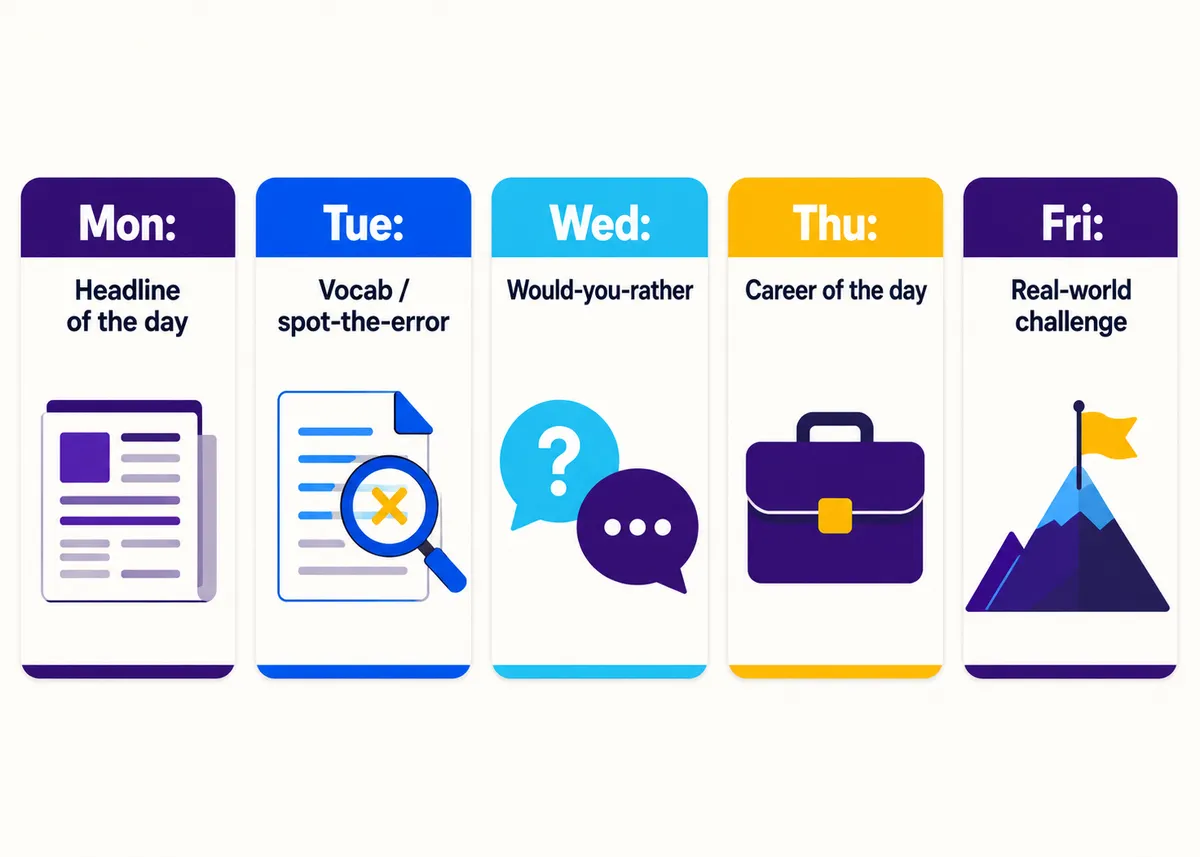
The fastest way to make bell ringers sustainable is to stop deciding what to do each morning. Assign a type to each day and let the rotation carry the load. Students learn the rhythm, and you stop reinventing the wheel at 7 a.m.
| Day | Warm-up type | Why it works here |
|---|---|---|
| Monday | Headline of the day | Eases the room back in; connects class to the weekend’s news |
| Tuesday | Vocabulary in context | Locks down terms from the prior week while they’re still fresh |
| Wednesday | Spot the error (code or budget) | Mid-week problem-solving rep when energy dips |
| Thursday | Would you rather / scenario | A decision to defend keeps Thursday from going flat |
| Friday | Career of the day or logic puzzle | A lighter, curiosity-driven close to the week |
Swap the slots to fit your course (a typing sprint fits any day in a tech class), but the value is in the predictability. Once students know Tuesday is vocabulary, they walk in ready, and you’ve reclaimed the planning energy you used to spend choosing.
How do you use bell ringers without losing 15 minutes?
The honest risk with warm-ups isn’t that they’re useless. It’s that a five-minute opener quietly grows into a fifteen-minute one, and your lesson pays for it. A few guardrails keep that from happening:
- Put a timer on the board. Set it for four minutes and let it run where everyone can see it. The clock does the classroom management for you.
- Have it ready before they arrive. The prompt is on the board when students walk in, so the warm-up starts without you. If you’re still setting it up, it’s already eating into class.
- Review fast, or don’t review at all. Spend ninety seconds on a quick share, or just collect a few and move on. Not every bell ringer needs a full debrief.
- Use one notebook or one slide. Keep all warm-ups in a single running doc or section so there’s no paper to hand out and nothing to lose. Setup time drops to zero.
- Let it run itself by October. Once the routine is trained, students start before the bell finishes ringing. That’s the goal: a warm-up that costs you almost nothing and buys you a settled, working room.
A few FAQs
Should bell ringers be graded? Lightly or not at all. A completion check or an occasional spot-grade keeps students honest without turning a warm-up into a high-stakes task. The reasoning rep is the reward.
How long should a CTE bell ringer take? Four to six minutes, start to finish, including a quick review. If it regularly runs longer, it’s a lesson, not a warm-up.
Where do I find headlines fast? Keep two or three reliable sources bookmarked (a business news site, a tech news site) and pull one headline the night before, or grab one in the hallway between classes. You only need the headline, not the article.
What’s the difference between a bell ringer and a warm-up? In practice they’re the same thing: a short, low-stakes opener students start as soon as they walk in. Some teachers reserve “bell ringer” for the very first task before attendance and “warm-up” for a slightly longer lead-in, but the goal is identical: get the room thinking fast.
Can I use the same bell ringers in a business class and a tech class? Mostly yes, with a swap of content. The formats (headline of the day, spot the error, “what would a professional do”) carry across both; you change the scenario from a budget to a buggy line of code. If you need the same idea for a day you’re out, the openers above also feed straight into CTE emergency sub plans.
Where to go next
If you want the bigger picture on how openers fit into a strong CTE lesson, head up to How to Teach CTE. For the days when you’re out and need the class to run itself, CTE Emergency Sub Plans leans on these same low-prep ideas. And if you’re just getting started, the First-Year CTE Teacher Guide walks through building routines like this one from scratch.
The bell ringer pack in the Free Library is ready to go on the board tomorrow morning. And when you want the rest of the hour handled too, the editable business and technology curriculum has a full year of warm-ups, lessons, and projects already built, whether you teach Personal Finance or AP® Cybersecurity.