


I came into teaching from industry, not from an education degree. I’d spent years in business and finance, earned an MBA, and designed curriculum at Pearson before I reached my own classroom through Florida’s alternative-cert route (the Educator Preparation Institute) while interning at Florida Virtual School. The job handed me computer science and digital business foundations, and the honest truth of that first stretch is that nobody had taught me how to teach. I knew the content cold. I did not know how to run a room.
If that’s you right now (you know your field, you just got handed a roster, and the gap between “I can do this work” and “I can teach thirty teenagers to do this work” feels like a canyon), this guide is the map I wish someone had handed me. It’s not about your subject. It’s about surviving the part nobody warned you about.
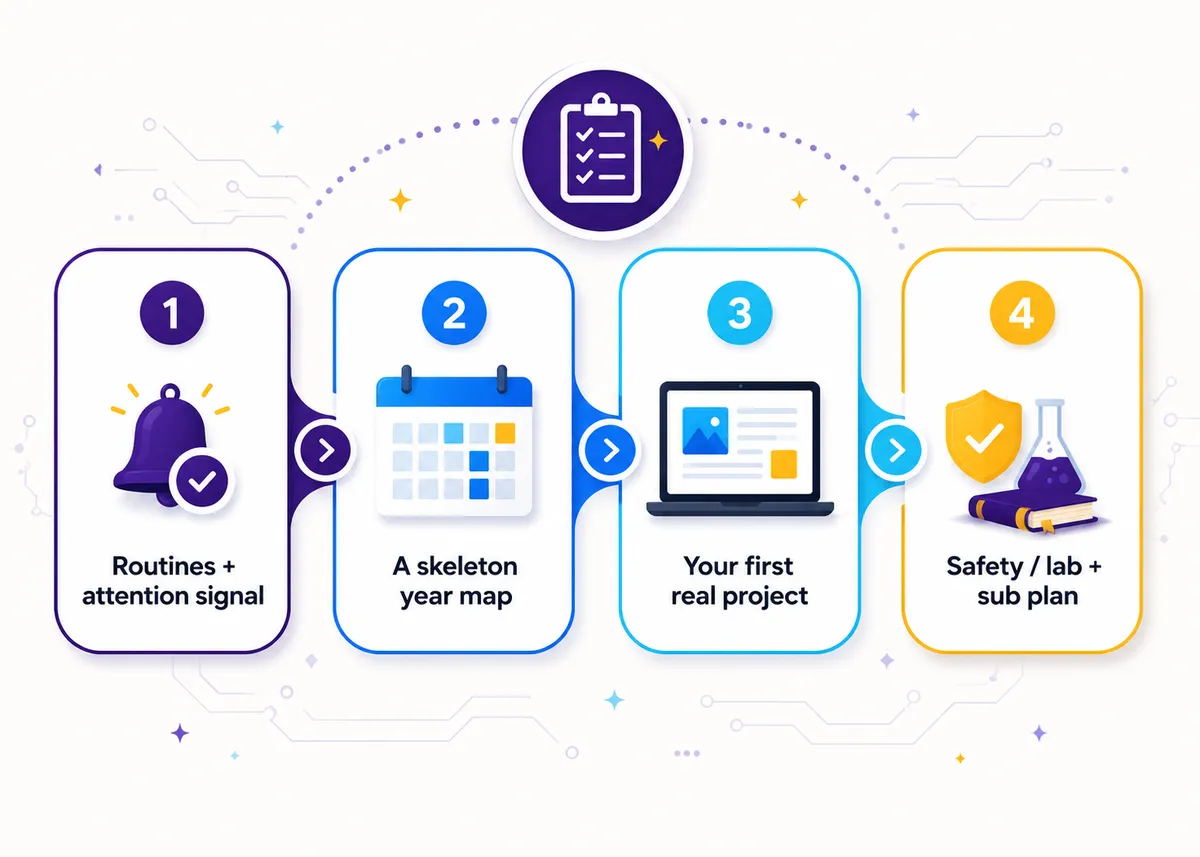
The short version: Most CTE teachers come straight from industry with no pedagogy training, and year one feels like drowning (classroom management, lab and equipment safety, and a tidal wave of paperwork). The fix isn’t working harder, it’s setting up a few load-bearing systems before day one: a couple of non-negotiable routines, a skeleton year map, one real first project, and a safety-and-sub plan you can hand off. Build those four things and the rest of the year has somewhere to stand.
What should a new CTE teacher do first?
Before you plan a single lesson, accept the thing that trips up every industry-to-classroom teacher: your expertise is not the hard part. You already cleared the bar most teachers spend years reaching, which is actually knowing the field. The hard part is everything around the content (getting thirty kids quiet, keeping a lab from becoming a hazard, surviving the forms), and none of that is in your wheelhouse yet. That’s normal. It’s not a sign you don’t belong.
So the first move is to stop trying to be a perfect teacher and start being a prepared one. Concretely, in your first week on the job (not your first week of school, the week you find out you’ve got the class):
- Find out what you’re actually teaching. Get the course standards or framework, the title on the master schedule, and any materials the last teacher left (even if they’re a closet full of outdated binders). You need the shape of the year before anything else.
- Find your people. The other CTE teacher down the hall, your department lead, your CTE coordinator. They know the equipment quirks, the kid you should seat near the door, and which form is due Friday. One good colleague is worth a hundred Pinterest boards.
- Walk the room. Count the devices, find the breaker, locate the fire extinguisher and eyewash if you’ve got a lab, and figure out what actually works. You cannot plan around equipment you haven’t laid hands on.
Do those three things and you’ve replaced panic with a to-do list. That alone changes the whole month.
How is teaching CTE different from an academic class?
This matters more than you’d think, because if you walk in expecting your class to behave like the history class you remember, you’ll plan the wrong things. CTE is its own animal, and the differences hit a first-year teacher in specific, practical ways.
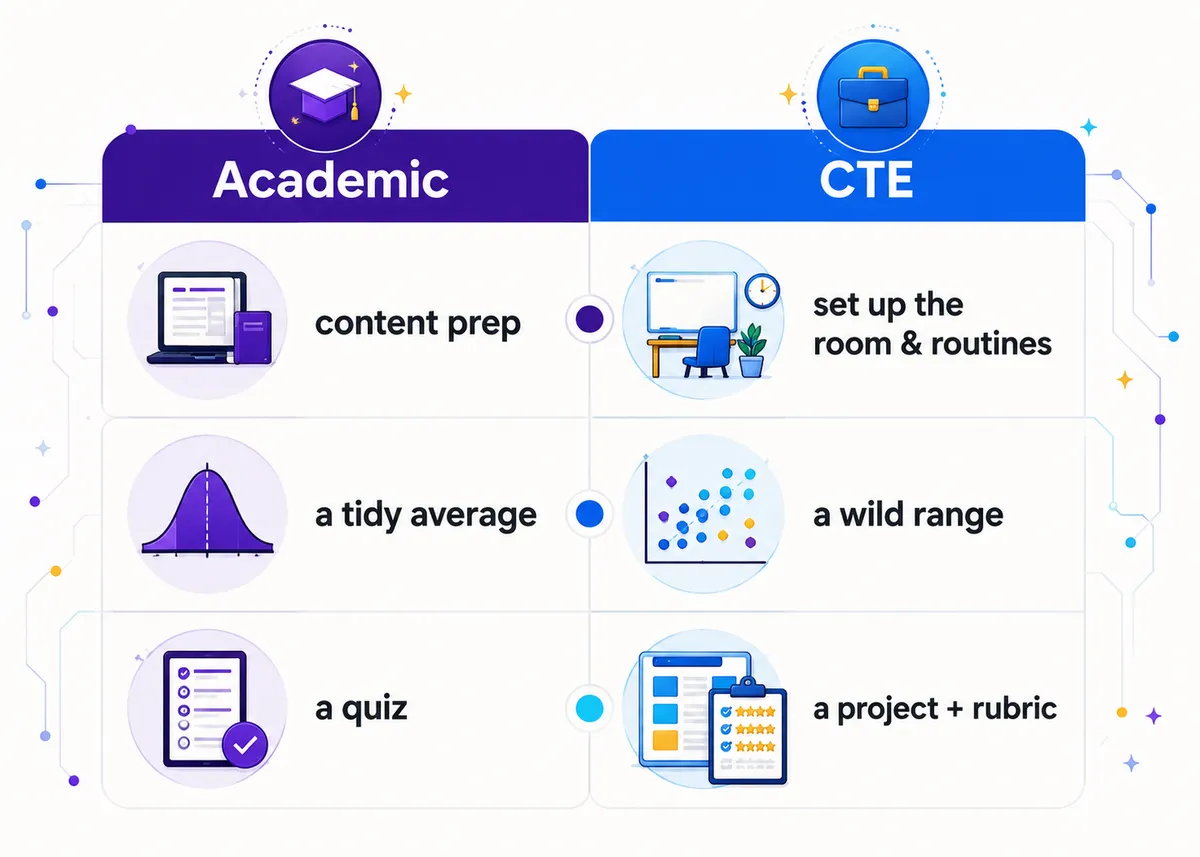
The goal is application, not recall. Your students don’t succeed by knowing things, they succeed by doing something with what they know (building the budget, hardening the network, pitching the venture). That changes how you plan every single day: you’re designing tasks, not just delivering content.
Your students arrive wildly uneven. There’s rarely a clean prerequisite chain, so you’ll get a senior who’s been building PCs since middle school sitting next to a sophomore who signed up because it fit their schedule. You plan for range, not for an average that doesn’t exist in your room.
The content moves, which means you’ll end up building and updating a lot of your own materials (tax law changes, platforms die, last year’s theoretical threat is this year’s headline). And in many CTE rooms there’s a lab, equipment, and real safety stakes that an English teacher never has to think about.
Here’s the contrast laid out, because seeing it side by side is what stops you from prepping like an academic teacher:
If you want the full picture of the CTE approach (and you should, it’s the foundation everything here sits on), How to Teach CTE is the umbrella guide this one lives under.
What do you set up before day one?
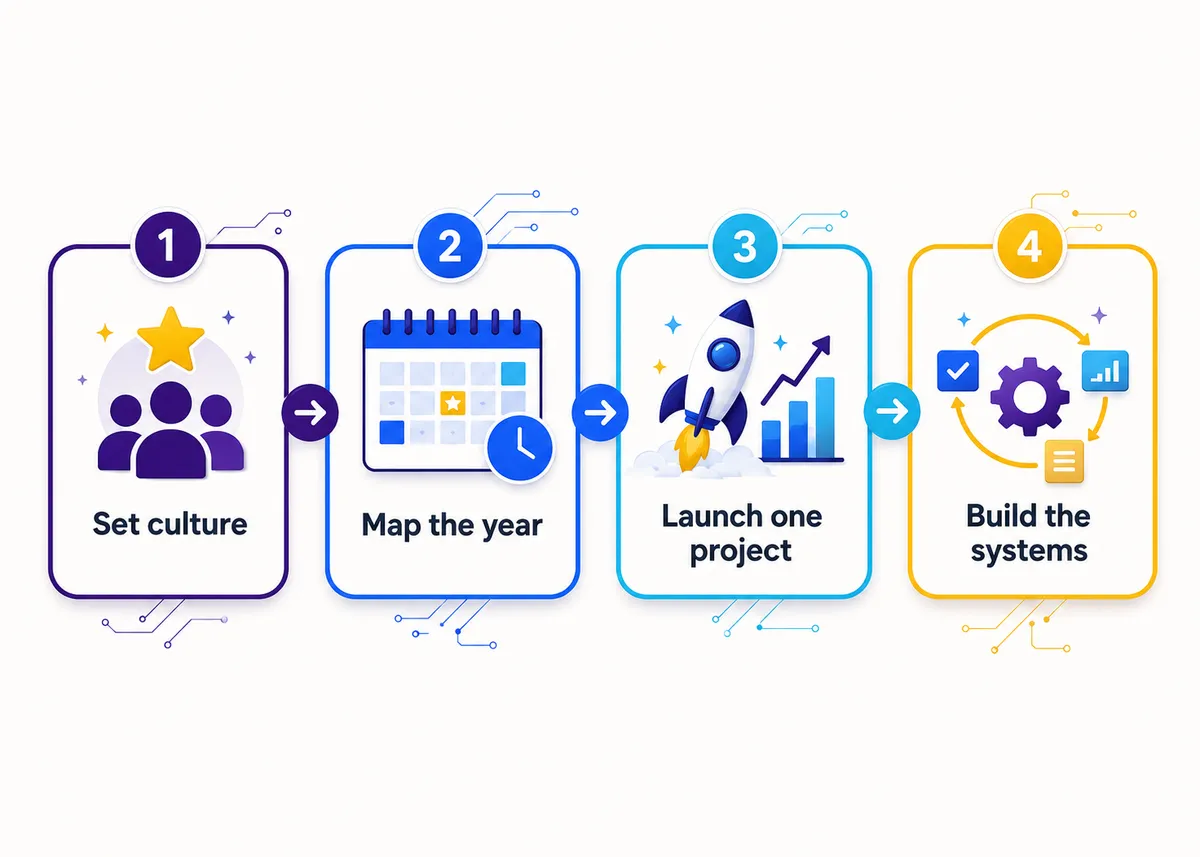
This is the heart of it. The teachers who survive year one aren’t the ones with the best lessons in September, they’re the ones who built a few load-bearing systems before students walked in. You can improve a mediocre lesson all year. You cannot retrofit classroom management in October once the room has decided what it can get away with.
Four things, in this order:
- Classroom routines and an attention signal. Decide exactly what students do when they walk in (a warm-up on the board), how you get the room silent (a screens-down signal you drill until it’s automatic, like “lids at 45, eyes up”), and how class ends (shut down, push in, line up). These bookends keep the middle calm. Set them day one and enforce them relentlessly the first two weeks.
- A skeleton year map. Not a daily plan, a unit-level skeleton: what the units are, roughly how long each runs, where the big projects land, and where you’ve left slack for the inevitable assembly and fire drill. This is the difference between Sunday-night panic and a plan you hang lessons on.
- Your first real project. Pick the one hands-on project you’ll run early, the one that signals “this is a class where we do things.” It doesn’t have to be your best one. It has to exist before the year starts so you’re not improvising relevance in week two.
- A safety/lab plan and a sub plan. If you have equipment, write the safety expectations and the lab routines now. And write one generic emergency sub plan you can leave on file, because you will be out sick and a scramble at 6 a.m. is the worst time to build one.
The diagram below lays out these four in the order you’d actually build them. For the openers themselves, our first-week activity guides for business and computer science give you day-one lessons you can run as-is, and CTE Bell Ringers and Warm-Ups stocks the entry routine for the rest of the year.
How do you manage a CTE classroom or lab?
Classroom management is the number-one thing that blindsides industry-to-classroom teachers, and a lab makes it harder, because the moment students touch keyboards or tools, half your attention-getting moves stop working. The good news: management in a CTE room is mostly systems, not charisma. A few routines prevent most problems.
- Get a fast, non-negotiable attention signal and drill it. You cannot teach over the glow of thirty monitors or the noise of thirty hands working. A screens-down or tools-down signal that the room executes in two seconds is worth more than any single great lesson.
- Use “ask three, then me.” Students check the resource, check a neighbor, and check the error before they raise a hand. It builds independence and keeps you from being pulled in twelve directions at once.
- Build entry and exit routines. What’s on screen (or on the bench) when students arrive, and how the room gets reset before the bell. The bookends keep the middle calm.
- Plan for fast finishers. The kids who race ahead need a real next step, or they’ll find their own entertainment. In a lab, extension challenges aren’t a luxury, they’re classroom management.
- Make safety a routine, not a lecture. If there’s equipment, the safety expectations get drilled the same way the attention signal does, until they’re automatic. A room that respects the equipment is a room that runs.
When you’re out (and you will be), a strong CTE emergency sub plan keeps a lab or project class from falling apart while you’re gone, which is its own kind of classroom management.
What if you came from industry with no pedagogy training?
Then you’re in the majority, and you’re going to be fine. A huge share of CTE teachers arrive exactly this way: deep in the field, brand new to teaching. The certification side of that varies by state (some let you start on a provisional certificate and finish the pedagogy requirements while you teach), so check your own state Department of Education for the specifics, and see How to Become a CTE Teacher for the full lay of the land.
But the daily reality is what you came here for, so here it is plainly. The pedagogy you’re missing is learnable, and most of it is just a handful of moves:
- Write objectives as something a student can do (“compare two financing options and justify a choice”), not something they’ll be “exposed to.” This one shift fixes half of bad lessons.
- Lead with a decision, not a definition. Start from something students have lived (a purchase they regret, an ad that worked on them) and pull the concept out of it. Relevance is your strongest tool and your industry background is full of it.
- Lower the cost of being wrong. Let students experiment, fail cheaply, and try again. Your field expertise lets you build realistic tasks, and the safe-to-fail loop does the teaching.
- Model not-knowing. When a student stumps you, narrate how you’d figure it out. That is the job in any technical field, and showing it is more valuable than pretending to know everything.
Your industry experience isn’t a deficit you’re working around. It’s the thing that makes your class real. The pedagogy is the part you layer on, and you can learn it a step ahead of your students.
How do you not drown in year one (workload)?
Let’s be honest about the part everyone whispers: year one is a lot. New preps, new systems, a flood of paperwork (rosters, IEP accommodations, CTE-specific reporting, CTSO forms if you’ve got one), and the constant low hum of feeling underprepared. The goal of year one is not to be excellent. It’s to survive intact and learn the room, so that year two can be good.
The single most useful reframe is “do vs. skip.” You cannot do everything, so decide on purpose what you’re letting go of:
- Do build the four before-day-one systems. Skip the Pinterest-perfect classroom decor.
- Do map the year at the unit level. Skip writing detailed daily plans for May in August (they’ll change anyway).
- Do reuse and adapt strong existing materials. Skip building every lesson from scratch to prove something. (Borrowing well is a skill, not a shortcut.)
- Do protect one project per unit that students actually care about. Skip trying to make every single day a showstopper.
- Do ask your colleagues for their stuff. Skip the guilt about it. Teachers share, and you’d do the same.
The teachers who burn out aren’t the ones who borrowed materials. They’re the ones who tried to handcraft a perfect year while also learning to manage a room, and ran out of road by October. Give yourself permission to start with a skeleton and a few good projects, and add the polish in year two.
Free resources to get you started
You do not have to build your first semester alone, and you definitely shouldn’t have to buy your way in just to test the waters. The Free Library has no-prep starting points (first-week activities and a pacing planner among them) that work across business and tech classes, so you can walk in on day one with something solid instead of a blank page. Grab what’s useful, see if the style fits how you teach, and build from there.

Want year one already planned? Browse editable, full-year business and technology curriculum: the year map, the projects, and the daily lessons, already assembled for courses like Personal Finance and AP® Computer Science Principles. It’s built for the industry hire who knows the content cold and needs the teaching part handled.
Frequently asked questions
What should a first-year CTE teacher do first? Before planning lessons, find out exactly what you’re teaching (standards and materials), find a colleague who knows the program, and walk your room to inventory the equipment and safety setup. Replace panic with a to-do list, then build your before-day-one systems.
How is teaching CTE different from a regular class? The goal is application, not recall, so you design tasks rather than just deliver content. Students arrive at wildly mixed skill levels in one room, the content changes constantly, and many CTE rooms add a lab with real safety stakes that an academic class never has.
What do you set up before the first day of a CTE class? Four things, in order: classroom routines and a fast attention signal, a unit-level skeleton year map, one real first project, and a safety/lab plan plus a generic emergency sub plan. Systems before lessons.
Can you teach CTE with no education degree or pedagogy training? Yes, and most CTE teachers start exactly there. Certification rules vary by state (many let you start on a provisional certificate and finish requirements while teaching), so check your state Department of Education. The core teaching moves are learnable a step ahead of your students. (See How to Become a CTE Teacher.)
How do you manage a CTE lab as a new teacher? Drill a two-second attention signal, use “ask three then me,” build entry and exit routines, plan extension work for fast finishers, and make safety a drilled routine rather than a one-time lecture. Management in a lab is systems, not charisma.
How do you avoid burning out in your first year of teaching? Decide on purpose what to skip. Build the load-bearing systems, map the year at the unit level, reuse strong materials without guilt, and aim to survive and learn the room rather than be perfect. Year one is for getting good footing; year two is for getting good.