
Work-based learning is the part of CTE that everyone wants and almost nobody has time to set up, because the word “internship” makes it sound like a logistics project with permission slips and liability forms attached. Some of it is. Most of it isn’t. The trick is to stop picturing WBL as one big intimidating thing and start picturing it as a ladder, where the bottom rung is a guest speaker you email this week and the top rung is a registered apprenticeship you build over a year.
This is the menu, ordered from easiest to hardest. Pick the rung you can actually reach right now, run it, and climb when you’re ready. None of it requires a fully built industry network on day one (more on that below).
What is work-based learning (and why does it matter for CTE)?
Work-based learning is any structured experience that connects classroom learning to a real workplace or a real workplace task. That covers a wide range: a professional talking to your class, a student shadowing someone for a morning, a class doing real work for a real client, a paid internship. What makes it “work-based” is the connection to actual work, not the size of the commitment.
It matters for two reasons. The practical one: WBL is where the skills you teach finally meet a real context, which is the whole point of CTE. The funding one: Perkins V (the federal law that funds a lot of CTE) names work-based learning as a priority, and many states track WBL participation as a program-quality measure. The WBL you run often counts toward the metrics your program gets judged on, so it’s worth doing even at the low-lift end.
One caveat that runs through this whole guide: the compliance rules (labor laws for minors, liability, transportation, paid-versus-unpaid, required hours) vary a lot by district and state. Treat everything here as the idea, and check your own WBL coordinator or state CTE office before anything leaves the building.
Low-lift WBL you can start now
These are the rungs you can reach this semester without a single field trip. Start here, especially in year one.
- Guest speakers. The lowest-lift WBL there is: email one professional in your field and ask them to talk to your class for twenty minutes about what they actually do all day. Give them three questions ahead of time so they aren’t winging it, and have students prepare one question each so it isn’t a monologue.
- Industry mentors. A step up in commitment, not difficulty: pair a willing professional with a student or small group to check in a few times across a project. The mentor doesn’t run anything; they just react to student work the way a real client or boss would. One good email seeds a whole semester of feedback you didn’t have to give yourself.
- Virtual job shadows. Plenty of organizations and career sites host recorded “day in the life” videos and virtual tours. Assign one, then have students write what surprised them and what the job actually requires. It’s a job shadow with zero transportation and zero permission slips.
- Informational interviews. Students reach out to one person in a field they’re curious about and hold a short, real conversation about how they got there and what the work is like. It builds the outreach email, the prepared questions, and the thank-you all at once. (It doubles as a networking activity, so it shows up in the career readiness activities guide too.)
- Real client projects. Instead of a hypothetical assignment, have students do real work for a real, low-stakes client: a logo for the booster club, a budget for a school event, a simple site for a local nonprofit. The client doesn’t have to pay or even be off-campus. They just have to be real, because a real audience changes how much the work matters.
The common thread: every one of these brings a real workplace or task into the room without sending a student out of it. That’s why they’re the right place to start.
Bigger WBL (job shadows, enterprises, internships, apprenticeships)
When you’ve got a relationship or two and some appetite for logistics, these are the next rungs. They take more setup and almost always more paperwork, so loop in your WBL coordinator early.
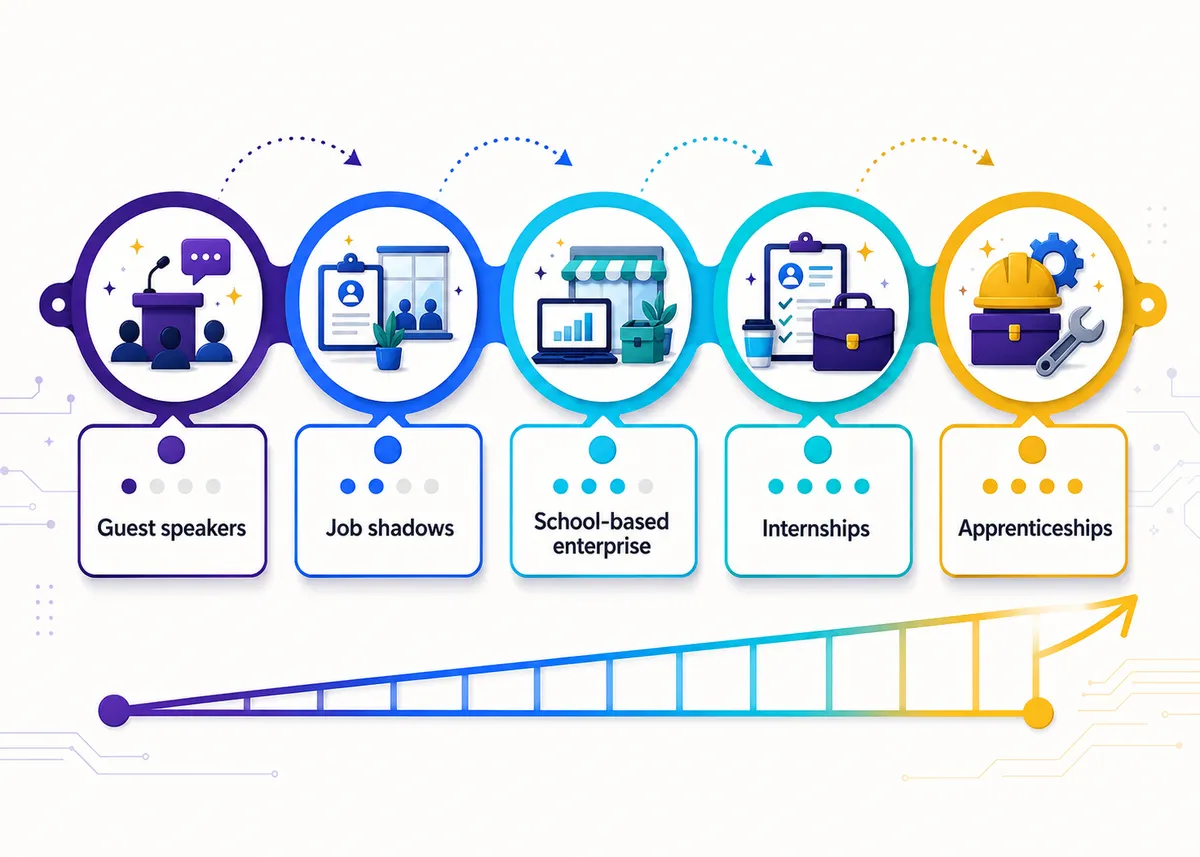
- Job shadows. A student spends part of a day with a professional, watching the work up close. The lift is mostly logistics: transportation, a release form, and a host willing to be shadowed. Keep the first one short (a morning), and give students an observation sheet so they come back with more than “it was cool.”
- School-based enterprises. A student-run business or service that operates inside the school: the coffee cart, the print shop, the design studio that takes real orders. It’s WBL that comes to you, which makes it one of the most sustainable options once it’s built, because the “workplace” lives down the hall.
- Internships. A student works in a real workplace for a stretch of time, paid or unpaid depending on your rules. This is where compliance gets real (minor labor laws, hours, supervision, agreements), so it’s genuinely a coordinator-level project. High value, high lift.
- Apprenticeships. The top rung: a structured, usually paid program that combines real employment with related instruction, often registered with your state or the Department of Labor. These are multi-partner, multi-month builds and almost never a solo-teacher project. If you’re headed here, you’re building a program, not running an activity.
| WBL option | Lift | Leaves the building? |
|---|---|---|
| Guest speaker | Low | No |
| Virtual job shadow | Low | No |
| Real client project | Low to medium | Usually no |
| In-person job shadow | Medium | Yes |
| School-based enterprise | Medium (to build) | No |
| Internship | High | Yes |
| Apprenticeship | Highest | Yes |
How do you start WBL without an industry network?
This is the real blocker for most teachers, and the honest answer is that nobody starts with a network. You build one, one email at a time, faster than you’d think. A few ways in:
- Mine the room you already have. Students’ parents, your own friends, the school’s alumni, the local chamber of commerce, the businesses that already sponsor the football team. Your first ten contacts are almost always one degree away.
- Start with the ask that costs nothing. “Would you talk to my class for twenty minutes” is an easy yes, and a speaker who has a good time is your warmest lead for the next mentor, shadow, or client project. Low-lift WBL is how you grow the network that makes high-lift WBL possible.
- Use your coordinator and advisory committee. Many CTE programs have a WBL coordinator or an industry advisory board whose job includes these connections. If yours doesn’t, your state CTE office often maintains employer-partner lists.
- Say thank you and stay in touch. The professional who enjoyed visiting is a relationship, not a one-off. A short thank-you and a “we’d love to have you back” turns one favor into an ongoing partner.
How do you make classroom projects more “work-based”?
You don’t always need an outside partner to move toward WBL. You can make the projects you already run feel more like real work by borrowing the conditions of a real job:
- Add a real client or audience. Even an internal one (another teacher, a school club, the front office) changes the stakes. Work nobody will see is homework; work someone will actually use is a job.
- Add real constraints. A budget, a deadline, a brief that can’t be ignored, a client who wants what they want. Constraints are what separate a project from a poster, and they’re exactly how the real version works.
- Add a defend-your-decision moment. End the project with the student justifying their choices to someone, the way a professional defends a recommendation. This is also where it becomes gradeable as reasoning, which is the same logic behind how to assess CTE skills.
- Add real roles. Run a stretch of class as a workplace, with students holding jobs, projects carrying deadlines, and check-ins on the calendar. It turns the soft skills into the mechanics of the room instead of a side lesson.
This is the bridge rung between a normal CTE project and true WBL, and it’s available to every teacher regardless of network or budget. For the wider view of how projects and career skills fit together, how to teach CTE is the overview.
Frequently asked questions
What is the easiest work-based learning to start with? Guest speakers. One email to a professional in your field, three questions sent ahead, and twenty minutes of class time. A speaker who enjoys it becomes your warmest lead for bigger experiences later.
Do I need an industry network to run work-based learning? No. Almost nobody starts with one. You build it one email at a time, usually starting with parents, alumni, and local businesses already connected to the school, and low-lift WBL like guest speakers is how that network grows.
What are the compliance rules for high school internships? They vary a lot by district and state (minor labor laws, hours, supervision, paid-versus-unpaid, liability). This guide stays general on purpose. Always check your WBL coordinator or state CTE office before a student does work off-campus.
What counts as work-based learning? Any structured experience that connects classroom learning to a real workplace or a real workplace task. A guest speaker, a virtual job shadow, a real client project, and a paid internship all count. What makes it work-based is the link to actual work, not the size of the commitment.
What is a school-based enterprise? A student-run business or service that operates inside the school, like a coffee cart, a print shop, or a design studio taking real orders. It is one of the most sustainable options because the workplace lives down the hall, so it brings WBL to you instead of sending students out.
How can I make a regular class project count as work-based learning? Borrow the conditions of a real job: add a real client or audience, real constraints (a budget, a deadline, a brief), and a defend-your-decision moment where the student justifies their choices. That last step also makes the work gradeable as reasoning, which is the same logic behind how to assess CTE skills.
Where to go next
You don’t have to build the speaker request, the shadow observation sheet, and the client-project brief from scratch. The Free Library has no-prep WBL starting points, like the work-based learning starter set, that drop into a business or tech class, so you can test a rung of this ladder without a weekend of prep.
Want the work-based pieces built in? Browse editable, full-year business, technology, and AP Career Kickstart curriculum, built around the same conditions this guide borrows from real work: client briefs, constraints, and a defend-your-decision moment. The AP Career Kickstart courses, AP® Business with Personal Finance and AP® Cybersecurity, lean hardest on simulated work experiences, a natural fit for the early rungs of this ladder.
AP® is a trademark registered by the College Board, which is not affiliated with, and does not endorse, this product.