Digital Citizenship Unit Bundle
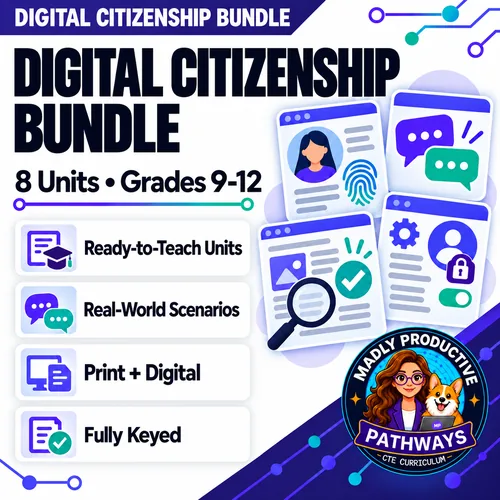
Eight no-prep high school digital citizenship units in one download: digital footprint, social media, cyberbullying, media literacy, online communication, screen time, chatbots and password security.
$50View bundle
Seven standalone units, three or four days each, on what students actually do online: what a digital footprint is and who put it there, how a feed and a free app work, cyberbullying and digital drama, checking a claim before sharing it, saying what you meant in a message, what screen time takes from a day, and how to use an artificial intelligence chatbot well. Every day is one bell ringer, one deck, one activity and one exit ticket, timed to a 45-minute period, with a key for every page. Take one unit, or the bundle.
Several units in one purchase, for less than buying them separately.
Eight no-prep high school digital citizenship units in one download: digital footprint, social media, cyberbullying, media literacy, online communication, screen time, chatbots and password security.
Most digital citizenship material is a pledge, a poster, or a worksheet of definitions, and students have seen all three since sixth grade. These units start from a situation and get to the rule second. The digital footprint unit opens on a runner who searches her own name after posting a photo of her shoes and finds that almost none of the results came from her. The media literacy unit hands students a post and makes them say its claim in their own words before they are allowed to check anything.
What students leave with is short enough to keep. Cyberbullying needs all three of unwanted, repeated, and a power imbalance, or a different name fits. You have three choices before you share something, not two. Deleting only works on what's yours. Each one is the point of a day, and the activity that follows makes students use it on cases they have not seen.
Almost nobody teaches a digital citizenship course. This gets taught in advisory, in health, in a computer science or technology elective, in the CTE course where the schedule left a gap, and during Digital Citizenship Week. So the units assume nothing: no prerequisite, no lab, no student accounts, no logins, and no background in the subject for the teacher. Print the guided notes, open the deck, run the activity, collect the exit ticket.
Because each one is three or four days rather than a semester, you can take exactly the one your building is asking for — the online safety worksheets week after a phone policy changes, the cyberbullying unit a counselor asked for, the chatbot unit the week your school's AI policy lands — and teach the rest later, in any order. No unit depends on a unit before it.
Every day is the same shape, so you learn the layout once and it holds all year: a bell ringer, an editable deck whose speaker notes tell you what to say, guided notes in Word and PDF, a hands-on activity, and an exit ticket. A 3-day unit runs 36 slides and a 30-term glossary; a 4-day unit runs about 48 to 52 slides and 40 terms. Every unit ends with a quiz worth 23 to 28 points and ships four or five self-grading Google Forms, so the exit tickets and the quiz exist as paper and as digital versions of the same assignment.
Every page has a key, and every written item's key gives a sample answer and says when to give the point — nothing in this line says "answers will vary." Each unit also ships a Standards and Skills Map. These are general-education digital literacy units, so they map onto reading, writing and speaking standards, ISTE, and the National Health Education Standards rather than a computer science framework, and each map comes with a page for converting it to your state's wording.
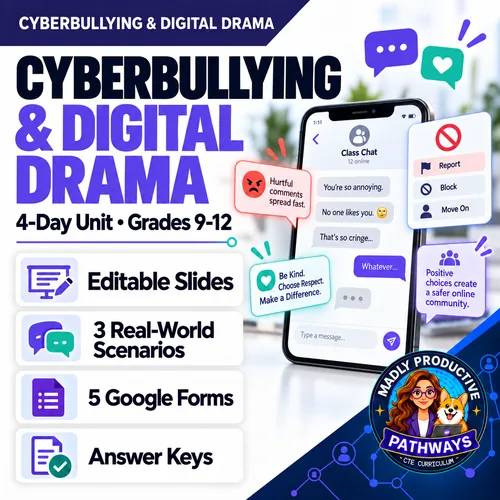
Every person, school, post and message in these units is made up. No task asks a student to share their own experience, and no page blames a student for being online. The cyberbullying unit never ends a story in self-harm and never presents bullying as a cause of suicide; its safety page names a crisis line and the people in your building instead of asking a teacher to judge whether a student is at risk.
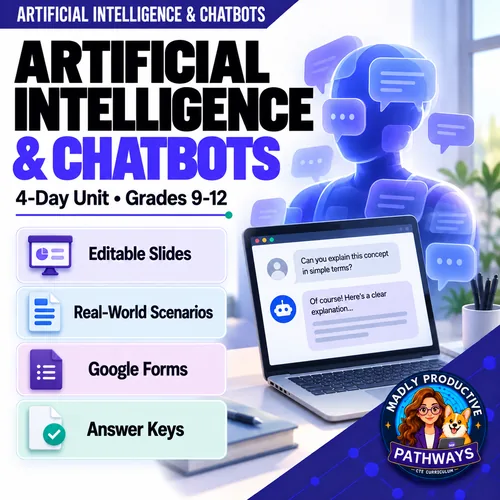
The same restraint runs through the claims. The screen time unit sets no target number of hours and asks no student to report their own use, and its third day teaches students to read what the research can and cannot settle rather than handing down a verdict. The chatbot unit is the opposite of a don't-use-it talk: refusing a legitimate use costs points on every activity in it, and it teaches which step of an assignment is the student's own, what not to type into a chatbot, and which questions belong with a person.
The bundle is these seven units plus one more: Passwords and Account Security, a 3-day unit that belongs to both lines and ships in both. That is where its totals come from — 8 units, 27 teaching days, 279 files, 270 glossary terms and 35 self-grading Google Forms — so the count includes a unit whose own product page sits under cybersecurity rather than here. You buy it once, inside whichever bundle you are taking.
The two shelves split cleanly. Digital citizenship is about how a person behaves online and what they leave behind. The cybersecurity units are about how the attacks and fakes aimed at them work: phishing and social engineering, deepfakes and AI scams, malware. Passwords sits on the seam between the two, which is why it counts in both.
Three or four days each, taught on their own in any order. No lab, no student accounts, no prerequisite, and no background in the subject needed to run one.
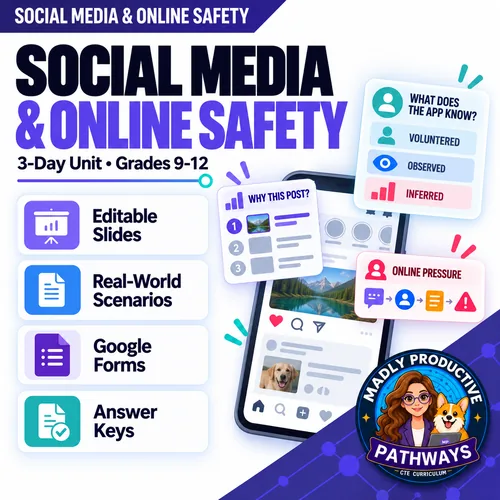
Every course opens with a complete free lesson: the real slides, notes, and activity, not a preview.
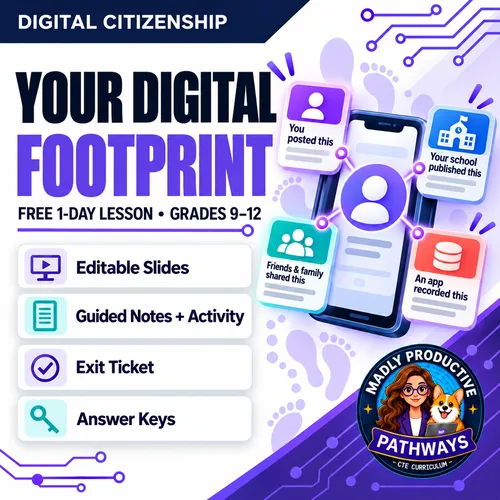
A free one-day high school digital citizenship lesson on what is really online about you and who put it there: editable slides, guided notes, an activity, an exit ticket and every answer key.