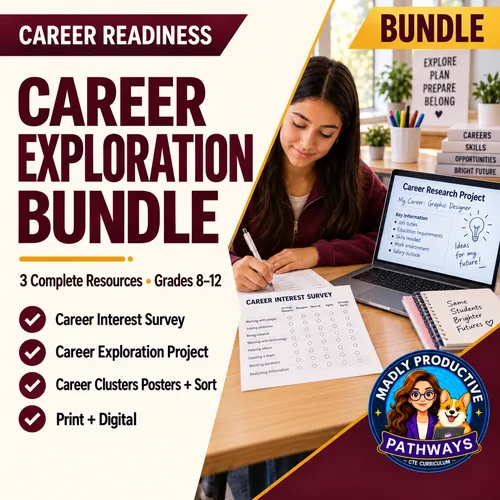
Career Exploration Bundle
$25
One line, two halves. Career exploration comes first, for students who do not yet have an answer to what job they even want: an interest survey that scores itself in one class period, the career clusters, and a research project they cannot fake. Then six standalone weeks on going and getting the job — resumes, cover letters, interviewing, soft skills, workplace professionalism, and professional email. Everything is editable and print-ready, with an original case study or project, an assessment, and every answer key. Take a bundle, the resume and cover letter pair, or one week when that is the gap in your course.
Several units in one purchase, for less than buying them separately.
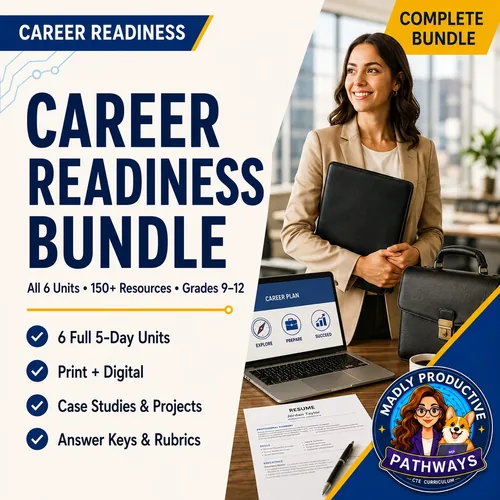
This content sits under a different name in almost every state. Virginia and the CTECS states assess Workplace Readiness Skills, Nevada runs Employability Skills for Career Readiness, and plenty of districts simply call it employability, professionalism, or work-based learning. The units are built against the Employability Skills Framework rather than one state's list, and each one ships a Standards & Skills Map with a page for converting it to your state's wording, so the crosswalk is a fill-in rather than a rewrite.
That also means these drop into more than a career-readiness course. Teachers use them in CTE completer courses, senior seminar, advisory, work-based learning, and the weeks before an internship or a co-op placement starts.
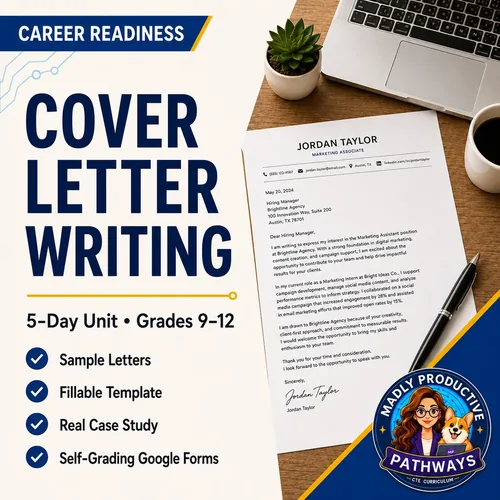
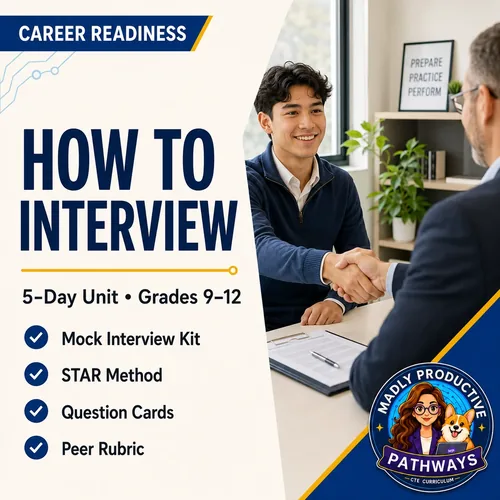
Most career-readiness material is a vocabulary sheet and a blank template. Every professionalism unit here turns on an original case study students have to diagnose: a resume that fails the six-second scan, two cover letters for the same posting, two finalists who interviewed very differently, a strong hire who stumbles through week one. Students work out what went wrong, then build their own version and have it reviewed against real criteria.
So the week ends with something that exists. A resume they could send. A tailored cover letter. A mock interview with a peer rubric and a follow-up note. A professionalism plan they wrote themselves.
The exploration half is built the same way. Students finish the interest survey holding a scored interest code and the career clusters it points to, and they finish the research project holding a career profile they had to source — a real current job posting and a real program of study among them, each one logged with its publisher, link, and date.
The alternatives in this space are mostly annual platform licenses: a seat fee per student, renewed every year, and gone the moment the budget is cut. These are files. You buy a unit or the bundle once, download it, and keep it, including the editable source documents. Nothing expires and nothing phones home.
That matters for a subject often taught by whoever has the section this year. The Read-First guide and the day-by-day plan mean a teacher who has never taught career readiness can pick up a unit and run it on about ten minutes of prep.
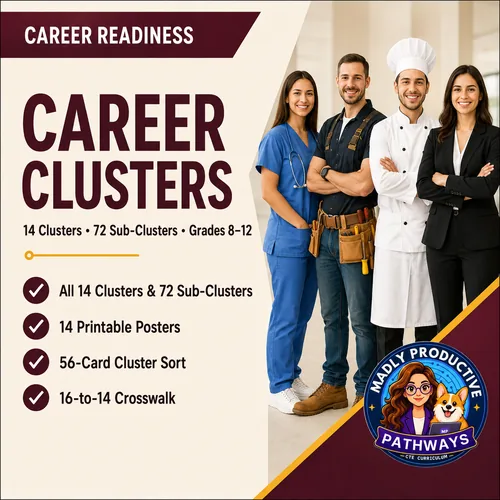
A resume unit quietly assumes a student already knows what job they are applying for. Plenty of them do not, and a blank template is a miserable place to find that out. The exploration half handles that step first: a career interest survey that runs in one class period and scores itself on paper, a career clusters unit built on the modernized 14-cluster framework with printable posters and a card sort, and a career research project that runs five days or stretches to two weeks.
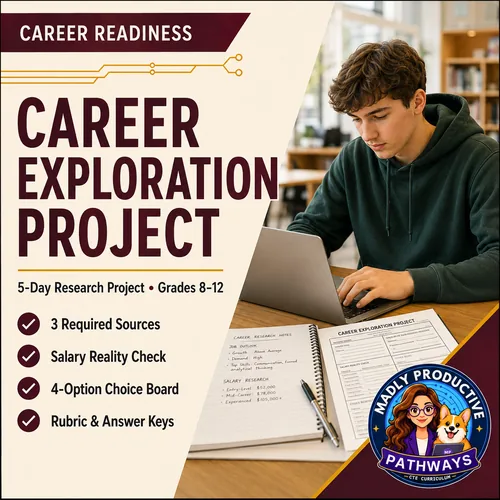
The research project is the one that stops a copy-and-paste career report. Students have to cite a real current job posting and a real program of study alongside the Bureau of Labor Statistics handbook, log every source, and reconcile the salary they assumed with the median and the entry-level figure. The three products sell as their own bundle and run in order, because the survey ends by naming a career cluster and the other two take that cluster somewhere.
This half is deliberately pitched a grade lower, Grades 8 to 12, because career exploration lands in middle school advisory and freshman seminar at least as often as it lands in a CTE completer course. The six professionalism units stay Grades 9 to 12.
The two halves are siblings, not a bundle inside a bundle, and the order between them is the obvious one: exploration answers what job a student wants, and the six professionalism weeks are how they go and get it. That is about eleven days for the exploration arc and six weeks for the rest, so one semester holds the whole line without hurrying.
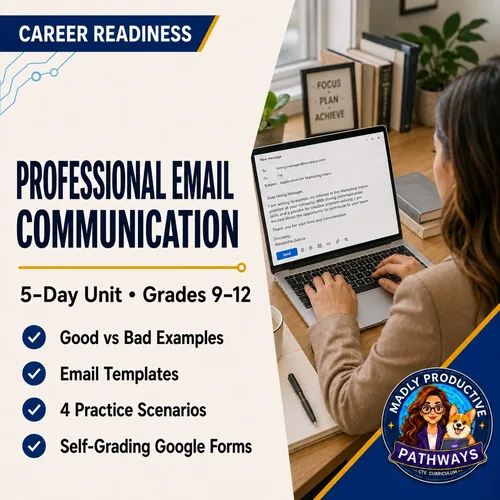
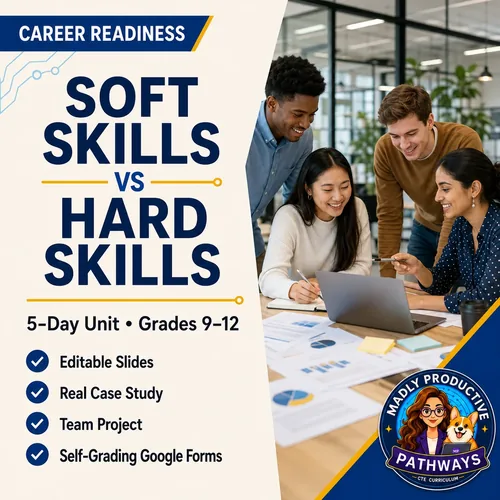
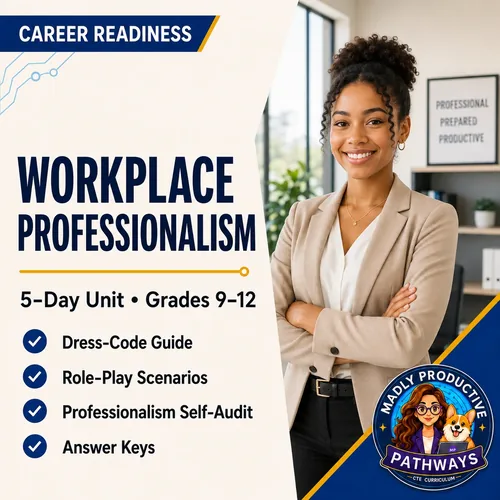
Inside the professionalism half, the order the bundle uses is deliberate: soft skills first to set what employers actually value, then resume and cover letter while students have that language fresh, then interviewing, then professionalism and email for what happens after they are hired.
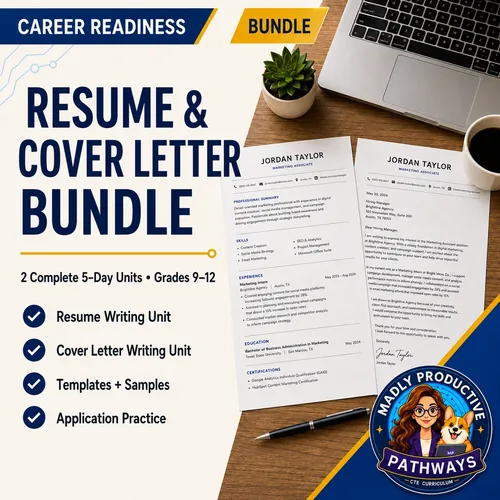
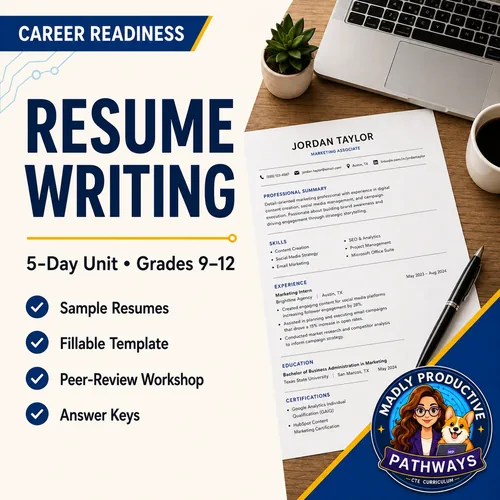
If you only have room for two weeks, take resume and cover letter together, because they share a case-study spine and students leave with both documents finished. That pair is sold as its own bundle for exactly that reason.
One standalone week at a time: a full 5-day unit with its own case study, project, assessment and keys.
Shorter than a unit: one class period, with the same teacher guide, editable slides, print-ready pages, and self-grading Google Forms.
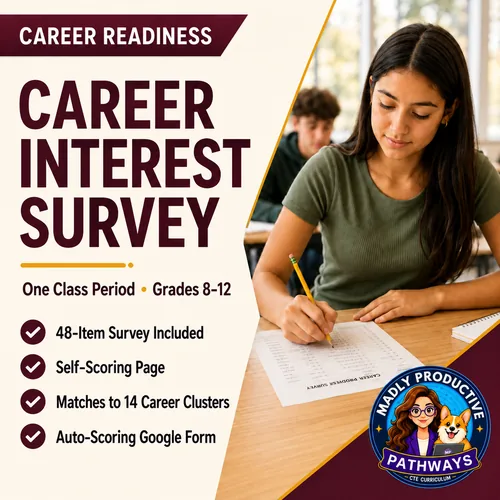
A 48-item career interest survey students take and score themselves in one class period, grades 8-12.