
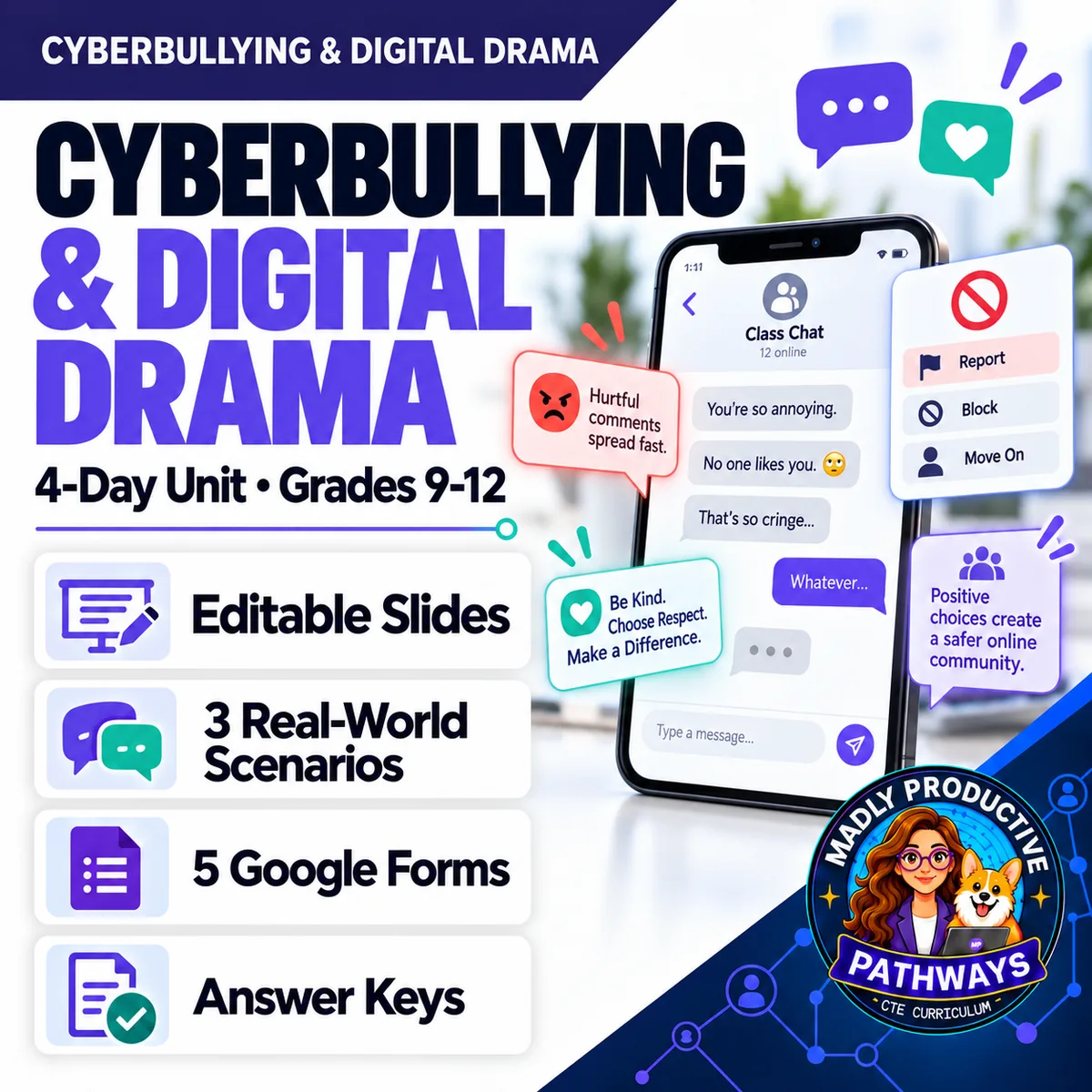
Cyberbullying & Digital Drama
 Digital Citizenship Grades 9–12 4-day unit 40 deliverables
 Most lessons on this stop at be kind online, which leaves students with nothing to say when a post is cruel but is not bullying. Four complete days that give them three names and a test for each one, then the steps that fit what they named. Written for a general-education class and ready to print.
● Instant download · Lifetime access · Editable & print-ready
 Editable formatsPowerPoint, Word, PDF & Google
 Every page keyedNothing says “answers will vary”
 Self-grading formsThe quiz and all 4 exit tickets
 No background neededPrint it and teach it
What does this unit cover?
Four days that start by naming the thing. Day 1 gives students three names and a separate test for each: digital drama is an online fight between evenly matched people, cyberbullying needs all three of unwanted, repeated and a power imbalance, and hate speech attacks people for a group they belong to. It also allows a fourth answer most lessons never do — not enough information — so students learn to name the one question they would need answered instead of guessing.
Day 2 explains why cruelty is easier online through three dials — anonymity, lag, missing cues — and immediately draws the line the explanation invites: an explanation says why something was easier, an excuse says it was not your fault, and the person who posted it is still responsible. Day 3 is the civics day, and it is unusually precise for a high school unit: a public school is part of the government, so it cannot punish an opinion, but it can act on conduct, even when the post was made at home. There is no exact rule for off-campus posts, so students draw their own line on a grid and compare it with a partner's.
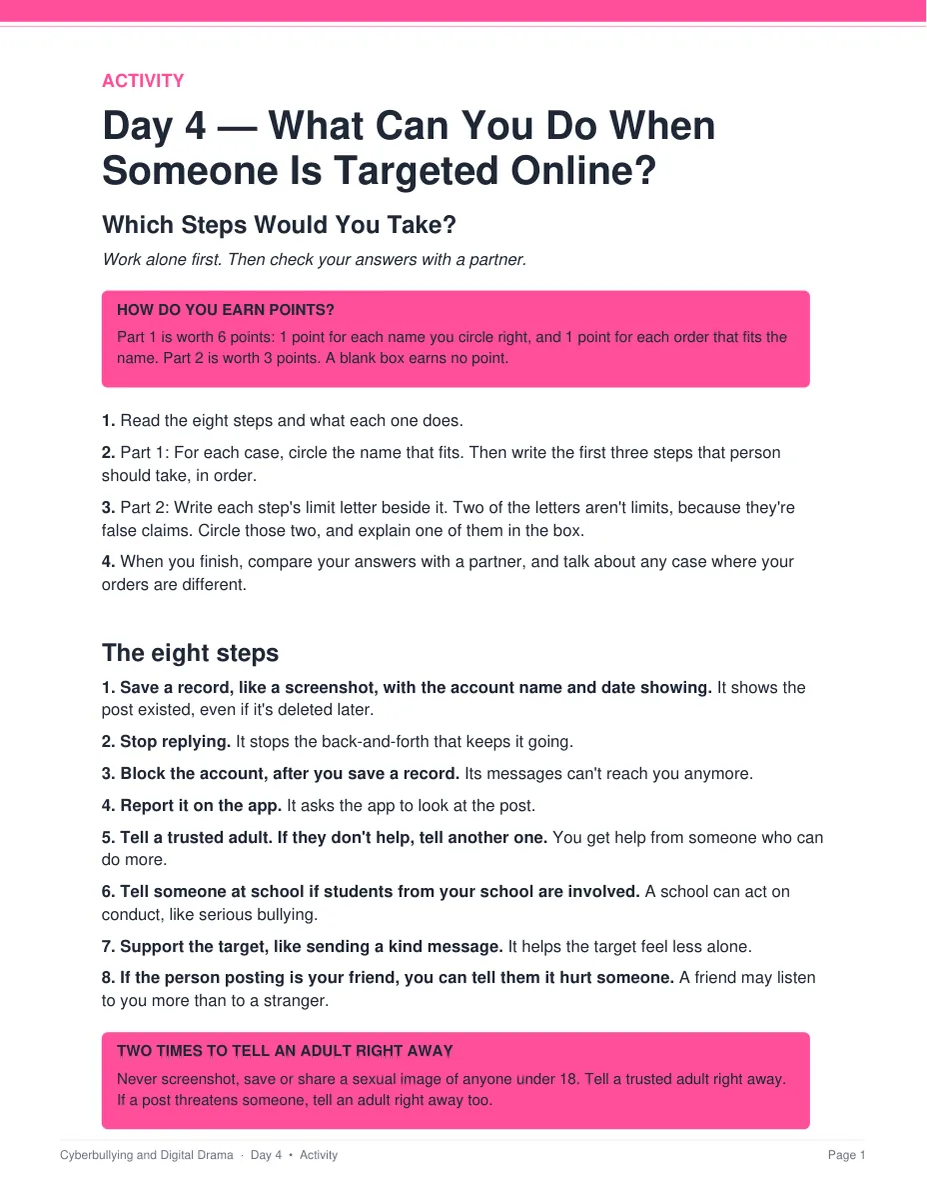
Day 4 is what to do. Eight steps, starting with saving a record, and every step paired with its limit — what it cannot do. Everything follows the same open-and-teach folders as the rest of the line: 00 Start Here / 01 Present / 02 Student Handouts / 03 Scenarios / 04 Activities / 05 Assessment / 06 Answer Keys, and every student page uses short, complete sentences.
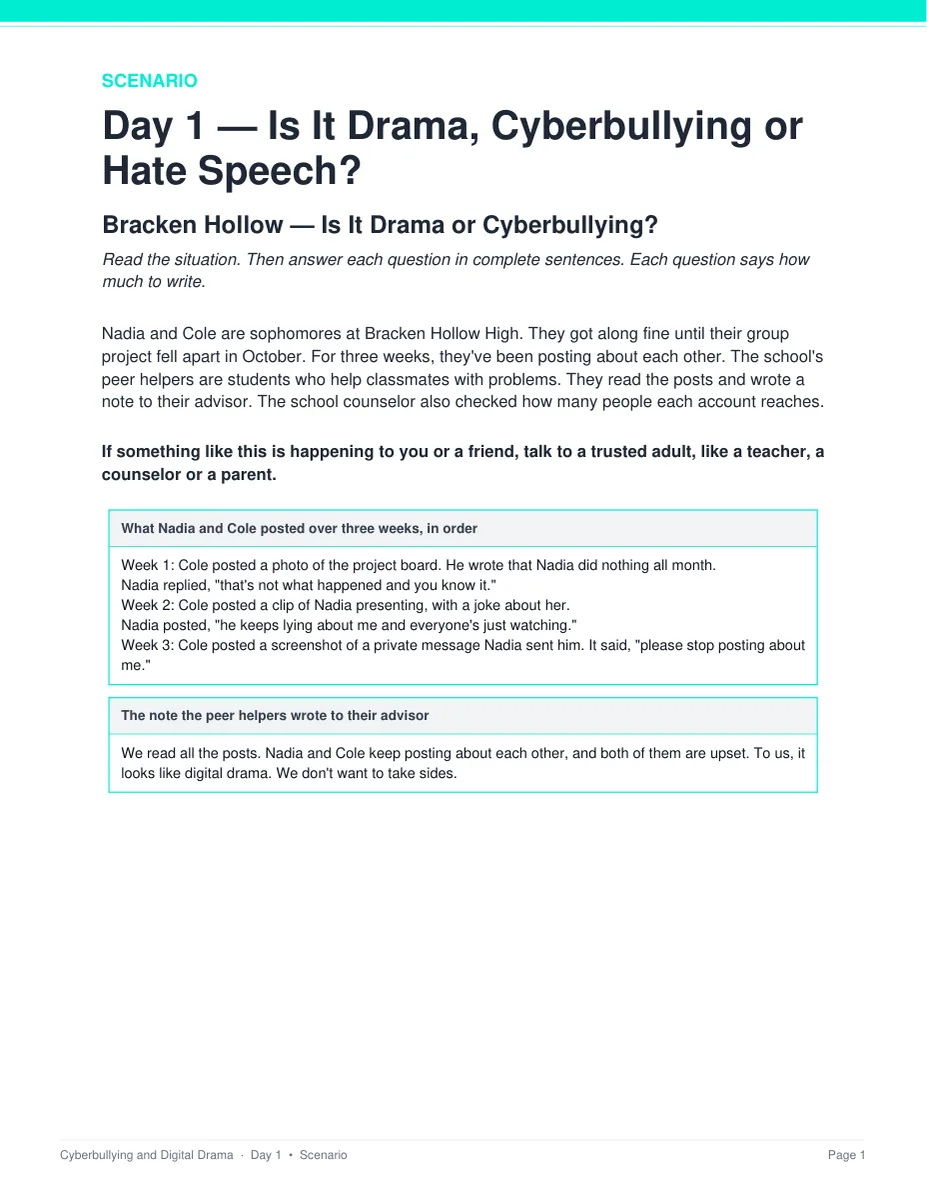
Bracken Hollow — Is It Drama or Cyberbullying?
Nadia and Cole have posted about each other for three weeks after a group project fell apart, so the school's peer helpers call it digital drama: both are posting, both are upset. Then the counselor's note adds what the thread cannot show — most of the grade follows Cole and a large chat reshares everything he posts, while Nadia's answers reach her cousin and a few friends. The answer flips. It is the unit's best argument for looking past what a thread shows.
Everything that's included
 00 Start Here: Teacher
- READ FIRST teacher guide: what to print, in what order, with the crisis line on the page
- Teacher guide and pacing: measured minute-by-minute timings for each day
- Skills Map and state standards, each code checked against its official wording, plus a ready-to-paste prompt for your own state
 01 Present: Whole class
- One editable PowerPoint deck per day (48 slides, four decks of 12), with speaker notes on every slide
- Four printable bell ringers, one warm-up per day
 02 Student Handouts
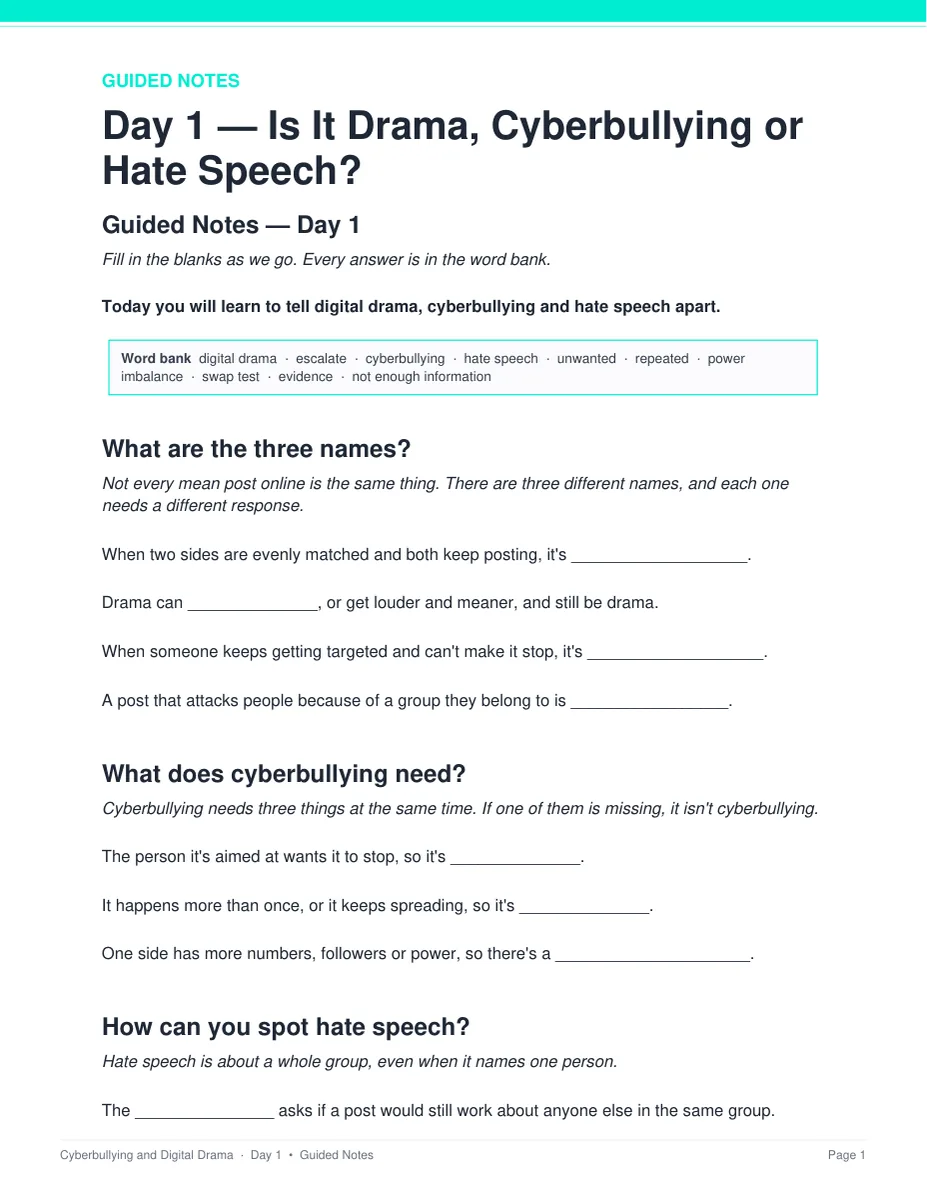
- Guided notes for all four days, in editable Word and print PDF
- Vocabulary glossary: all 40 terms, ten a day, across three pages
 03 Scenarios
- Bracken Hollow — Is It Drama or Cyberbullying? — two pages, keyed
- Marrow Ridge — What Can the School Act On? — two pages, keyed
- Halloway Creek — What Should Tiana Do First? — two pages, keyed
 04 Activities
- Which Name Fits? — Day 1: six posts, four possible answers, 6 points
- More Likely or Less Likely? — Day 2: one story and four changed versions, 4 points
- Where Would You Draw the Line? — Day 3: five posts placed on a grid, then students draw their own line, 5 points
- Which Steps Would You Take? — Day 4: the biggest activity in the line, in two parts, 9 points
- Three pages each. Everything prints on the sheet students write on — nothing to cut out or laminate
 05 Assessment
- Four exit tickets, one per day, 5 points each
- Unit quiz: 28 points, 20 multiple choice and 4 written, across five pages, about 25 minutes
Digital: self-grading Google Forms™
- Five ready-to-assign forms — the unit quiz and all four exit tickets — with 28 auto-graded items
- Multiple choice grades itself on submit, with feedback on every wrong answer; written responses land in your response sheet
06 Answer Keys
- Seven key PDFs: every activity, scenario, exit ticket and the quiz
- Every written prompt keyed with what to look for, a model response, what else to accept and what to reject — and every activity item carries a sample answer and a rule for the point
See the actual pages
Page one of four real files out of the download, exactly as they print.
One editable deck per day
Twelve slides a day, low text, with the icons and layouts built as real shapes rather than flat images. Recolor them to match your room, or delete any of them.
- ✓ 48 slides across the four days
- ✓ Speaker notes on every slide
- ✓ 13 pictures, each one matching the words around it
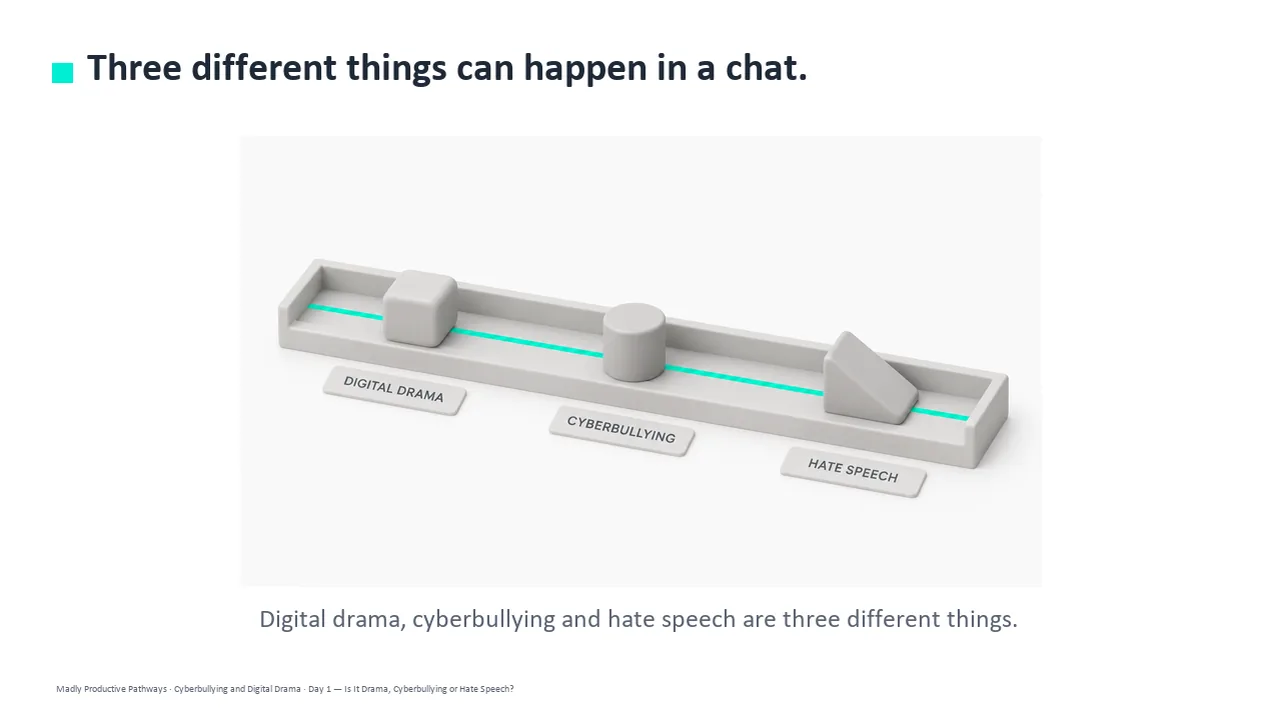
Notes students fill in as you teach
One page per day with a word bank of that day's ten terms and real room to write. Editable Word and print-ready PDF, and every one has a complete key.
- ✓ Four days, Word and PDF
- ✓ Short, complete sentences on every student page
- ✓ Full answer key for every page
The case where the answer flips
Three long-form cases, two pages each, worth 3 points, with the trusted-adult line printed on page 1. Every person, school and post in them is invented.
- ✓ Bracken Hollow, Marrow Ridge and Halloway Creek
- ✓ Students diagnose first, then explain
- ✓ Teacher key with sample answers
Eight steps, and what each one cannot do
Day 4 runs in two parts: name three cases and write the first three steps in order, then match each of the eight steps to its limit. Two of the offered limits are false for every step, and finding them is the point.
- ✓ Three pages, 9 points
- ✓ Nothing to cut out or laminate
- ✓ Debrief script in the teacher key
Why teachers pick this unit
 Three names, and a test for each
Cyberbullying isn't just drama that went too far. Students get a separate test for digital drama, cyberbullying and hate speech, and they use the evidence before they pick.
“Not enough information” is a real answerA thread cannot show whether somebody wants it to stop. Students learn to name the one question they would need answered instead of guessing at it.
 Every step has a limit
Day 4 pairs all eight steps with what that step cannot do. Blocking doesn't delete a post, and reporting doesn't prove who typed the message.
Nothing says “answers will vary”Every written question ships with what to look for, a model response, and what else to accept or reject.
 Handled with care
Every person, school and post is made up, and no task asks students to share their own experiences. No story ends in a death or a self-harm act.
Print and digitalPrint-ready PDFs plus five self-grading Google Forms™ for the quiz and all four exit tickets.
What Teachers Say
Be the first to review this
Reviews help me a lot, and they help other teachers pick the right resources for their classes. It takes about a minute.
Leave a reviewQuestions teachers ask
How do I get the files after I buy?
Instant download right after checkout. You get editable PowerPoint and Word, print-ready PDF of everything, and the links for the self-grading Google Forms™.
Do I need a background in this?
No. Each day has a plan and the speaker notes tell you what to say. The READ FIRST guide says exactly what to print and when, and every page has a key.
What if a student in my room is going through this?
The teacher guide carries a crisis line on the Start Here page and again on the safety page, and the safety page says who in your own school to go to. It never asks a teacher to decide whether a student is at risk. No task asks students to share their own experiences, and no story in the unit ends in a death or a self-harm act.
Is Day 3 safe to teach? It sounds like a legal question.
It is a civics day, and it is precise rather than vague. A public school cannot punish an opinion, but it can act on conduct, even when the post was made at home. The unit says plainly that there is no exact rule for off-campus posts, so students place five posts on a grid and draw their own line, with one fixed point: a threat always goes inside the line and always to an adult.
When does the unit quiz happen?
It sits after the four lessons, not inside them. The quiz is about 25 minutes and all four periods are full lessons. Run it as a Day 5 in class or set it as a take-home with the Google Form. Either way you already have a grade for every student from the four exit tickets.
What standards does it map to?
It is a general-education unit, so it maps onto reading and speaking standards alongside health and ISTE codes rather than a computer science framework: RI.9-10.1 and SL.9-10.1 with the 11-12 equivalents, Health 2.12.1, 4.12.3 and 5.12.4 in the 2024 wording with the 2007 equivalents, and ISTE 1.2.b. The Skills Map lists what students learn each day, with every code checked against its official wording, plus a ready-to-paste prompt for your own state.
Can I buy this with the other Digital Citizenship units?
Yes. The Digital Citizenship Unit Bundle holds this unit and seven more — 27 teaching days and 279 files in one download, for less than buying them one at a time.