
A syllabus is the one document every student, parent, and administrator actually sees, and most of us write it once in a panic the night before open house and never touch it again. That is a waste, because a good syllabus does real work all year: it sets the tone, it answers the questions you’d otherwise field forty times, and it gives you something to point at when a grade gets disputed in March.
This is a section-by-section template for a high school business class syllabus. It’s built to be reusable (write it well once, tweak it every August) and to cover the things business classes specifically need that a generic template misses: a CTSO mention, a real AI-use policy, and grading that fits project work. We’ll close with a trick for getting students to actually read the thing.
What should a high school business syllabus include?
The honest answer is: less than you think, organized better than you’d expect. A syllabus that runs four pages and reads like a legal contract gets skimmed and forgotten. The goal is a one-to-two page document that a sophomore can read in five minutes and a parent can scan during a conference.
Nine sections cover everything a business class needs. Each one answers a specific question someone in your room will eventually ask, so think of the syllabus as pre-answering your most common questions in writing.
A section-by-section template
Here’s the whole structure, with a one-line guide for what goes in each section. Build it in this order and you won’t leave a hole.
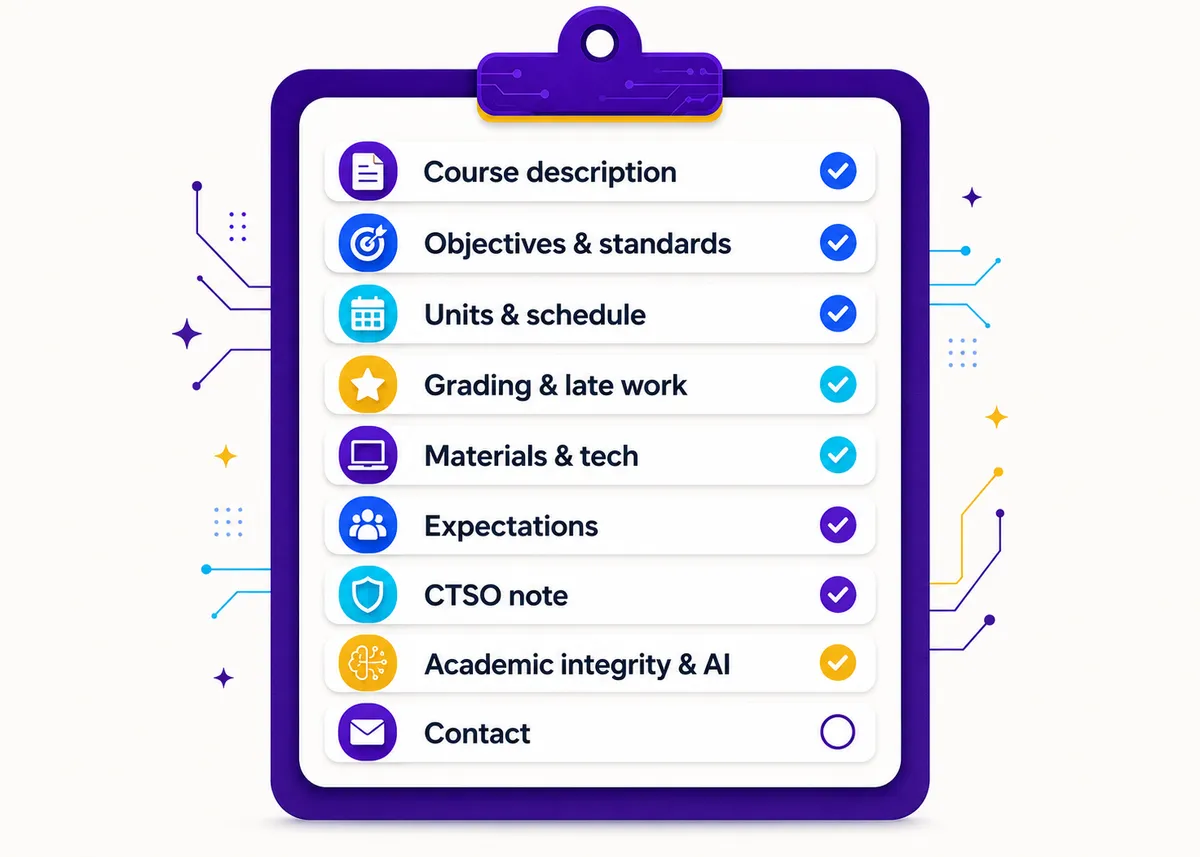
| Section | What goes here |
|---|---|
| Course description | Two or three sentences on what the course is and why it’s worth taking (lead with a decision students will get to make, not a topic list). |
| Objectives and standards | The 4 to 6 things students will be able to do by June, loosely tied to your state framework or course code. |
| Units and rough schedule | The unit list with approximate timing (“Marketing: weeks 5 to 9”), not a day-by-day calendar that’s wrong by October. |
| Grading and late-work policy | How the grade breaks down (projects, daily work, assessments) and exactly what happens when work is late. |
| Materials and technology | What students need to bring or access (a charged device, a notebook, a specific login or platform). |
| Classroom expectations | The 3 to 5 norms that actually matter to you, stated plainly, not a wall of rules. |
| CTSO and FBLA note | A short line on the chapter, what it offers, and how to get involved (competitions, leadership, real deadlines). |
| Academic integrity and AI policy | What honest work looks like in this class, and a clear, modern statement on when and how AI tools are allowed. |
| Contact and help | How and when to reach you, and what to do when a student falls behind or misses class. |
A few of these deserve a closer look, because they’re where business syllabi tend to go wrong.
Course description. Resist the textbook summary. “This course covers the principles of marketing” tells a student nothing. “You’ll pick a real product, find its customer, and build a campaign you could actually run” tells them what they’re signing up for. Lead with the decision, the same way you’d lead a first lesson.
Grading and late-work. Business classes lean on projects, so your grading categories should reflect that. If a third of the grade is a campaign or a business plan, say so. And spell out late-work concretely (a flat penalty, a hard cutoff, a redo window) because vagueness here is what generates the March email. Whatever you pick, write the rule down so you’re enforcing a policy, not a mood.
CTSO and FBLA note. Most generic syllabi skip this entirely, which is a missed chance. Even two sentences (“This class is connected to our FBLA chapter. Membership is optional but it’s where the competitions, travel, and leadership roles live, ask me if you’re curious”) plants the seed early. If you run DECA for marketing instead, swap it in. The point is to signal on day one that this class has a path beyond the gradebook.
Academic integrity and AI policy. This is the section that’s changed the most in the last two years, and a syllabus from 2021 looks ancient without it. Don’t pretend AI doesn’t exist and don’t ban it on principle. State your actual rule. A clean, modern version reads something like:
You may use AI tools (like ChatGPT) for brainstorming, feedback, and checking your understanding. You may not submit AI-generated work as your own. When AI helps on an assignment, note how you used it. The thinking and the final decisions have to be yours, because that’s the skill this class is actually building.
That covers the realistic middle ground: AI as a tool you’re teaching them to use honestly, not a thing to police out of existence. Adjust the strictness to your course and your school’s policy, but say something specific.
How do you make a syllabus students actually read?
You don’t, if you just hand it out and read it aloud. Nobody retains a monotone walk down a one-pager. The fix is to make them use it, and the easiest way is a syllabus scavenger hunt.
It’s exactly what it sounds like: a short worksheet (or a digital form) with 8 to 12 questions whose answers live in the syllabus. “What percent of your grade is projects?” “What happens if you turn something in two days late?” “Name one thing our FBLA chapter does.” “When can you use AI on an assignment?” Students race to find the answers, and in the process they actually read the document instead of letting it slide into a backpack.
A few things make it land:
- Make the answers matter. Ask about the policies they’ll care about later (late work, grading, AI), so they’re learning the rules they’ll actually invoke.
- Make it quick and a little competitive. First three done correctly get a small reward, or run it in pairs. It’s a day-one activity, not a quiz.
- End with a signature or exit ticket. A quick “I read this” line (or a parent signature) closes the loop and gives you a paper trail.
This doubles as a soft first-week activity, the kind that sets the “we do things here” tone. (If you want more openers like it, First Week of Business Class Activities collects a stack of them.)
How do you keep it editable year to year?
The reason most syllabi rot is that they’re built to be thrown away. A reusable one is built to be edited, and that comes down to a few habits.
Separate the stable from the seasonal. Most of your syllabus (course description, expectations, grading philosophy, AI policy) barely changes year to year. What changes is the calendar, the room number, the specific platforms, and your contact hours. Keep the changeable bits grouped at the top or in their own short block so your August edit is a five-minute pass, not a rewrite.
Date it and version it. Put the school year right in the document so you never hand out last year’s by accident. A single editable master file (one you copy and tweak each August) beats hunting through five near-identical PDFs every fall.
Keep the schedule loose on purpose. The units-and-rough-timing approach isn’t just easier to write, it’s easier to keep. A syllabus that promises specific dates is wrong by October and makes you look like you fell behind. One that says “Marketing: weeks 5 to 9” stays true all year and survives the snow days. (That’s the same loose-mapping logic behind a whole year’s plan, which we walk through in How to Build a Full-Year CTE Curriculum.)
The syllabus is really just the student-facing front end of your scope and sequence. If your year is mapped, the syllabus mostly writes itself, and the start-here view of the whole business program lives in How to Teach High School Business if you’re building from scratch.
A quick word on tone
One last thing, because it’s easy to miss: the syllabus is your first impression in writing. A warm, plain-spoken document signals a warm, plain-spoken class. A wall of bold-faced rules signals something else. You can be clear about expectations without sounding like a parking ticket. Write it the way you’d actually talk to a student in the hallway, and it’ll do more for your classroom culture than the rules themselves.
Free template to start from
You don’t have to build this from a blank page. The Free Library has an editable syllabus template with all nine sections laid out (plus the AI-policy language and a scavenger-hunt worksheet to go with it), so you’re filling in your course instead of inventing the format. Grab it, make it yours, and reuse it every August.
Want the whole course built around it? The editable AP® Business with Personal Finance curriculum comes with the units, projects, and pacing already mapped, so the rough-schedule section fills itself in. You write the nine syllabus sections once, and the unit list drops straight into your August edit every year.
Frequently asked questions
What should a high school business syllabus include? Nine sections cover it: course description, objectives and standards, units and rough schedule, grading and late-work, materials and technology, classroom expectations, a CTSO or FBLA note, academic integrity and AI policy, and contact info. Keep it to one or two pages.
How long should a class syllabus be? One to two pages. A syllabus that runs four pages gets skimmed and forgotten. Aim for something a student can read in five minutes and a parent can scan during a conference.
Should a syllabus include an AI policy? Yes. A syllabus without one looks dated, and “no rule” defaults to confusion. State specifically when AI tools are allowed (brainstorming, feedback) and when they aren’t (submitting generated work as your own), and ask students to note how they used them.
How do I get students to read the syllabus? Make them use it. A syllabus scavenger hunt (8 to 12 questions whose answers live in the document) gets students reading the policies they’ll actually care about later, and it doubles as a low-stakes first-week activity. First Week of Business Class Activities collects more openers in the same spirit.
Should a business syllabus mention FBLA or DECA? Yes. Even two sentences on your CTSO chapter signals on day one that the class has a path beyond the gradebook (competitions, travel, leadership roles). Use FBLA for a general business class or swap in DECA if your focus is marketing.
How do I keep a syllabus reusable year to year? Separate the stable parts (course description, expectations, grading philosophy, AI policy) from the seasonal ones (calendar, room number, platforms, contact hours), and keep the changeable bits grouped so your August edit is a five-minute pass. Date and version a single editable master file, and keep the schedule loose (“Marketing: weeks 5 to 9”) so it stays true past October.