
If you’re teaching AP® Cybersecurity in 2026-27, you’re in the first national cohort, and that comes with a specific kind of nervous energy: a brand-new course, a small community, and a launch year where you’re learning the material a step ahead of your students. The good news is that this course rewards the instincts a good CTE teacher already has. It runs on applied, hands-on, scenario-based work built around defense and reasoning rather than memorizing definitions.
This is the planning guide: what to set up before day one, how the course is shaped, whether anyone needs to code, how to pace it, and the lab, resources, and PD to line up early. For the wider context on what AP Career Kickstart is and how it differs from traditional AP, start with the cornerstone guide, What Is AP Career Kickstart?
One ground rule first: AP Cybersecurity (the pilot-era name “AP Cybersecurity Fundamentals” was shortened) launches nationally in Fall 2026, with first national exams in May 2027. Anything specific about units or exam format should be confirmed against the published Course and Exam Description.
What do you set up before day one?
The single most useful thing you can do is read the published Course and Exam Description (CED) cover to cover. It’s the source of truth for what’s tested and how, and it’s where you confirm the things you shouldn’t guess at (the exam format included).
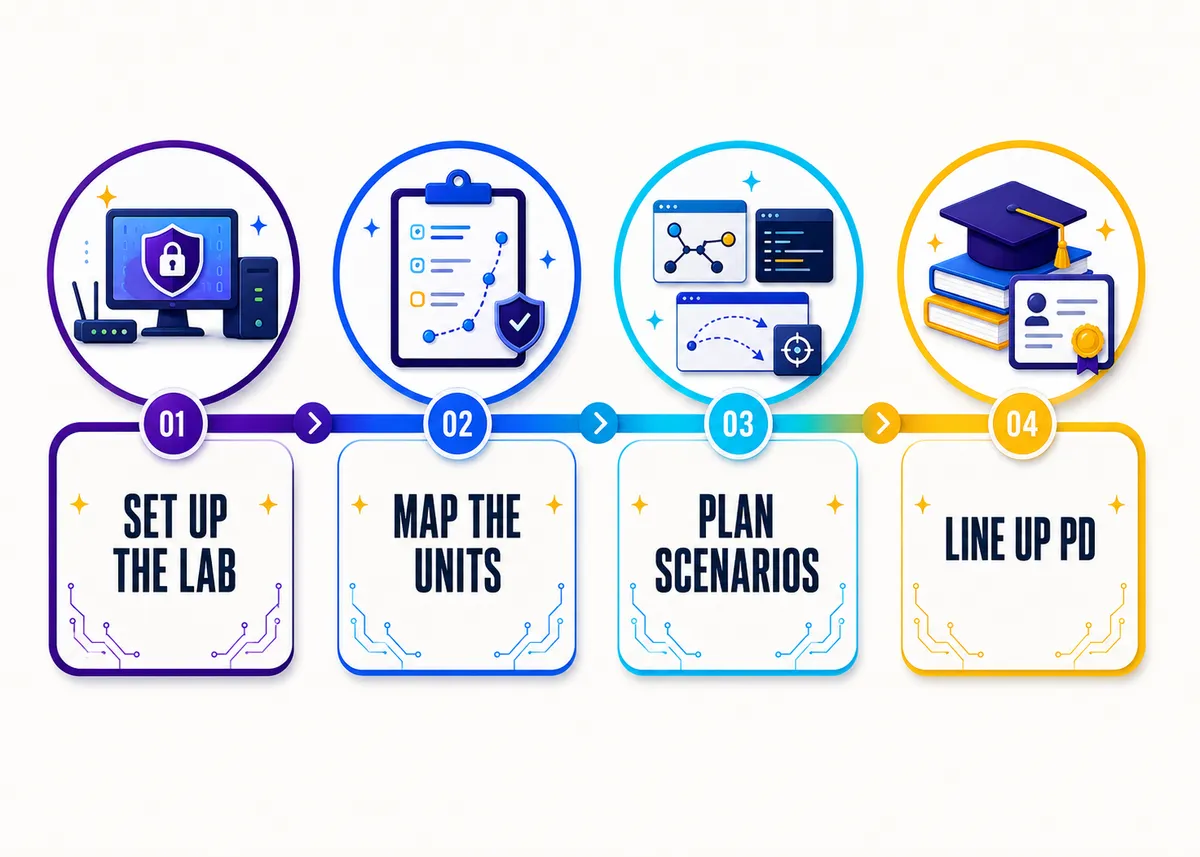
Here’s a concrete before-day-one checklist:
- Read the CED and map its units onto a rough pacing calendar: a skeleton to hang daily lessons on, not a perfect plan you’ll abandon by October.
- Confirm the credential details. AP Cybersecurity pairs college credit with an industry-recognized employer credential aligned to the NICE Workforce Framework. Exams are scored 1-5, and the credential is earned at a 3 or higher. Learn to pitch that to students and parents.
- Sort lab access and accounts early. Find out what your school can support (managed devices, a sandbox or virtual environment, accounts on whatever platforms you’ll use) and get tickets in with IT before the term, not in week three.
- Build or source your scenarios. This course lives on applied work: phishing teardowns, threat-modeling, capture-the-flag, incident walk-throughs. Have a starter set ready so week one isn’t improvised.
- Settle network boundaries with IT. A security class will have students poking at how systems work. Agree in advance on what’s allowed on the school network and what stays inside a sandbox.
If assembling all of that from scratch in a launch year sounds like a lot, our editable AP Cybersecurity curriculum is organized around the scenario-and-defense model the course rewards, and its Introduction to Security unit gives you the opening weeks ready to teach.
How is the course structured?
AP Cybersecurity is built as an applied, scenario-based course, the same engine that drives a strong CTE class. Rather than front-loading vocabulary and testing recall, it asks students to do something with the material: reason about risk, defend a system, and explain their choices.
In practice the spine of the course is defensive thinking. Students learn to look at a system, ask what could go wrong, and decide what to do about it. The emphasis is on protection and tradeoffs, not on breaking in. If you’ve taught cybersecurity before, this is the familiar “think like a defender” framing, and it pairs naturally with the credential’s alignment to the NICE Workforce Framework, which describes the actual roles and tasks in the security workforce.
For the exact units, sequence, and weightings, go to the CED. That’s the part we deliberately don’t pin down here, because the official document is where it stays current.
Do you (or your students) need to code?
No, and this is the fear that keeps good teachers out of the room. AP Cybersecurity is about defense and reasoning, not writing exploits or building software. The work is scenario-driven: analyzing a phishing email, mapping where a school’s data lives, hardening an account, explaining why one tradeoff beats another.
Your students don’t need to arrive as coders either. They need to think clearly about risk and consequence, a skill you can build with kids who’ve never touched a terminal. If you’re coming to this out of field, modeling how you work through a problem you don’t immediately know is one of the most honest things you can show them, because that’s the real job in security. For the broader “you don’t need to be a coder” case, see How to Teach Cybersecurity to Beginners.
How do you pace it?
Don’t over-engineer the pacing in a launch year. Map the course once at the unit level, leave real slack for schedule chaos, and adjust as you learn what the material demands. A rough working rhythm:
| Phase | Rough timing | Focus |
|---|---|---|
| Foundations | Early term | Core concepts, lab routines, “think like a defender” framing |
| Applied units | Bulk of the year | Scenario work, projects, the CED’s units in sequence |
| Synthesis and review | Late spring | Pulling skills together, exam familiarization, credential prep |
Treat that as a skeleton, not a mandate. The CED’s unit weightings should drive how much time each stretch actually gets, so build your calendar off the published document. Two instincts that hold up in a first year: anchor to the CED rather than teaching the whole internet (when you’re unsure whether a topic belongs, check what’s actually assessed), and front-load lab routines, since the early weeks are where logins, accounts, and devices go sideways.
What lab setup, resources, and PD should you line up?
You don’t need a hacking lab. You need a safe, contained place for students to practice defensive thinking, plus the official supports for a first-year course.
- Lab and environment. Work with IT on a sandbox or virtual environment where students can experiment without touching live school systems. Confirm device access, account provisioning, and any filtering that might block your tools.
- Official resources. The CED is non-negotiable reading. Watch for College Board’s teacher materials, sample assessments, and AP Classroom supports as they’re released, and check back as more arrives through the first year.
- Professional development. Look for College Board’s official AP Cybersecurity training and summer institutes. If you’re newer to security content, free beginner curricula and intro courses are a low-cost way to get ahead over the summer.
- A first-cohort network. Find the other teachers running this in 2026-27. Shared scenarios, shared troubleshooting, and shared sanity are worth it.
For the first-week game plan that pairs with this guide, see First Week of AP Cybersecurity Activities. And keep one eye ahead: AP Networking launches nationally in 2027-28, so if your school is building out the technology side of AP Career Kickstart, this course is likely the first of two.
Free resources to get you started
You don’t have to build your launch year from scratch, and you shouldn’t have to buy your way in just to see if the style fits. The Free Library has no-prep starting points (bell ringers, a project rubric, first-week activities, a pacing planner) that work for a scenario-driven cybersecurity class. Grab what’s useful and test it against your room.
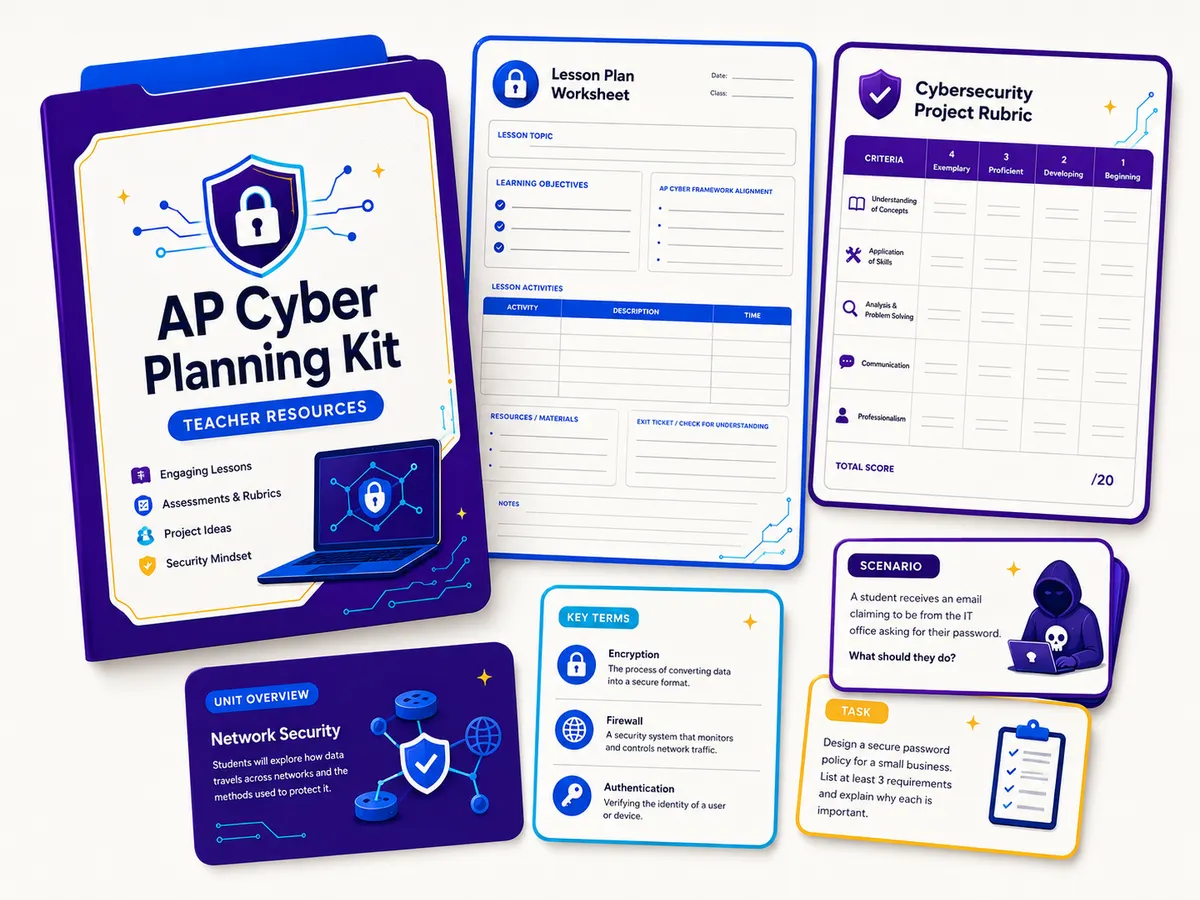
Want the planning done for you? The editable, full-year AP Cybersecurity curriculum has the scenario work and defensive-thinking projects built for every unit. It’s yours to edit, so you can fit it to your lab setup, your IT constraints, and your bell schedule.
Frequently asked questions
When does AP Cybersecurity launch and when are the first exams? It launches nationally in 2026-27 (Fall 2026), with the first national exams in May 2027. Teach it that year and you’re in the first national cohort.
Do students need to know how to code for AP Cybersecurity? No. The course centers on defensive, scenario-based thinking (risk, protection, and tradeoffs), not writing code or exploits. Students need to reason clearly about systems, not arrive as programmers.
What do students earn? Exams are scored 1-5. A qualifying score can earn college credit like any AP exam, and a 3 or higher also earns an industry-recognized employer credential aligned to the NICE Workforce Framework.
How should I prepare to teach it? Read the CED first, map it onto a rough pacing calendar, confirm the credential details, sort lab access and network boundaries with IT, and build a starter set of scenarios before day one.
What lab setup do I need for AP Cybersecurity? Not a hacking lab: a safe, contained sandbox or virtual environment where students practice defensive thinking without touching live school systems. Work with IT early on device access, account provisioning, and any filtering that might block your tools, since the early weeks are where logins and accounts go sideways.
Do I need a security background to teach it? No. The course rewards the instincts a good CTE teacher already has, and modeling how you reason through a problem you don’t immediately know is honest preparation for the real job in security. For the full “you don’t need to be a coder” case, see How to Teach Cybersecurity to Beginners.
AP® is a trademark registered by the College Board, which is not affiliated with, and does not endorse, this product.