
You don’t need a lab, a single account, or even working Wi-Fi to teach a great first week of AP® Cybersecurity. What you need is a tone: this is a course about thinking like a defender, where reasoning matters more than tricks and being wrong is just part of the work. AP Cybersecurity is an applied, scenario-based AP Career Kickstart course launching nationally in 2026-27, and it pairs college credit with an industry credential aligned to the NICE framework. None of that lands in week one, though. Week one is about culture and curiosity.
This is the concrete, do-it-Monday companion to the bigger planning picture in What Is AP Career Kickstart?. Below are activities you can run unplugged, in any order, to set a defense-and-reasoning tone before the real content starts.
How should week one feel?
It should feel like a course where curiosity is rewarded and mistakes are cheap. That matters more in cybersecurity than almost anywhere, because the subject can intimidate students who think they need to be “computer people” to belong. Your job in week one is to prove they don’t.
Two culture rules do most of the heavy lifting, and they’re worth saying out loud on day one and reinforcing all week:
- Errors are normal. Defenders are wrong constantly: a misread alert, a control that didn’t hold, a guess that didn’t pan out. The work is noticing and adjusting, not being right the first time. A room where being wrong is embarrassing is a room where students stop reasoning out loud.
- Ask three, then me. Students check their own notes, check a neighbor, and check the posted resource before they raise a hand. It builds the independence the course rewards and keeps you from being pulled in twelve directions while thirty kids settle in.
One more tone-setter to name early and often: this is a defense course, not a hacking course. We reason about risk, spot what’s wrong, and protect systems. We don’t break into things. Students will ask (someone always does), so answer it plainly and move on.
Day-one activities (start unplugged, no lab required)
The first week of any tech class is usually a mess of logins and accounts that aren’t ready. Skip all of it. These openers need nothing but paper, a board, and the students in the room.
Think like a defender (the opener). Put a simple, familiar system on the board: a coffee shop, the school’s front office, a house. Ask one question: “If you wanted to keep this safe, what would you protect first, and from whom?” Let them argue. There’s no single right answer, which is exactly the point. You’re teaching them that security starts with “what matters and who might want it,” not with tools. Close by naming what they just did: that’s threat modeling, and it’s the spine of the whole course.
Phishing-spotting warm-up. Project two or three messages (an email, a text, a DM) and ask the room to vote: real or fake? Then drag the reasoning out of them. What tipped you off? The mismatched sender, the urgency, the slightly-wrong link, the weird greeting. Don’t lecture the red flags first; let them surface the flags, then name them. This is the course in miniature: look closely, reason from evidence, defend your call.
Errors-are-normal demo. Be wrong on purpose. Make a small confident claim, let a student catch it, and thank them out loud. Tiny moment, big signal: in this room, catching a mistake is a contribution, not an attack. It sets up the “ask three, then me” culture for the rest of the term.
First-week activities that preview the course
Once the culture is set, spend the rest of the week on activities that quietly preview what the course is actually about: defense, risk, tradeoffs, and where this work leads.
Personal digital-hygiene audit. Hand out a short checklist and have students privately rate their own habits: password reuse, two-factor on key accounts, how much they overshare publicly, whether they update their phone. Nobody collects it; it’s theirs. Then debrief the patterns, not the people: “Where do you think most teenagers are weakest?” It makes the abstract personal without anyone having to confess.
Threat-model-your-own-life. Scale the day-one opener down to something they own: a phone, a gaming account, a backpack. Walk the same three questions: What’s valuable here? Who might want it? What’s one cheap thing that would protect it? Keep it to a single page. You’re not after a perfect analysis; you’re after the habit of asking those questions in that order.
Credential vs. credit (a framing activity). This is worth ten minutes early, because it changes how seriously students take the year. Put two terms on the board and have them sort the differences: college credit (counts toward a degree, recognized by a registrar) versus an industry credential (signals a skill to an employer, aligned to a workforce framework, in this case NICE). The pitch lands better when they build the distinction themselves: a strong result in this course can do both.
Careers-in-cyber exploration. Cybersecurity is bigger than the hoodie-in-a-basement stereotype, and most students don’t know that. Give them a short list of real roles (security analyst, incident responder, GRC, penetration tester, security awareness trainer) and have them match each to a “kind of person who’d like this.” It opens the field up and plants the idea that there’s a seat here for the careful, the curious, and the communicators, not just the coders.
Syllabus scavenger hunt. Turn the syllabus walkthrough into a hunt: a short list of questions they can only answer by actually reading it (late-work policy, the ask-three rule, what the credential earns them). It beats reading the syllabus aloud, and it sneaks in the culture rules as findable facts.
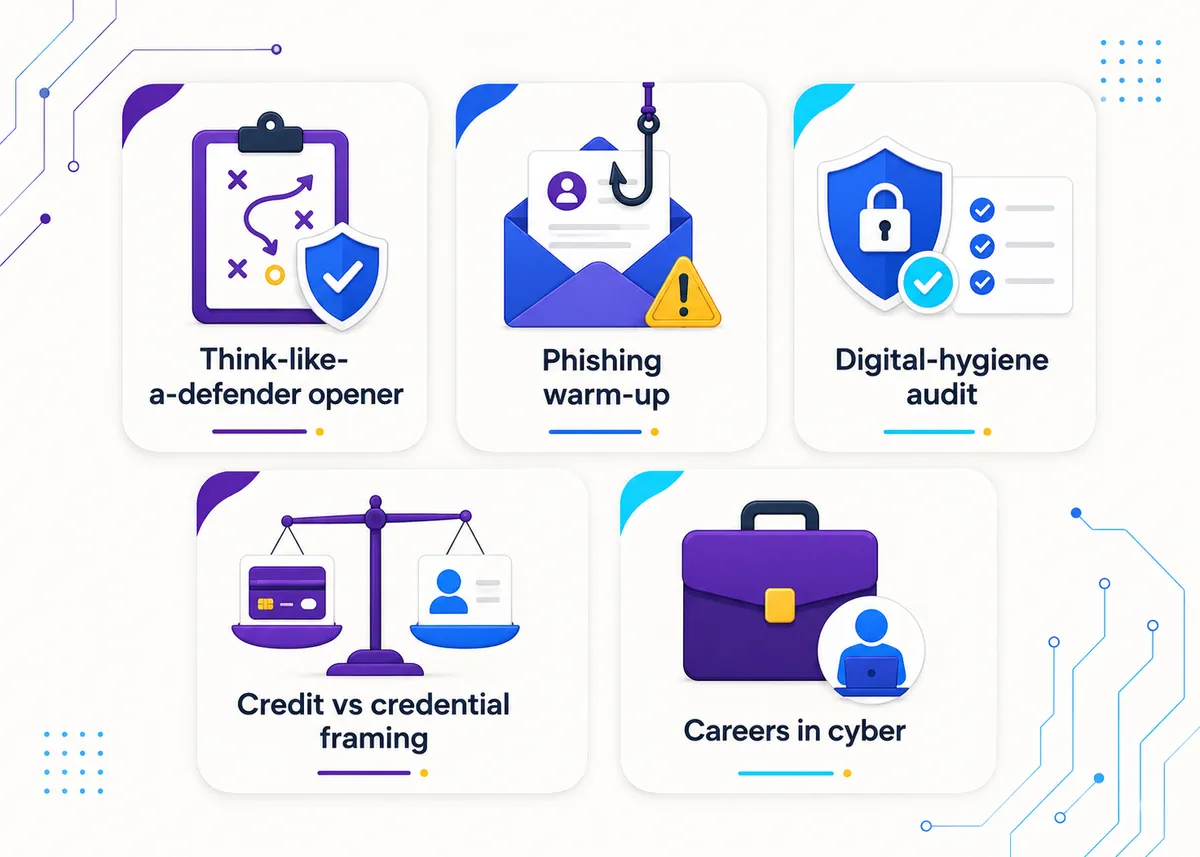
Here’s a quick way to map the week if you want a skeleton:
| Activity | Sets up | Unplugged? |
|---|---|---|
| Think like a defender | Threat modeling, reasoning tone | Yes |
| Phishing warm-up | Evidence-based judgment | Yes |
| Digital-hygiene audit | Personal relevance | Yes |
| Threat-model-your-life | Core analytic habit | Yes |
| Credential vs. credit | Buy-in and stakes | Yes |
| Careers in cyber | Belonging, motivation | Yes |
| Syllabus scavenger hunt | Procedures and culture | Yes |
How do you set expectations for a college-level course?
Be honest that it’s college-level work, then make the standard feel reachable rather than scary. The students who thrive aren’t the ones who already know cybersecurity. They’re the ones who reason carefully, stay curious, and aren’t rattled by being wrong. Say that out loud, because a lot of them will assume the opposite.
A few expectation-setters that pay off all year:
- Name the reasoning standard. Tell them early that you grade the thinking, not just the answer. In a defense course, “why did you make that call?” is the whole game, so reward students who can defend a choice even when the choice was imperfect.
- Normalize not-knowing. Model it yourself when something comes up you can’t immediately answer: “I don’t know, here’s how I’d find out.” That’s the actual job in security, and showing it is more useful than pretending to have memorized everything.
- Keep the credential in view. Remind them what a strong year earns (college credit plus a credential an employer recognizes) without making week two feel like exam prep. Motivation now, pressure later.
You’re not trying to make week one impressive. You’re trying to make it the kind of room students want to reason out loud in, because that’s the room where the rest of the course works.
Frequently asked questions
Do I need a computer lab for the first week of AP Cybersecurity? No. Every activity above runs unplugged, which is a feature in a week when logins and accounts are rarely ready. Start with reasoning on paper and save the tooling for once the routines are set.
How do I set the right tone for a security course? Make two things explicit on day one: errors are normal, and we ask three before me. Then frame the course as defense and reasoning, not hacking, so students know it’s about protecting systems and thinking through risk.
What’s the difference between college credit and an industry credential? College credit counts toward a degree and is recognized by a registrar. An industry credential signals a skill to employers and is aligned to a workforce framework (the NICE framework here). A strong year in the course can earn both, which is worth saying to students early.
What if students ask about hacking? Answer it plainly: this is a defense course. We reason about risk, spot what’s wrong, and protect systems rather than break into them. Naming it early heads off the question for the rest of the term.
What unplugged activities work for the first week of AP Cybersecurity? A think-like-a-defender opener (what would you protect, and from whom?), a real-or-fake phishing vote, a private digital-hygiene audit, a threat-model-your-own-life page, a credential-versus-credit sort, and a careers-in-cyber matching exercise. Each needs only paper and a board, and each previews the reasoning the course rewards. For activities that carry past week one, see Cybersecurity Activities for High School Students.
For the full planning picture (what to set up before day one, how the course is structured, surviving a first-year rollout), start with What Is AP Career Kickstart?. For the deeper course-build, see the AP Cybersecurity teacher planning guide, and for a bank of activities that work all year, Cybersecurity Activities for High School Students. Our first-week activities set has no-prep starting points you can run as-is. And if you’d rather not build the year from scratch, the editable AP Cybersecurity curriculum is built around that same defender’s mindset, starting with the Introduction to Security unit for the weeks right after this one.
AP® is a trademark registered by the College Board, which is not affiliated with, and does not endorse, this product.