

If you’re teaching AP® Business with Personal Finance in 2026-27, you’re in the first national cohort, and that means there’s no veteran down the hall to borrow a binder from. This guide is the practical companion to the overview in What Is AP Career Kickstart?: less “what is this course” and more “what do I actually do before students walk in.” We’ll move through setup, structure, pacing, what makes it different to teach, and the professional development worth lining up.
One caution up front, because it shapes everything below: the course launches nationally in Fall 2026 with first national exams in May 2027, and the published Course and Exam Description (the CED) is your source of truth. Where this guide stays general, that’s on purpose. Confirm the specifics against the CED rather than against any one teacher’s blog (this one included).
What do you set up before day one?
The single most useful thing you can do is read the CED cover to cover, then build a rough skeleton you can hang daily lessons on. Everything else is logistics in service of that.
A before-day-one checklist:
- Read the CED end to end and note the units, the weighting, and how the course splits between business and personal finance. This is also where you confirm assessment details (more on that in a moment).
- Confirm the credential mechanics. This course pairs college credit with an industry-recognized employer credential, and the credential is earned with a score of 3 or higher. Know exactly what your students earn so you can pitch it correctly to them and their parents.
- Sketch a unit-level pacing calendar for the whole year before you plan a single day. You want a skeleton, not a perfect plan.
- Source your projects and scenarios early. This course runs on applied, project-based work grounded in real-world situations, so those need to be built or gathered before the term, not improvised in week three.
- Sort the hands-on logistics: any simulation tools, spreadsheet access, or accounts your projects depend on, plus where student work will live.
- Set up your gradebook around applied work rather than around quizzes. If most of the learning happens in projects, the gradebook should reflect that from day one.
A note on assessment, because it’s the easy thing to get wrong: the pilot exams were multiple-choice, but that does not confirm the national exam format. Don’t build your assessment plan on the pilot. Build it on the published CED for your course.
How is the course structured (business + personal finance)?
The name tells you the shape: this is a business course and a personal finance course living under one roof. Core business concepts (how firms make money, the basics of marketing, the language of accounting, the economic forces that push on every decision) sit alongside the personal finance content that more and more states now require students to graduate.
The two halves reinforce each other more than they compete. A unit on revenue versus profit makes a student’s own budget make more sense, and a budgeting simulation gives the business content somewhere concrete to land. The CED lays out exactly how the units are organized and weighted, so let it drive your sequence rather than imposing a structure from a textbook you happen to have.
What stays constant across both halves is the engine: applied, project-based learning grounded in real-world scenarios. Whether the day’s content is a marketing mix or a credit score, the move is the same. Start from a decision a student can picture making, pull the content in to serve it, and grade the reasoning.
How do you pace the year?
Pacing a brand-new course is mostly about humility. You don’t yet know which units run long, where students get stuck, or how much slack the scenarios eat. So plan loosely on purpose and tighten next year.
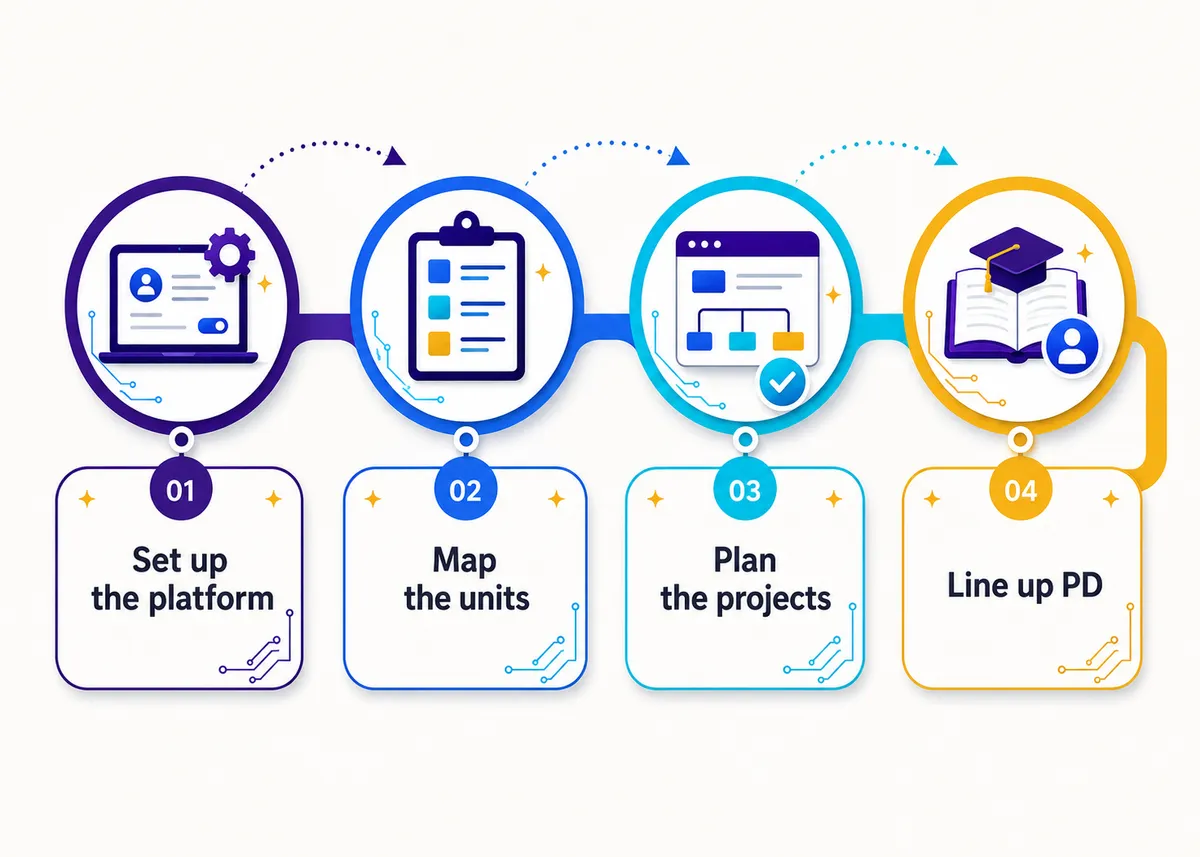
A sane approach for a launch year:
- Map the year once at the unit level, in proportion to the CED’s weighting. Heavier units get more weeks; lighter ones get fewer.
- Leave real slack. Build in buffer weeks for the schedule chaos that always comes (assemblies, snow days, testing windows). A calendar with no give will break by October.
- Anchor each unit to its signature project and back-plan the content from there, so the projects don’t get squeezed out when time runs short.
- Protect a runway before the May exam for review and for whatever applied practice the CED points to. Decide that block now, not in April.
- Keep a teaching log. Jot what ran long, what landed, what flopped. That log is the raw material for a much tighter year two.
The mistake to avoid is over-engineering a perfect daily calendar in August. You’re partly building the plane while flying it this year. Map it once, leave room, and adjust as you learn what the course actually demands.
How does it differ from a traditional AP class?
If you’re coming from traditional AP, the adjustment is real. If you’re coming from CTE, you’re most of the way there already. Here’s the contrast that matters most for planning:
| Traditional AP | AP Business with Personal Finance | |
|---|---|---|
| Day-to-day | Lecture, reading, exam drills | Applied projects and real-world scenarios |
| What you plan around | Content coverage | Decisions students work through |
| What students earn | Possible college credit | College credit plus an employer credential (with a 3 or higher) |
| Where your prep time goes | Slides and recall checks | Sourcing and building projects |
The practical upshot: your prep time moves. Less of it goes into lecture decks, more into building or sourcing the projects and scenarios that carry the learning. If you’ve taught business or any hands-on CTE course, that’s a familiar trade. Many of the instincts you already have carry straight over, which is the whole argument of How to Teach High School Business.
What resources and PD should you line up?
You don’t have to assemble year one entirely from scratch, and you shouldn’t try to in a launch year.
- College Board’s official supports. Start with the CED and whatever AP Classroom resources and professional learning College Board publishes for the course. These are the materials aligned to the actual exam, so they come first.
- An AP Summer Institute or course-specific PD if your district will fund it. A few days with the framework before August saves weeks of guessing later.
- Your first-cohort community. A small group of teachers launching this alongside you is still a community, and they will save you hours. Find them early, online or through your district.
- Free, no-prep starting points. The Free Library has bell ringers, a project rubric, first-week activities, and a pacing planner you can test against your room before committing to anything.
- A built-for-you spine if you want one. Our editable AP Business with Personal Finance curriculum comes with the projects and scenarios already built for every unit, in exactly the applied model this course rewards. It’s fully editable, so it bends to your pacing calendar rather than the other way around.
Once setup is done, the next thing on your list is the first week itself. We map concrete openers in First Week of AP Business with Personal Finance Activities, so you can walk in on day one with a plan that sets the right tone (this is a class where you do things, not just define them). And if you want the opening stretch of content ready before students arrive, the Businesses, Competition & New Ideas unit covers Unit 1 with the projects and scenarios done.
Frequently asked questions
When does AP Business with Personal Finance launch? It launches nationally in the 2026-27 school year (Fall 2026), with the first national exams in May 2027.
What do students earn from the course? Exams are scored 1-5. A strong score can earn college credit like any AP exam, and a 3 or higher also earns an industry-recognized employer credential.
What should I do first to prepare? Read the published Course and Exam Description cover to cover, then map its units onto a rough unit-level pacing calendar. Confirm the credential details and source your projects before you plan any individual days.
Will the national exam be multiple-choice? Don’t assume so. The pilot exams were multiple-choice, but that does not confirm the national exam format. Check the published CED for your course rather than planning from the pilot.
Do I need to be an AP veteran to teach it? No. The course runs on applied, project-based learning, so business and CTE instincts often transfer better than a traditional AP background does. See How to Teach High School Business for the foundation it builds on.
AP® is a trademark registered by the College Board, which is not affiliated with, and does not endorse, this product.