


The first week of AP® Business with Personal Finance is your one clean shot at setting the tone for the whole year. This course is applied and project-based, it pairs college credit with an industry credential, and it launches nationally in 2026-27. If week one feels like a lecture and a syllabus read-through, students will quietly file the course under “another AP class to survive.” Open with decisions instead, and they’ll figure out fast that this one runs differently.
Here’s a first-week plan built around that idea: lead with choices, not definitions, and let the vocabulary follow. (For the big-picture view of what this course is and how it works, start with What Is AP Career Kickstart?.)
How should week one feel in an applied AP course?
It should feel like the work, not like the prep for the work. Students in an applied, project-based course need to learn on day one that you’ll hand them a real decision and ask them to defend a call, then give the content names as you go. That’s the whole engine of the course, so don’t hide it behind a week of housekeeping.
A few principles to hold week one to:
- Lead with a decision, not a definition. Every activity below starts with a choice a student can actually picture making.
- Make the payoff explicit early. “This counts for college credit and an industry credential” changes how seriously students take the work, so say it out loud in week one.
- Get them talking before they’re graded. Low-stakes debate and votes tell you who’s in the room without putting anyone on the spot.
- Preview the projects. End the week pointing at the kind of applied work the course actually rewards, so the routine feels normal by week two.
Day-one activities
Day one is for tone, not content mastery. Pick two of these and leave the syllabus march for later in the week.
The “real business decision” opener. Put a genuine business call on the board before you say a word about the course. Something like: a local coffee shop is losing money on weekday afternoons, so do they cut hours, add a happy-hour discount, or start a delivery deal that eats into their margin? Have students pick a side, defend it in pairs, then vote as a class. There’s no clean right answer, which is the point. You’re showing them that business is decisions under uncertainty, and that this room is where they make them. (Then tell them the course is built on exactly this: applied, project-based work grounded in real scenarios.)
A personal-money reality check. Run a quick, anonymous gut-check on money. Hand out (or post) a few prompts: roughly what does a one-bedroom apartment cost in your town, what’s a realistic first-job monthly take-home, how much does a used-car repair run? Have students guess, then reveal rough real numbers. The gap between guess and reality is the hook for the whole personal-finance side of the course. Keep it light and keep it anonymous, because the goal is curiosity, not embarrassment.
A “credit vs. credential” framing activity. This one is unique to AP Career Kickstart, so spend real time on it. Ask students what they think the difference is between earning college credit and earning an industry credential. Let them wrestle with it, then frame it cleanly: college credit can count toward a degree, and an industry credential is something an employer recognizes on a resume. This course is built to pair both. A short think-pair-share works well here. The takeaway you want: a strong result in this class keeps their options open whether they’re headed to college, to work, or to both.
First-week activities that preview the projects
Once the tone is set, spend the middle of the week pointing at the actual work. These activities preview the project-based nature of the course without committing students to a full project yet.
A syllabus scavenger hunt. You still have to cover the syllabus, so don’t read it at them. Turn it into a hunt: a short list of questions students answer by digging through the document (where do projects fit in the grade, what counts as late work, what’s the credential pathway, when’s the first big project due). They learn the rules by using them, and you reclaim twenty minutes of monotone reading. Let them race in small teams if your room likes a little competition.
A goal-setting plus “why this course” activity. Have students write down, privately, why they’re in this class and what they’d want to walk away with. Then give them the three things this course can offer (college credit, an industry credential, real applied skills) and ask them to rank what matters most to them. You’re not collecting this to grade it. You’re getting them to articulate a stake in the course, and you’re learning what motivates the room so you can pitch projects to it later.
A first mini-case. Close the week with a small case that behaves like a mini version of the real projects. Give students a one-paragraph scenario (a teen wants to start a lawn-care side hustle with $200 of savings: what do they spend it on, and how do they price a yard?) and have them produce a one-page plan in pairs. It’s short, it’s low-stakes, and it rehearses the exact move the course runs on: take a real situation, make defensible decisions, show your reasoning. When the first graded project lands a few weeks later, the format already feels familiar.
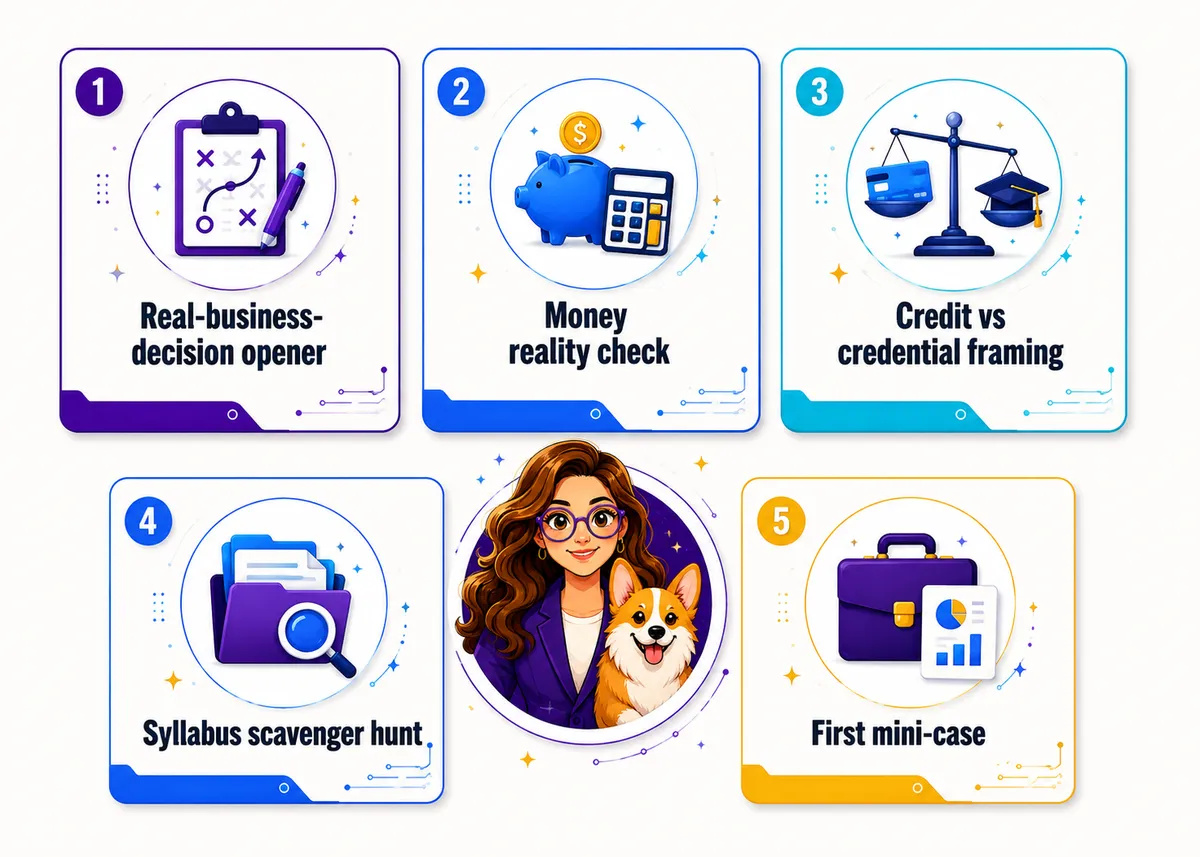
Here’s a simple way to sequence the week:
| Day | Focus | Anchor activity |
|---|---|---|
| 1 | Set the tone | Real business decision opener |
| 2 | Make it personal | Personal-money reality check |
| 3 | Frame the payoff | Credit vs. credential activity |
| 4 | Cover logistics | Syllabus scavenger hunt + goal-setting |
| 5 | Preview the work | First mini-case in pairs |
Swap the order to fit your block schedule. The sequence matters less than the shape: decisions first, logistics in the middle, a project preview to close.
How do you set expectations for a college-level workload?
This is a college-level course, and students should hear that clearly in week one. The trick is to set the bar high without scaring off the kid who wandered in because it fit their schedule.
A few things that help:
- Be honest about the load, then show the support. Name that the work is real, then show them the structure (clear projects, scaffolds, rubrics) that makes it doable. Rigor with a visible path is motivating. Rigor with no path is just dread.
- Sell the dual payoff again. When the workload feels heavy in October, the students who remember that this earns both credit and a credential are the ones who keep going. Plant that in week one.
- Show a rubric early. Hand out the rubric for that first mini-case before they start it. College-level work means knowing what “good” looks like up front, not guessing.
- Normalize defensible answers over right answers. Tell them plainly that a lot of this course grades reasoning, not recall. That reframes the workload from “memorize everything” to “think it through,” which is both more accurate and less terrifying.
For the deeper planning behind the year (pacing, projects, surviving a launch year), the AP Business with Personal Finance teacher planning guide is your next stop. And if you teach a non-AP business section too, the openers in First Week of Business Class Activities share the same lead-with-a-decision DNA.
Frequently asked questions
What should I teach on the first day of AP Business with Personal Finance? Lead with a real business decision and a personal-money reality check, not a syllabus read-through. The course is applied and project-based, so day one should feel like the work: students making and defending calls, with the vocabulary following.
How do I explain the difference between college credit and an industry credential? Frame it simply: college credit can count toward a degree, and an industry credential is something an employer recognizes. This course is built to pair both, which is worth saying out loud in week one because it changes how seriously students take the work.
How much of the first week should be syllabus and logistics? Less than you think. Cover the rules through a scavenger hunt rather than a read-through, and spend the rest of the week on decision-driven activities and a first mini-case that previews the projects.
What is a good first mini-case for AP Business with Personal Finance? A one-paragraph, low-stakes scenario students plan in pairs, like a teen starting a lawn-care side hustle with $200: what they spend it on and how they price a yard. It rehearses the exact move the course runs on (real situation, defensible decisions, shown reasoning) so the format feels familiar when the first graded project lands.
How do you set expectations for a college-level workload in week one? Be honest that the work is real, then show the structure (clear projects, scaffolds, a rubric handed out before the first mini-case) that makes it doable. Normalize defensible answers over right answers, since much of this course grades reasoning rather than recall. The deeper pacing and project plan lives in the AP Business with Personal Finance teacher planning guide.
Free resources to get you started
You don’t have to build week one from scratch. The Free Library has no-prep first-week starting points (bell ringers, a project rubric, a first-week activity set, a pacing planner) that fit the applied, project-based style this course rewards. Grab what’s useful and test it against your room.
Want the planning done for you? Our editable, full-year AP Business with Personal Finance curriculum opens the year the way this week does, with real decisions students defend. The Businesses, Competition & New Ideas unit picks up right where these first-week activities leave off.
AP® is a trademark registered by the College Board, which is not affiliated with, and does not endorse, this product.