
CTE teachers build more of their own materials than almost anyone else in the building, which means the budget conversation usually starts the same way: what can I get for free, and is it any good? The honest answer is that some of the best CTE material in the country is free, built by nonprofits, government agencies, and industry groups who genuinely want more students in these classes. You just have to know where to look, and you have to be able to tell the gold from the filler.
This is the curated map. We’ll cover where free CTE resources actually come from, the strongest free tools for business teachers, the strongest free tools for tech teachers, the ones that work no matter what you teach, and (the part nobody else will tell you straight) how to spot a junk freebie and when it’s worth paying instead. Everything below is a real, currently free resource we’d point a colleague to. No filler.
The short version: The best free CTE resources come from nonprofits and government agencies, not random worksheet sites. For business and finance, start with Next Gen Personal Finance, the SIFMA Foundation’s Stock Market Game, EconEdLink, and Junior Achievement. For tech, start with Code.org, CodeHS, and Common Sense Education. Free is genuinely enough for content and practice; you usually start paying when you need a full year mapped, aligned, and editable so you’re not rebuilding it every August.
Where can you find free CTE resources?
Free CTE material clusters in a few reliable places, and knowing the categories saves you from drowning in search results.
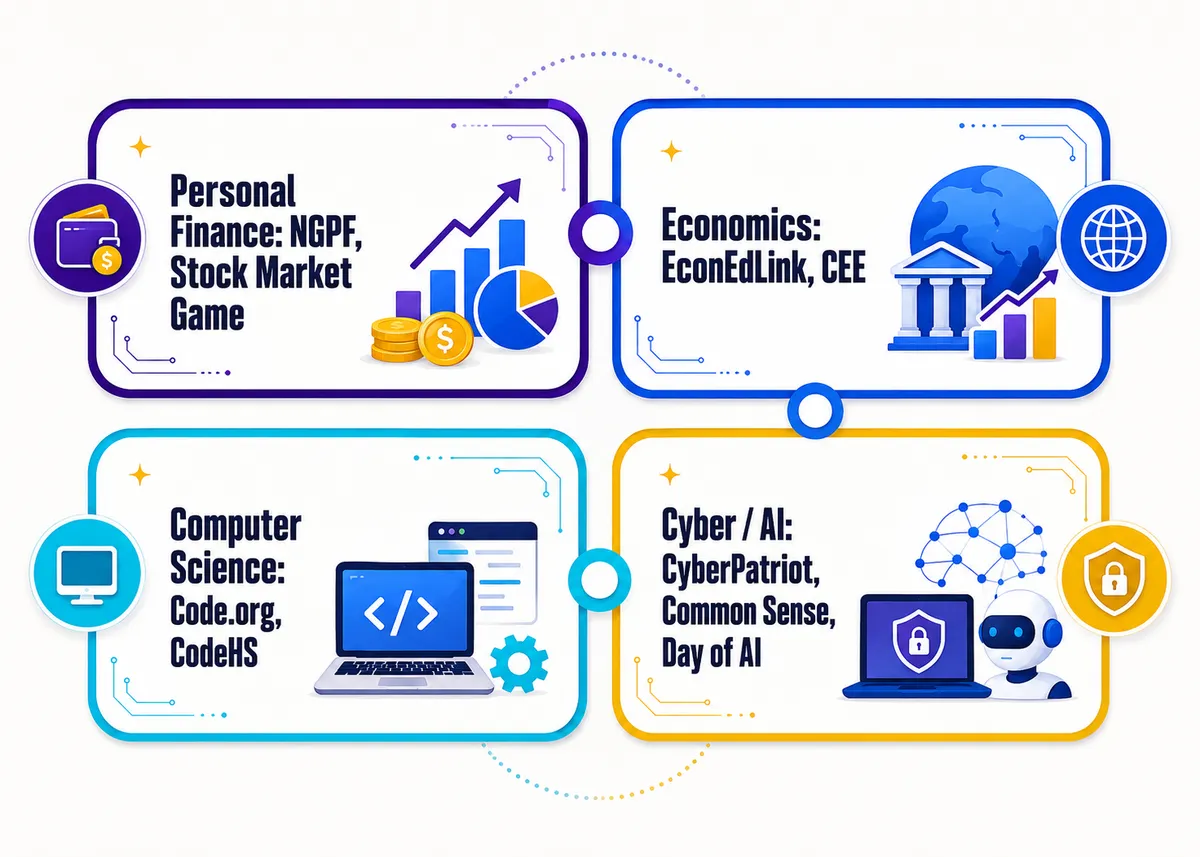
- Nonprofits and foundations build the deepest free curricula, because their whole mission is getting these subjects taught. Next Gen Personal Finance, the Council for Economic Education, and Junior Achievement all fall here.
- Government and agency resources are free, credible, and weirdly underused. The Federal Reserve and the Consumer Financial Protection Bureau (CFPB) both publish classroom-ready finance material.
- Tech companies and CS nonprofits pour real money into free computer science education. Code.org is the obvious one, but it’s a whole field.
- Competitions and student organizations (CTSOs) double as free curriculum: the structure, deadlines, and real-world stakes come built in.
The thing to internalize: the trustworthy free stuff is almost always made by an organization with a mission, not by a content mill chasing ad clicks. That single filter cuts your search down fast. If you’re newer to all of this and want the wide-angle view first, How to Teach CTE is the umbrella guide this roundup lives under.
What are the best free resources for business teachers?
Business and finance might be the single most generous corner of free CTE, largely because banks, exchanges, and the government all have a stake in financially literate teenagers. Here’s what we’d actually reach for.
Next Gen Personal Finance (NGPF). This is the heavyweight. NGPF offers a complete, free personal finance curriculum (full units, lessons, projects, assessments, and answer keys) plus free teacher certification courses and professional development. It’s the first thing we recommend to anyone handed a finance course with no materials. Their free arcade-style game Payback, where students navigate paying for college, is a great low-prep day that students actually enjoy. If you teach finance, start here.
The SIFMA Foundation’s Stock Market Game. A free online investing simulation for grades 4 through 12, where student teams manage a virtual portfolio with real market data. It’s a long-running, well-supported program that turns “investing” from an abstraction into something students check obsessively. Great for a unit-long thread running underneath your other lessons.
EconEdLink and the Council for Economic Education (CEE). EconEdLink (run by CEE) is a free library of economics and personal finance lessons, interactives, and videos, searchable by concept and grade level. This is where you go when you need one solid, standards-aligned lesson on a specific economics topic without building it yourself. The CEE behind it is a long-established nonprofit, so the material is credible.
Junior Achievement (JA). JA runs experiential programs on financial literacy, work readiness, and entrepreneurship, often with a volunteer from the community co-delivering. JA Finance Park is the well-known one: a budgeting simulation (sometimes a physical “town,” sometimes virtual) where students live a month on an assigned income. Availability depends on your local JA chapter, so check what’s offered in your area.
Federal Reserve education resources. The Fed publishes a surprising amount of free, high-quality classroom material on economics and personal finance, including lesson plans, videos, and interactive tools. Credible, free, and built by the institution that literally runs monetary policy. Hard to beat on authority.
CFPB youth resources. The Consumer Financial Protection Bureau offers free, practical money material aimed at young people (and the adults teaching them), strong on the everyday-consumer side: credit, debt, scams, and financial decisions. A good complement to a fuller curriculum like NGPF.
One honest note: Knowledge Matters Virtual Business is excellent but paid, not free. You’ll see it recommended alongside the free tools above, so don’t let the company fool you into expecting a free login.
For where these tools fit into actual lessons, the deep dives are in Personal Finance Activities for High School, and the wider program map is in How to Teach High School Business.
What are the best free resources for tech teachers?
Technology might be the most generous corner of all, because the tech industry has spent a decade funding free computer science education. If you got handed a CS course out of field, the free curricula below are built to carry you (lessons, auto-graded practice, and teacher training included).
Code.org. The big one. A complete, free K-12 computer science curriculum with full courses, auto-graded exercises, and extensive teacher resources and professional development. It’s designed for teachers who are learning a step ahead of their students, which describes a huge share of CS teachers. If you need a coding course tomorrow, this is your answer.
CodeHS. A computer science platform with lessons, coding exercises, and grading tools across multiple languages. CodeHS has free tiers (the company also sells paid tiers with more teacher tooling and reporting), so read what’s included before you assume you need to pay. The free side is a real, usable starting point.
CS Unplugged. Free activities that teach computer science concepts (binary, algorithms, sorting, networks) with no computers at all: cards, string, movement, puzzles. Perfect for the first week while logins and devices are still a mess, and perfect for lowering the intimidation factor before anyone touches code.
Common Sense Education. Free, well-built lessons on digital citizenship, media literacy, and increasingly AI literacy. This is the go-to for the “how to be a person online” side of a tech class, and their high school material avoids the babyish tone that makes older students check out. Strong, free, classroom-ready.
Day of AI. A free AI literacy curriculum (from MIT) designed for teachers with no AI background, walking students through what AI is, where it fails, and how to use it responsibly. AI literacy is the fastest-rising topic in tech CTE, and this gives you a credible, free on-ramp.
CyberPatriot. The national youth cyber defense competition (run by the Air & Space Forces Association). It’s a competition, not a course, but it doubles as free structure and curriculum: students learn to harden systems and think like defenders, with real stakes and deadlines. A great spine for a cybersecurity class or club.
For how to teach with these, see Cybersecurity Activities for High School Students, and the full program map in How to Teach High School Technology.
What free tools work across both?
A few resources earn their keep no matter which CTE course you’re standing in front of, because they solve problems every teacher has.
- Common Sense Education spans business and tech: digital citizenship, media literacy, and AI literacy are relevant whether you teach marketing or cybersecurity.
- CTSOs (Future Business Leaders of America for business, plus the IT and cyber events under various organizations) provide free competitive structure, leadership roles, and a reason for students to care beyond the grade. They’re free curriculum disguised as clubs.
- Government resources (the Fed, the CFPB) carry credibility that worksheet sites can’t touch, and the economics content overlaps with both finance and general business.
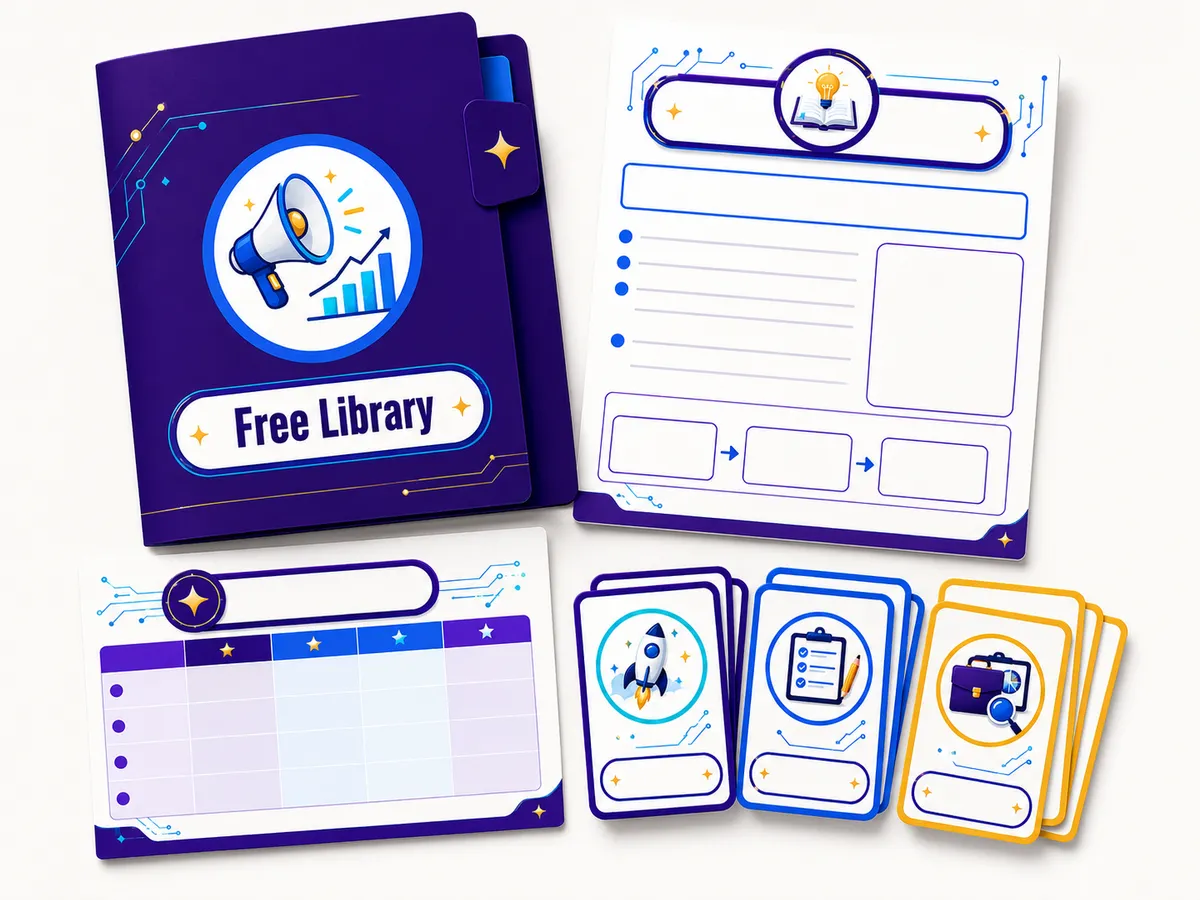
- Your own Free Library of no-prep starting points (bell ringers, a project rubric, first-week activities, a pacing planner) is built to work across both business and tech, so you can walk in with something solid while you figure out which of the bigger curricula fits your room.
For the day-to-day glue (warm-ups and emergency coverage that work in any CTE room), see CTE Bell Ringers and Warm-Ups and CTE Emergency Sub Plans.
Need the full year, not just the tools? The free resources above genuinely cover single lessons, practice, and simulations, and we’d start there. When you need an entire course mapped, aligned, and editable, browse our business and technology curriculum: courses like Personal Finance and AP® Computer Science Principles come with the projects, rubrics, and pacing already assembled.
How do you tell a good free resource from junk (and when is it worth buying)?
Not all free is created equal, and “free” can quietly cost you more than money if it eats your weekend. Here’s the honest screen we use before adding anything to a course.
A free resource is worth your time when:
- The source has a mission, not an ad budget. Made by a nonprofit, agency, or established organization beats a random printable site every time.
- It’s current. Tax law, platforms, and threats change fast in CTE. A finance worksheet citing old contribution limits or a CS lesson built around a dead platform is worse than nothing.
- It’s actually classroom-ready. Real lessons, answer keys, and clear instructions, not just a slick PDF you’ll spend two hours rebuilding into something teachable.
- It aligns to something. Standards, a clear objective, a defined skill. “Looks fun” is not alignment.
And here’s the part most roundups skip: free is genuinely enough for a lot of what you do, but there’s a real line where buying saves you more than it costs. The trade is almost always your time.
| When free is enough | When it’s worth buying | |
|---|---|---|
| Time to adapt | A single lesson or activity you can run as-is | A full year you’d otherwise spend nights and weekends assembling |
| Coverage | One topic, one unit, one good day | An entire course mapped start to finish, no gaps |
| Alignment | You can match it to your standards yourself | You need it already aligned to your state or AP framework |
| Editability | The content fits your room out of the box | You need to edit names, numbers, and pacing to fit your students |
| Support | You’re comfortable troubleshooting solo | You want answer keys, a coherent structure, and someone who’ll fix errors |
Read that table as permission, not a sales pitch. Use the free tools hard. They’re excellent, and we recommend them sincerely. The moment you find yourself rebuilding a free resource from scratch every August, or stitching forty free worksheets into a year that doesn’t quite hang together, that’s when an editable, mapped, paid curriculum stops being a luxury and starts being the cheaper option (because your time is worth something too).
Frequently asked questions
What is the best free personal finance curriculum? Next Gen Personal Finance (NGPF) is the standout: a complete, free personal finance curriculum with full units, lessons, projects, assessments, and answer keys, plus free teacher certification and professional development. Pair it with the SIFMA Foundation’s Stock Market Game and CFPB youth resources for simulations and consumer-side material.
What is the best free curriculum to teach computer science? Code.org is the most complete free option: a full K-12 computer science curriculum with auto-graded practice and teacher training, built for teachers learning alongside their students. CodeHS has a usable free tier as well, and CS Unplugged is great for screen-free intro lessons.
Are there free resources for teaching cybersecurity? Yes. CyberPatriot (the national youth cyber defense competition) doubles as free structure and curriculum, teaching students to harden systems and think like defenders. It works as the spine of a class or a club. For lesson ideas, see Cybersecurity Activities for High School Students.
Where can I find free AI literacy lessons? Day of AI (from MIT) offers a free AI literacy curriculum built for teachers with no AI background, and Common Sense Education has free, classroom-ready AI literacy and media literacy lessons. Both avoid the babyish tone that makes high schoolers tune out.
Is free curriculum good enough, or should I buy? Free is genuinely enough for individual lessons, practice, and simulations, and the tools in this guide are excellent. You usually start paying when you need a full year mapped, aligned to your standards, and editable, so you’re not rebuilding it every August. The trade is your time more than the content quality.
How do I tell a good free resource from a junk one? Check the source (mission-driven nonprofit or agency beats a random printable site), check that it’s current (tax law, platforms, and threats change fast), check that it’s actually classroom-ready with answer keys and clear instructions, and check that it aligns to a standard or a defined skill rather than just looking fun.