
If you just got handed a cybersecurity course and you’re not a security person, here’s the reassuring part: beginner cybersecurity is one of the most teachable subjects in the whole technology hub. It runs on reasoning, not exploits, and the order you teach it in matters more than any single lesson. This guide is the planning piece: what to teach first, a unit-by-unit order you can lift into your pacing guide, and the free curricula that fill in the lessons. (Want the ready-to-run lessons themselves? That’s the activities post; this one is the map.)
What should you teach first in cybersecurity?
Start with the stuff every student already half-lives in: passwords, accounts, and personal digital hygiene. It’s the lowest-intimidation entry point in the whole course, every kid has a stake in it, and it sets up everything that follows (you cannot reason about phishing or malware until “why does this account matter” is real to a student).
Resist the urge to open with networking diagrams or the CIA triad as a vocabulary list. Those land much better once students have a concrete reason to care. Day one should feel like “here’s how you stop getting your stuff stolen,” not “here’s a definition you’ll be quizzed on Friday.”
Do students need to code to learn cybersecurity?
No. This is the single most common worry for teachers handed the course, and it keeps good people out of these rooms for no reason. Beginner cybersecurity is almost entirely conceptual: students reason about risk, defense, and tradeoffs. They analyze a phishing email, they think through what an attacker wants, they decide where a school should spend a limited security budget. None of that requires writing a line of code.
Coding shows up later, and optionally: a student going deep into the field will eventually meet scripting and the command line. But for a first course, treating cybersecurity as a thinking discipline (not a programming one) is both more honest to how the work starts and far more accessible to a mixed-level room. If a student can argue a case, they can do beginner cybersecurity.
A beginner scope and sequence
Here’s the order we’d teach, with a one-line why for each unit. The logic is simple: start where students already live, widen the lens one ring at a time, and end on where this could take them.
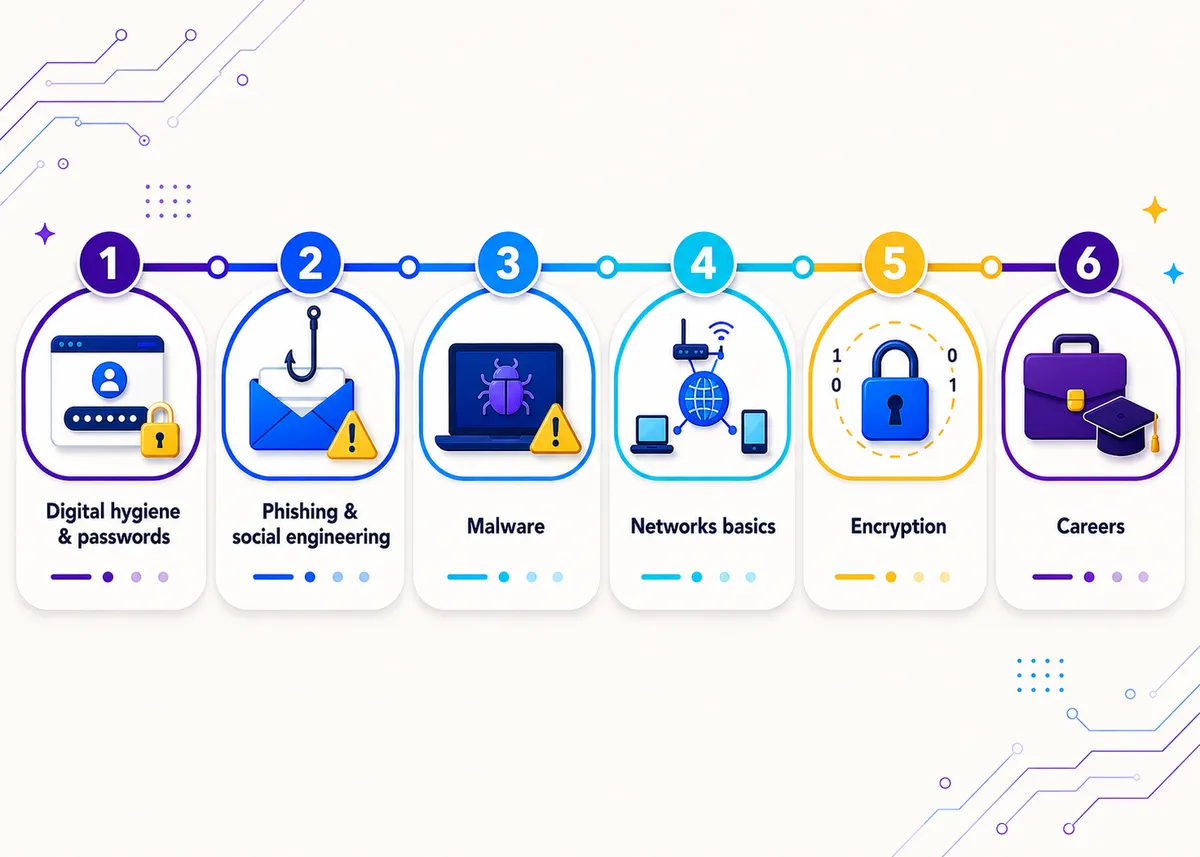
| # | Unit | Why it goes here |
|---|---|---|
| 1 | Digital hygiene & passwords | Lowest-intimidation entry point; every student already has a stake in it. |
| 2 | Phishing & social engineering | The most common real-world attack, and it’s all reasoning, no tools. |
| 3 | Malware | Names the threats students have heard of and explains how they spread. |
| 4 | Networks basics | The “where attacks travel” layer; only now do diagrams make sense. |
| 5 | Encryption | How we actually protect data; pays off everything above it. |
| 6 | Careers & credentials | Ends on the door this opens (jobs, certs, competitions). |
A few notes on why this order and not another:
- Phishing before malware because social engineering is the attack they’re most likely to actually face, and it requires zero technical setup. A phishing teardown is a discussion, not a lab.
- Malware before networks because students already have a fuzzy mental model of “viruses,” so you’re sharpening something familiar before introducing something abstract.
- Networks before encryption because you can’t really explain why we encrypt traffic until students picture data moving across a network in the first place.
- Careers last because by then students have enough vocabulary to see themselves in the field, and it sends them out the door with somewhere to go.
You don’t have to spend equal time on each. Hygiene, phishing, and malware can move quickly and carry a lot of engagement; networks and encryption are where you slow down. The point is the arc, not the minutes.
What free curriculum can you use?
You do not have to build this from scratch. The cybersecurity field is unusually generous with free, classroom-ready material, and a beginner course can be assembled almost entirely from it.
- CodeHS Intro to Cybersecurity is a full beginner course with lessons, activities, and auto-graded exercises. It’s a strong spine if you want something sequenced and ready to assign.
- Teaching Security (teachingsecurity.org) offers free, standards-aligned lessons and activities built specifically for high school classrooms, good for dropping into units you’re assembling yourself.
- The Virginia Cyber Range / US Cyber Range provides free, browser-based virtual lab environments and courseware for educators (Virginia teachers get the most access, but the broader US Cyber Range serves teachers more widely). It’s where you go when you want hands-on practice without setting up your own machines.
And one to know even if you don’t run it day to day: CyberPatriot is the national youth cyber defense competition. It isn’t a curriculum, but it’s a fantastic engagement engine and a natural home for fast finishers and an after-school club. Plenty of teachers use a beginner course as the on-ramp and let interested students compete from there.
Mix and match. A common setup is CodeHS or Teaching Security for the structured lessons, a Cyber Range lab when you want students hands-on, and CyberPatriot as the stretch goal for the kids who catch fire.
How do you keep it engaging?
Cybersecurity has a built-in advantage most subjects would kill for: the stakes feel real to teenagers, because their actual accounts and reputations are on the line. Lean into that.
- Teach through scenarios. “Here’s a suspicious email, talk me through it” beats a lecture on phishing every time. Real artifacts (screenshots, headlines, breach stories) do the motivating for you.
- Make it a little competitive. A classroom capture-the-flag, a “spot the phish” challenge, or a threat-modeling exercise turns reasoning into a game. CyberPatriot exists precisely because this subject rewards competition.
- Keep the stakes low while they learn. Same principle as the rest of the tech hub: students should be able to be wrong cheaply. Nobody’s actually breaking anything, so let them argue, guess, and revise.
- Connect it to careers early and often. This is a field with real jobs and real shortages, and students sit up when they realize the thing they’re doing in fourth period is a paying career.
For the ready-to-run versions of all of this (phishing teardowns, a classroom CTF, threat-modeling prompts), see the sibling Cybersecurity Activities for High School Students. And if you’re heading toward the AP-level course, the planning specifics live in the AP Cybersecurity Teacher Planning Guide.
Frequently asked questions
What should you teach first in cybersecurity? Digital hygiene and passwords. It’s the lowest-intimidation entry point, every student already has a personal stake in it, and it sets up the reasoning behind everything that follows.
Do students need to know how to code to learn cybersecurity? No. Beginner cybersecurity is conceptual: students reason about risk, defense, and tradeoffs. Coding shows up later and optionally, but a first course needs none of it.
What free cybersecurity curriculum can I use? CodeHS Intro to Cybersecurity, Teaching Security, and the Virginia Cyber Range / US Cyber Range all offer free classroom material. CyberPatriot is a free national competition that works well as a stretch goal or club.
How is teaching cybersecurity different from teaching coding? Cybersecurity leads with reasoning rather than syntax. The core skill is thinking like a defender (what’s at risk, who’s attacking, where to spend limited resources), which makes it accessible to students who haven’t coded.
What order should the units go in for a beginner cybersecurity course? Digital hygiene and passwords, then phishing and social engineering, then malware, then networks, then encryption, and finally careers and credentials. The logic is to start where students already live and widen the lens one ring at a time, so each unit gives them a reason to care about the next.
How do you keep a beginner cybersecurity class engaging? Teach through real scenarios (a suspicious email to dissect, a breach in the news) and add light competition like a classroom capture-the-flag or a “spot the phish” challenge. Keep the stakes low so students can be wrong cheaply, and connect every unit to real careers. For ready-to-run versions, see the Cybersecurity Activities for High School Students post.
Where to go next
This post is one spoke of the technology hub. For the wider view of teaching the whole tech side of CTE (CS, AI literacy, digital citizenship, and lab management), start with the cornerstone: How to Teach High School Technology.
Want no-prep starting points? The Free Library has bell ringers, a project rubric, and first-week activities that work across the tech hub. If you’d rather have the year already sequenced, our editable AP Cybersecurity curriculum follows the same start-where-students-live arc laid out above, and its opening Introduction to Security unit handles the digital-hygiene and defender-mindset groundwork for you.
AP® is a trademark registered by the College Board, which is not affiliated with, and does not endorse, this product.