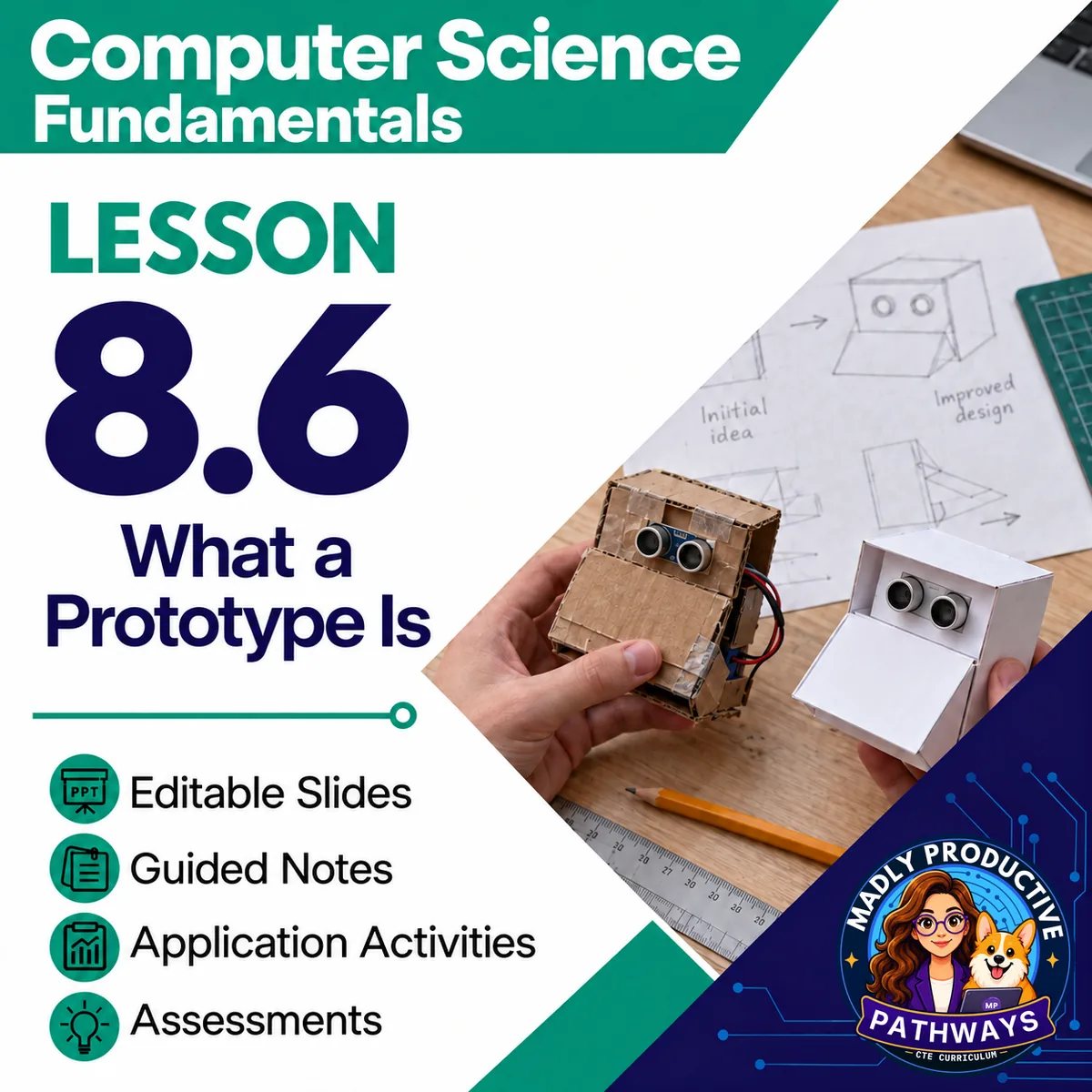
What a Prototype Is
 Computer Science Fundamentals Grades 9–12 3-day lesson 26 deliverables
This micro:bit lesson teaches students what a prototype is and how designers make one better. In the Quick Prototype lab, they build a vote device, have a partner try it out, then change it for the next version.
● Instant download · Lifetime access · Editable & print-ready
 Print + digitalPDF, PowerPoint, Word & Google
 Answer keysA key for every page
 Built-in assessmentExit tickets + lesson quiz
 45-minute daysEvery day planned and timed
What does this lesson cover?
Students often think a prototype has to be finished and free of mistakes, or that it's done once the maker likes it. This lesson shows them that a prototype is an early version made to be tried out and improved. It also teaches teamwork directly, so students learn that a disagreement doesn't mean the team is failing.
The lab on Day 1 has an online version that uses MakeCode, Microsoft's free editor. Students build in MakeCode, a free website with a micro:bit simulator, on a computer or tablet, with no account and no micro:bit. They build version 1 of a vote device, a partner tries it out, and they build version 2 with one change. Every online version comes with a paper version, so no internet is needed.
Quick Prototype
Students build version 1 of a vote device, a partner tries it out, and they make one change for version 2, on paper or in MakeCode.
Everything that's included
 00 Start Here
- READ FIRST: every file in the lesson and when you use it
- Teacher guide and pacing: the plan for each day, what to print and how to grade
- Skills map: which standards each day teaches
 01 Present
- One editable PowerPoint deck for all three days, 28 slides, with speaker notes
- Slide script: the speaker notes, printed
- Bell ringers: a short warm-up for each day
 02 Student Handouts
- Guided notes for all three days, in PDF and editable Word, with the word bank on the page
- Vocab slip: the lesson's words and what they mean, on one page
 03 Labs
- Quick Prototype: build version 1 of a vote device, a partner tries it out, and make one change for version 2, on paper or in MakeCode
 04 Activities
- Team Talk: write how they'd use the five steps for three disagreements on a design team, then role-play one with a partner
- Prototype or Product? Sort eight things as a prototype or a finished product, with a reason, and write the definition of a prototype
 05 Assessment
- Exit tickets, one per day: quick questions that show who needs more help
- Lesson quiz: 10 multiple-choice questions and 2 written answers about all three days
06 Answer Keys
- 5 answer key files: a key for each day (its bell ringer, notes and exit ticket) and the activity and lab keys, plus the quiz key

 Digital: Google Forms™ + Google Slides™
- 4 Google Forms™ of the exit tickets and the quiz, ready to copy into your Drive
- The multiple choice grades itself, and you grade the written answers
- A Google Slides™ copy of the deck, with the same slides and speaker notes, for Google Classroom™
 Online: MakeCode
- MakeCode, Microsoft's free editor: the online version of the Day 1 lab, with a micro:bit simulator
- No account and no micro:bit needed
- Every online version has a paper version, so no internet is needed
Why teachers love this lesson
 Students improve a design with feedback
A partner tries the first version, and students make one change for the next, so they see how testing makes a design better.
 Students practice handling a team conflict
They use I-statements, active listening and compromise to work through disagreements, then role-play a case with a partner.
Print and digitalEvery page is a print-ready PDF, and the Google Forms™ and Google Slides™ let you teach the same lesson in Google Classroom™.
Real online activitiesStudents can use MakeCode on a computer or tablet, and every online version has a paper version that works with no internet.
A key for every pageEvery day has its own answer key, and every written question has a sample answer and what to look for.
Every day fits a 45-minute classEach day's plan is timed activity by activity against real reading and writing speeds.
What Teachers Say
Be the first to review this
Reviews help me a lot, and they help other teachers pick the right resources for their classes. It takes about a minute.
Leave a reviewQuestions teachers ask
How do I get the files after I buy?
Instant download right after checkout: PowerPoint and Word files you can edit, print-ready PDFs, and links that copy the Google Forms™ and Google Slides™ into your Drive.
Can I buy the whole unit or course instead?
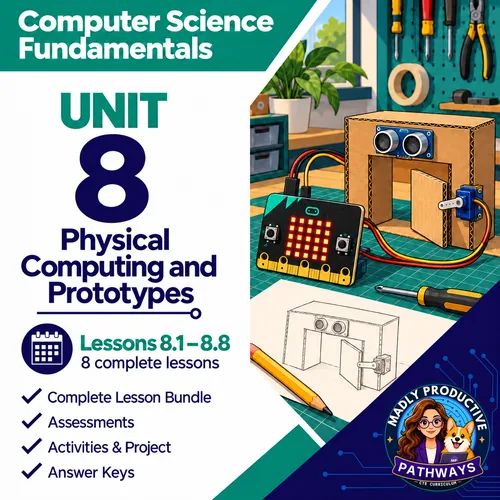
Yes. This lesson is part of the Unit 8 bundle and the complete Computer Science Fundamentals course. Both cost less than buying the lessons one at a time.
Is this AP Computer Science?
No. It is a full-year, non-AP intro course for grades 9 to 12. For AP, see AP Computer Science Principles and AP Computer Science A.
What formats are the files in?
Every page is a print-ready PDF. The slides are an editable PowerPoint and the guided notes an editable Word file. The exit tickets and the quiz also come as Google Forms™, and the deck as Google Slides™.
Which standards does it cover?
Written for Florida's Advanced Information Technology course (9007610). The skills map in the lesson shows which standards each day teaches.
Do I need micro:bits or robots?
No. MakeCode is a free website with a micro:bit simulator, and every online version comes with a paper version.