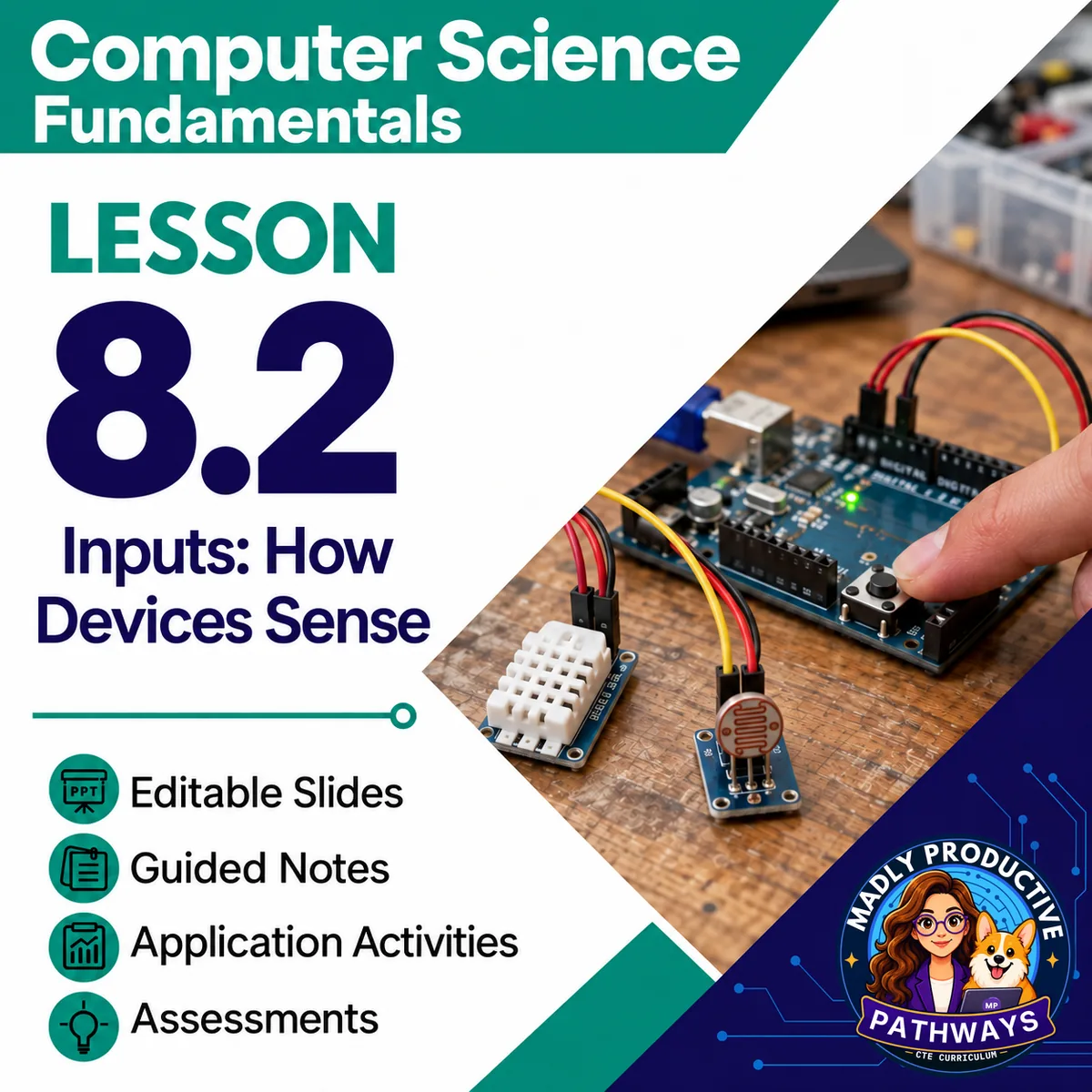
Inputs: How Devices Sense
 Computer Science Fundamentals Grades 9–12 3-day lesson 26 deliverables
In this micro:bit lesson, students learn how a device senses the world with inputs like buttons, a light sensor and a temperature sensor. They study devices at Sweetgum Road Greenhouse and at home, naming the input each one uses, the reading it gets and how it responds.
● Instant download · Lifetime access · Editable & print-ready
 Print + digitalPDF, PowerPoint, Word & Google
 Answer keysA key for every page
 Built-in assessmentExit tickets + lesson quiz
 45-minute daysEvery day planned and timed
What does this lesson cover?
Students often think a sensor knows what it senses, or that a computer only gets input when someone types or clicks. This lesson shows them that a sensor gives the program a reading, and the program decides what to do. They also learn when to use an if block and when to use a wait until block, which students often mix up.
The lab on Day 2 has an online version that uses Robot Maze, our online game, in the Sense It level. It practices using buttons A and B, the light sensor and the temperature sensor, so one program works in every test. Every online version comes with a paper version, so no internet is needed. Our game is free, with no accounts or sign-ins.
Sense It
Students program four input rooms and write each program and what the robot does in each test, on paper or in Robot Maze.
Everything that's included
 00 Start Here
- READ FIRST: every file in the lesson and when you use it
- Teacher guide and pacing: the plan for each day, what to print and how to grade
- Skills map: which standards each day teaches
 01 Present
- One editable PowerPoint deck for all three days, 27 slides, with speaker notes
- Slide script: the speaker notes, printed
- Bell ringers: a short warm-up for each day
 02 Student Handouts
- Guided notes for all three days, in PDF and editable Word, with the word bank on the page
- Vocab slip: the lesson's words and what they mean, on one page
 03 Labs
- Sense It: program four input rooms and write each program and what the robot does in each test, on paper or in Robot Maze
 04 Activities
- Sense and Respond: sort six devices at Sweetgum Road Greenhouse and at home by the input each one uses, with the reading it gets and how it responds
- What Will It Do? Predict what a greenhouse robot cart does in four programs on paper
 05 Assessment
- Exit tickets, one per day: quick questions that show who needs more help
- Lesson quiz: 10 multiple-choice questions and 2 written answers about all three days
06 Answer Keys
- 5 answer key files: a key for each day (its bell ringer, notes and exit ticket) and the activity and lab keys, plus the quiz key

 Digital: Google Forms™ + Google Slides™
- 4 Google Forms™ of the exit tickets and the quiz, ready to copy into your Drive
- The multiple choice grades itself, and you grade the written answers
- A Google Slides™ copy of the deck, with the same slides and speaker notes, for Google Classroom™
 Online: Robot Maze
- Robot Maze, Sense It level: the online version of the Day 2 lab
- Every online version has a paper version, so no internet is needed
- Free to play, with no accounts or sign-ins
Why teachers love this lesson
 Students meet the micro:bit's sensors
They learn what its light sensor, temperature sensor and accelerometer measure, and that it senses light with its LEDs because it has no camera.
 One test is not enough
Some rooms have more than one test, so students learn that a program that works once may still fail the next test.
Print and digitalEvery page is a print-ready PDF, and the Google Forms™ and Google Slides™ let you teach the same lesson in Google Classroom™.
Real online activitiesStudents can use Robot Maze on a computer or tablet, and every online version has a paper version that works with no internet.
A key for every pageEvery day has its own answer key, and every written question has a sample answer and what to look for.
Every day fits a 45-minute classEach day's plan is timed activity by activity against real reading and writing speeds.
What Teachers Say
Be the first to review this
Reviews help me a lot, and they help other teachers pick the right resources for their classes. It takes about a minute.
Leave a reviewQuestions teachers ask
How do I get the files after I buy?
Instant download right after checkout: PowerPoint and Word files you can edit, print-ready PDFs, and links that copy the Google Forms™ and Google Slides™ into your Drive.
Can I buy the whole unit or course instead?
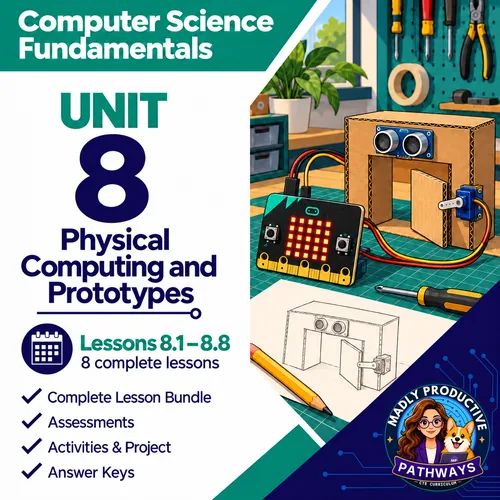
Yes. This lesson is part of the Unit 8 bundle and the complete Computer Science Fundamentals course. Both cost less than buying the lessons one at a time.
Is this AP Computer Science?
No. It is a full-year, non-AP intro course for grades 9 to 12. For AP, see AP Computer Science Principles and AP Computer Science A.
What formats are the files in?
Every page is a print-ready PDF. The slides are an editable PowerPoint and the guided notes an editable Word file. The exit tickets and the quiz also come as Google Forms™, and the deck as Google Slides™.
Which standards does it cover?
Written for Florida's Advanced Information Technology course (9007610). The skills map in the lesson shows which standards each day teaches.
Do I need micro:bits or robots?
No. Robot Maze is a free browser game, and every online version comes with a paper version.