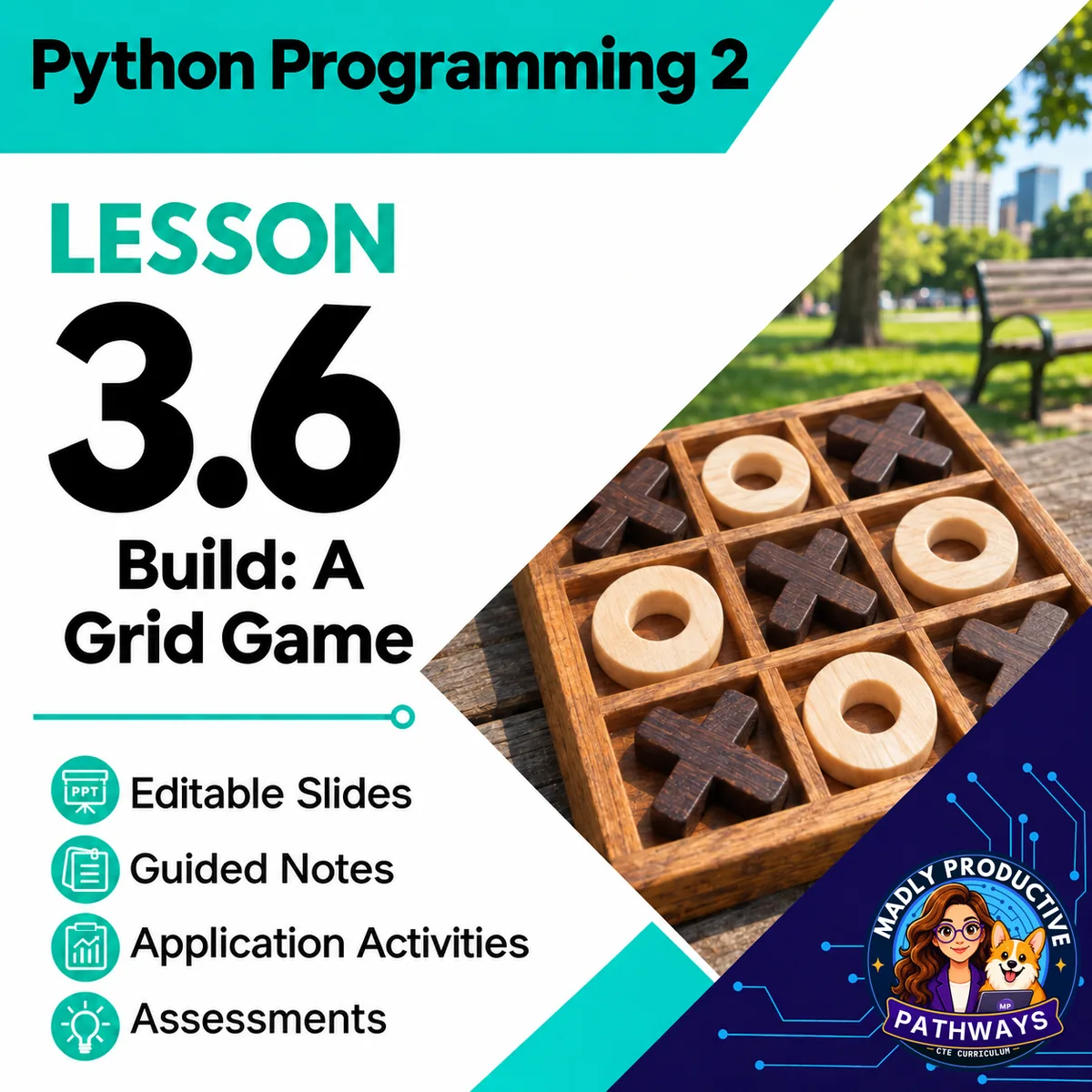
Build: A Grid Game
 Python Programming 2 Grades 9–12 2-day lesson 24 deliverables
Teach students to plan, build and test a game in Python that runs on a grid. Students pick Tic-Tac-Toe, Sea Battle, Treasure Hunt or their own idea and plan the starting grid, the functions and the end check. They build a game that shows the board after each turn, asks for a row and a column with checked input and returns a (row, col) tuple.
● Instant download · Lifetime access · Editable & print-ready
 Print + digitalPDF, PowerPoint, Word & Google
 Answer keysA key for every page
 Built-in assessmentExit tickets + project rubric
 45-minute daysEvery day planned and timed
A short coding level practices this lesson in CodeGrove, our code lab that runs in the browser. Students write the program, run it and check it, with no account and nothing to install. Use it with the lesson or as practice later.
Open the levelWhat does this lesson cover?
A game can seem to work until it fails to stop or never notices a win. This project has students plan the end check before they code. A partner plays a whole game with bad answers, so students test every way the game can end.
The build runs online in CodeGrove, our in-browser code lab, on both days, so students need a computer or tablet. Students pick one of 4 builds: My Own Grid Game, Sea Battle, Tic Tac Toe or Treasure Hunt. The Grid Game Build level practices building a game on a grid that shows the board after each turn, asks for a row and a column with a checked input, returns a (row, col) tuple, changes the grid and stops at an end check. On the last day, students send the turn-in Form with their CodeGrove link. CodeGrove is free, with no accounts, sign-ins or installs.
Grid Game Build
Students build their grid game in CodeGrove, have a partner play it and turn it in with the turn-in Form. Students pick one of 4 builds: My Own Grid Game, Sea Battle, Tic Tac Toe or Treasure Hunt.
Everything that's included
 00 Start Here
- READ FIRST: every file in the lesson and when you use it
- Teacher Guide and Pacing: the plan for each day, what to print and how to grade
- Skills map: which standards each day teaches
 01 Present
- One editable PowerPoint deck for both days, 13 slides, with speaker notes
- Slide script: the speaker notes, printed
- Bell ringers: a short warm-up for each day
 02 Student Handouts
- Guided notes: one packet for both days, in PDF and editable Word. Students fill in the blanks during the slides, with the word bank on the page
- Vocab slip: the lesson's words and what they mean, on one page
 03 Labs
- Grid Game Build: students build their grid game in CodeGrove, have a partner play it and turn it in with the turn-in Form. Students pick one of 4 builds: My Own Grid Game, Sea Battle, Tic Tac Toe or Treasure Hunt
 04 Activities
- Plan Your Game: students pick one idea and plan it: the starting grid, a table of the functions they write, the end check in plain steps, three musts and two bad answers to test
- Partner Play Log: partners play one whole game of each other's grid game and type two bad answers
 05 Assessment
- Exit tickets: quick questions that show who needs more help
- Project rubric: what the whole project is graded on, row by row
06 Answer Keys
- 3 answer key files: a key for each day (its bell ringer, notes and exit ticket) and the activity and lab keys

 Digital: Google Forms™ + Google Slides™
- 3 Google Forms™ of the exit tickets and the turn-in Form, ready to copy into your Drive
- The multiple choice grades itself, and you grade the written answers
- A Google Slides™ copy of the deck, with the same slides and speaker notes, for Google Classroom™
 Online: CodeGrove
- In CodeGrove: the Grid Game Build on both days, on a computer or tablet for each student
- Free to use, with no accounts, sign-ins or installs
Why teachers love this lesson
 The end check needs a plan
Students plan the starting grid, the functions and what each one returns, and the check that stops the game.
 A partner play test finds what the author missed
A partner plays one whole game and types bad answers. Students fix what fails and retest every answer.
Print and digitalEvery page is a print-ready PDF, and the Google Forms™ and Google Slides™ let you teach the same lesson in Google Classroom™.
Real online labsStudents write and run real Python in CodeGrove, our in-browser code lab, on a computer or tablet, with no accounts or installs.
A key for every pageEvery day has its own answer key, and every written question has a sample answer and what to look for.
Every day fits a 45-minute classEach day's plan is timed activity by activity against real reading and writing speeds.
What Teachers Say
Be the first to review this
Reviews help me a lot, and they help other teachers pick the right resources for their classes. It takes about a minute.
Leave a reviewQuestions teachers ask
How do I get the files after I buy?
Instant download right after checkout: PowerPoint and Word files you can edit, print-ready PDFs, and links that copy the Google Forms™ and Google Slides™ into your Drive.
Can I buy the whole unit or course instead?
Yes. This lesson is part of the Unit 3 bundle and the complete Python Programming 2 course. Both cost less than buying the lessons one at a time.
Is this AP Computer Science?
No. It is a full-year, non-AP second course in Python for grades 9 to 12. For AP, see our AP Computer Science A and AP CSP courses.
What should students know before this lesson?
Students know list methods, the loop patterns, tuples, grids and how to check input.
Do students need computers?
Yes, on the CodeGrove days. Each student needs a computer or tablet that's online, and CodeGrove needs no account or install. The bell ringers, notes, exit tickets and quiz are on paper.
What formats are the files in?
Every page is a print-ready PDF. The slides are an editable PowerPoint and the guided notes an editable Word file. The exit tickets and the turn-in Form also come as Google Forms™, and the deck as Google Slides™.
Which standards does it cover?
Written for Florida's Intermediate Programming course (9007220). The skills map in the lesson shows which standards each day teaches.