 Java Programming Grades 9–12 2-day lesson 22 deliverables
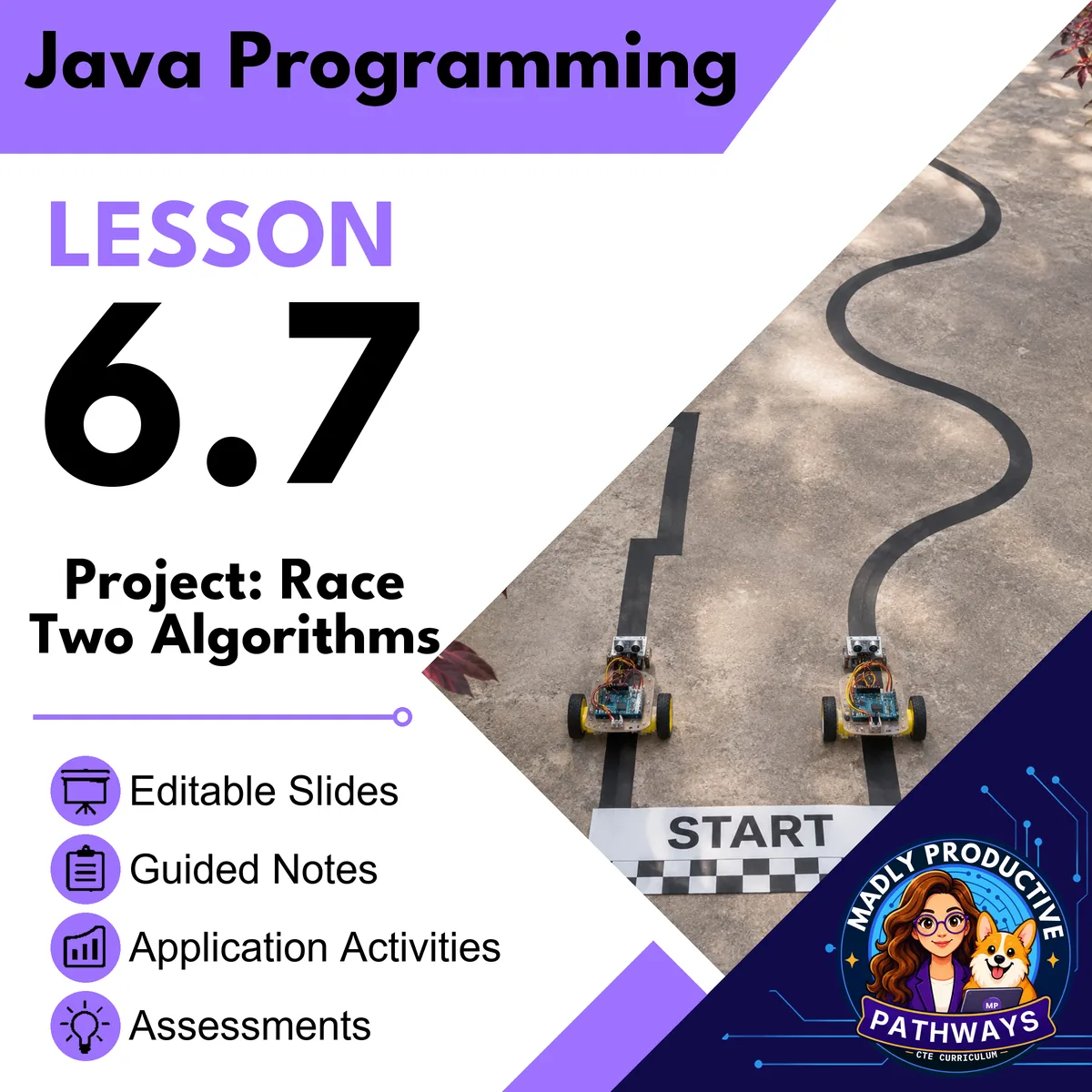
Teach students to race two algorithms fairly in Java and explain what the counts and the times tell them. Students pick one race, such as a recursive sum against a loop and two threads, and plan it on paper. In our online code lab, they finish the race's method until Check passes and run three sizes three times each. They finish with a five-sentence race report.
● Instant download · Lifetime access · Editable & print-ready
 Print + digitalPDF, PowerPoint, Word & Google
 Answer keysA key for every page
 Built-in assessmentExit tickets + project rubric
 45-minute daysEvery day planned and timed
A short coding level practices this lesson in CodeGrove, our code lab that runs in the browser. Students write the program, run it and check it, with no account and nothing to install. Use it with the lesson or as practice later.
Open the level→Students may time one run and call a winner, or expect two threads to always be twice as fast. This lesson has them run each size more than once, use the middle time and compare the counts. They back up every claim with their own results table.
The build runs online in CodeGrove, our in-browser code lab, on both days, so students need a computer or tablet. Students pick one of 3 builds: Search Race, Sort Race or Sum Race. The Race Two Algorithms level practices finishing one race's method (a recursive sum and two threads, two step counters, or a selection sort's swap), passing Check, then running three sizes three times each and comparing the counts and the times. On the last day, students send the turn-in Form with their CodeGrove link. CodeGrove is free, with no accounts, sign-ins or installs.
Students finish one race in Race Two Algorithms, in CodeGrove, our online code lab. Students pick one of 3 builds: Search Race, Sort Race or Sum Race.
 00 Start Here
 01 Present
 02 Student Handouts
 03 Labs
 04 Activities
 05 Assessment06 Answer Keys

 Digital: Google Forms™ + Google Slides™
 Online: CodeGrove
 Students test their claims with their own numbers
Each race gets three sizes and three runs at each size, and students fill a results table with the counts and the times.
 Counts and times tell different things
The counts stay the same every run while the times change, so students use the middle time and explain which algorithm they would use.
Print and digitalEvery page is a print-ready PDF, and the Google Forms™ and Google Slides™ let you teach the same lesson in Google Classroom™.
Real online labsStudents write and run real Java in CodeGrove, our in-browser code lab, on a computer or tablet, with no accounts or installs.
A key for every pageEvery day has its own answer key, and every written question has a sample answer and what to look for.
Every day fits a 45-minute classEach day's plan is timed activity by activity against real reading and writing speeds.
Reviews help me a lot, and they help other teachers pick the right resources for their classes. It takes about a minute.
Leave a reviewInstant download right after checkout: PowerPoint and Word files you can edit, print-ready PDFs, and links that copy the Google Forms™ and Google Slides™ into your Drive.
Yes. This lesson is part of the Unit 6 bundle and the complete Java Programming course. Both cost less than buying the lessons one at a time.
No. It is a full-year, non-AP Java course for grades 9 to 12, and it is not built for the AP exam. For AP, see our AP Computer Science A and AP CSP courses.
Students can write recursive methods, count the steps of a search and the compares of a sort, and start and join threads.
Yes, on the CodeGrove days. Each student needs a computer or tablet that's online, and CodeGrove needs no account or install. The bell ringers, notes, exit tickets and quiz are on paper.
Every page is a print-ready PDF. The slides are an editable PowerPoint and the guided notes an editable Word file. The exit tickets and the turn-in Form also come as Google Forms™, and the deck as Google Slides™.
Written for Florida's Advanced Programming course (9007230). The skills map in the lesson shows which standards each day teaches.