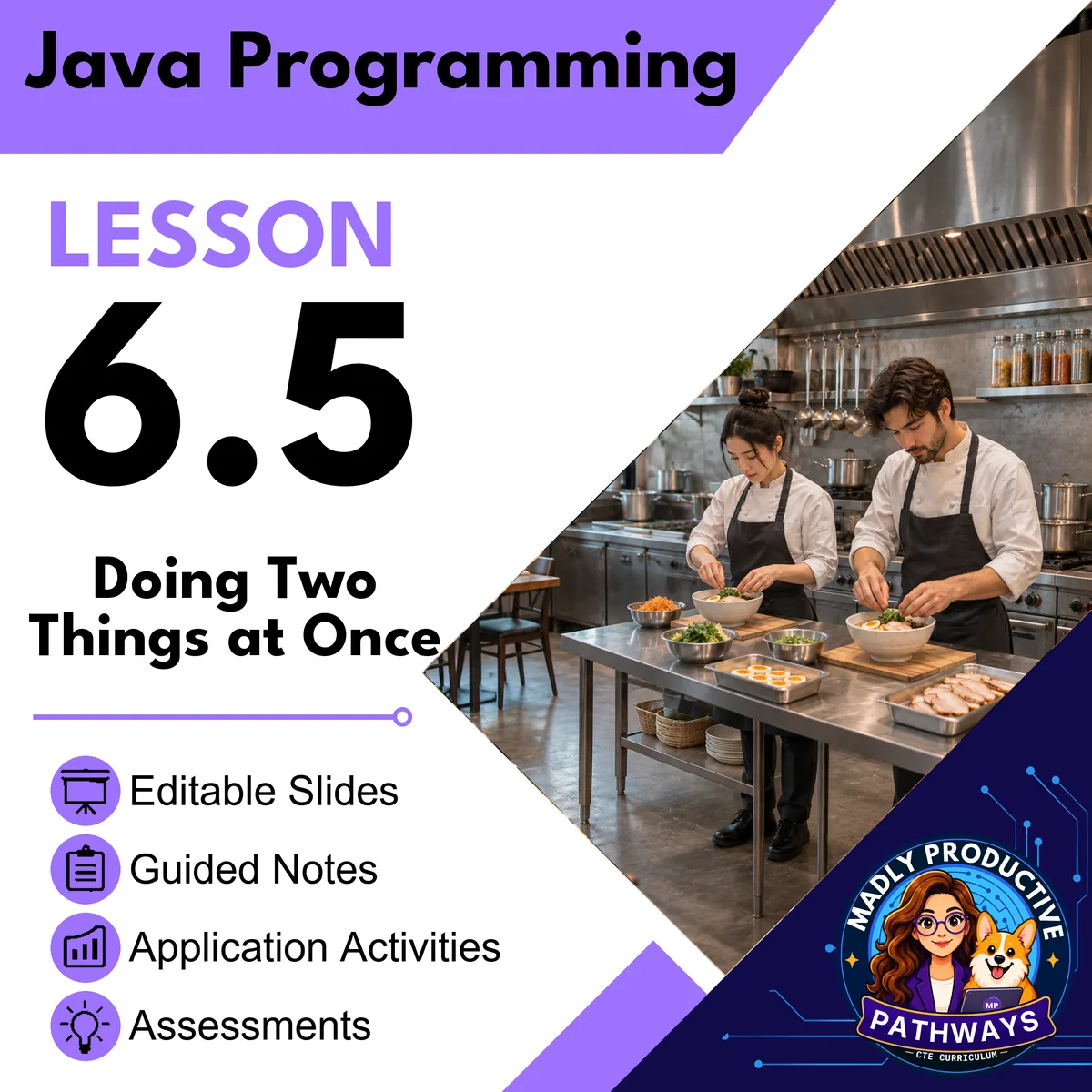
 Java Programming Grades 9–12 2-day lesson 21 deliverables
Teach students how a big job can be split into parts that run at the same time, and why that is not always much faster. Students add grids of numbers in three timed rounds, first alone, then in pairs, then in groups of four. In our online code lab, they write a Java method that adds one part of an array, so two calls can split the job.
● Instant download · Lifetime access · Editable & print-ready
 Print + digitalPDF, PowerPoint, Word & Google
 Answer keysA key for every page
 Built-in assessmentExit tickets + lesson quiz
 45-minute daysEvery day planned and timed
A short coding level practices this lesson in CodeGrove, our code lab that runs in the browser. Students write the program, run it and check it, with no account and nothing to install. Use it with the lesson or as practice later.
Open the level→Students often think twice the workers means twice as fast, or that every job can be split. This lesson has them time the same job with more and more workers. They see that the last step waits for every part and that some jobs can't be split.
The quiz task on Day 2 runs online in CodeGrove, our in-browser code lab, so students need a computer or tablet on that day. The 6.5 Quiz Task level practices writing a method that adds one part of an array, so that two calls split the job of adding it. CodeGrove is free, with no accounts, sign-ins or installs.
Students add three grids of 64 numbers in three timed rounds, first alone, then in pairs, then in groups of four, all on paper with computers closed.
 00 Start Here
 01 Present
 02 Student Handouts
 04 Activities
 05 Assessment06 Answer Keys

 Digital: Google Forms™ + Google Slides™
 Online: CodeGrove
 Students time the speedup themselves
The teacher writes each round's time on the board, so students can see how much faster pairs and groups of four really are.
 The combined answer waits for every part
Each part adds its own numbers, and the last step adds the parts together only after all of them finish.
Print and digitalEvery page is a print-ready PDF, and the Google Forms™ and Google Slides™ let you teach the same lesson in Google Classroom™.
Real online labsStudents write and run real Java in CodeGrove, our in-browser code lab, on a computer or tablet, with no accounts or installs.
A key for every pageEvery day has its own answer key, and every written question has a sample answer and what to look for.
Every day fits a 45-minute classEach day's plan is timed activity by activity against real reading and writing speeds.
Reviews help me a lot, and they help other teachers pick the right resources for their classes. It takes about a minute.
Leave a reviewInstant download right after checkout: PowerPoint and Word files you can edit, print-ready PDFs, and links that copy the Google Forms™ and Google Slides™ into your Drive.
Yes. This lesson is part of the Unit 6 bundle and the complete Java Programming course. Both cost less than buying the lessons one at a time.
No. It is a full-year, non-AP Java course for grades 9 to 12, and it is not built for the AP exam. For AP, see our AP Computer Science A and AP CSP courses.
Students can write a method that adds the items of an array in a for loop, use a static field, and catch an error with try and catch.
Yes, on the CodeGrove days. Each student needs a computer or tablet that's online, and CodeGrove needs no account or install. The bell ringers, notes, exit tickets and quiz are on paper.
Every page is a print-ready PDF. The slides are an editable PowerPoint and the guided notes an editable Word file. The exit tickets and the quiz also come as Google Forms™, and the deck as Google Slides™.
Written for Florida's Advanced Programming course (9007230). The skills map in the lesson shows which standards each day teaches.