
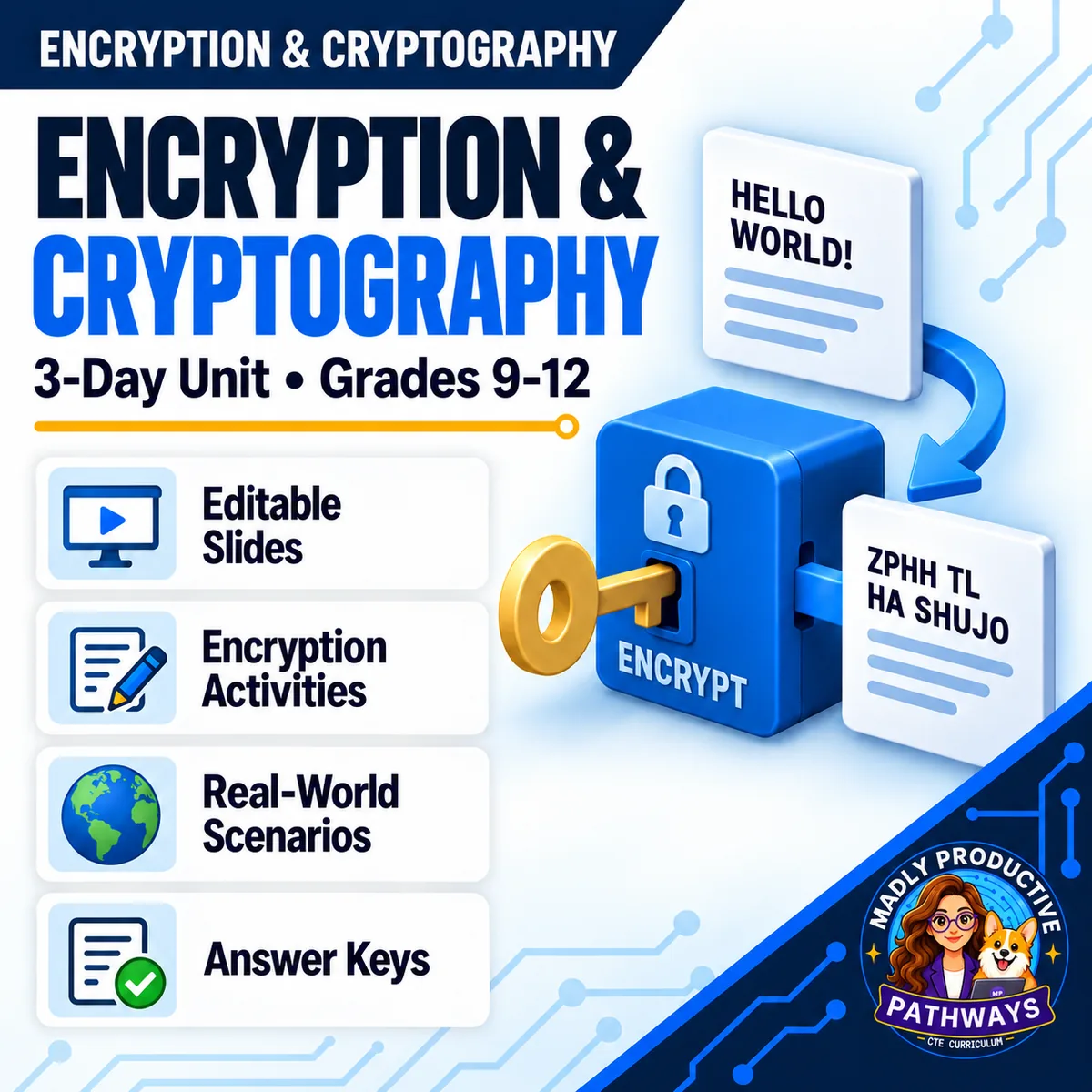
Encryption & Cryptography
 Cybersecurity Grades 9–12 3-day unit 32 deliverables
 Students hear “it's encrypted” and stop asking questions. Three complete lessons that start with a Caesar cipher they break by hand, move to the shared keys and key pairs protecting their phones, and end on the part nobody teaches — what cryptography cannot protect and what a lock icon does not prove.
● Instant download · Lifetime access · Editable & print-ready
 Editable formatsPowerPoint, Word, PDF & Google
 Every page keyedNothing says “answers will vary”
 Self-grading formsThe quiz and all 3 exit tickets
 No background neededPrint it and teach it
What does this unit cover?
Three days that move from a cipher students can break with a pencil to the encryption already running on their phones. Day 1 is How Ciphers Hide a Message — plaintext, ciphertext, the Caesar shift, and why a cipher with only 25 keys falls apart in minutes. Day 2 is How Encryption Works Today — shared keys, key pairs, in transit versus at rest, and the metadata end-to-end encryption still leaves behind. Day 3 is What Cryptography Can and Can't Do — signatures, certificates, why encoding is not encryption, and the honest answer on quantum computers.
Each day runs the same way: a bell ringer, guided notes off the deck, a printed activity in the middle where the learning actually happens, and an exit ticket collected on the way out. Every activity was costed against real reading and writing rates, so each day fits inside a 45-minute period with time to spare.
Everything follows the same open-and-teach folders as the rest of the line: 00 Start Here / 01 Present / 02 Student Handouts / 03 Scenarios / 04 Activities / 05 Assessment / 06 Answer Keys. Every student page is written to a grade 9-10 reading level, with the real technical terms taught first and then used.
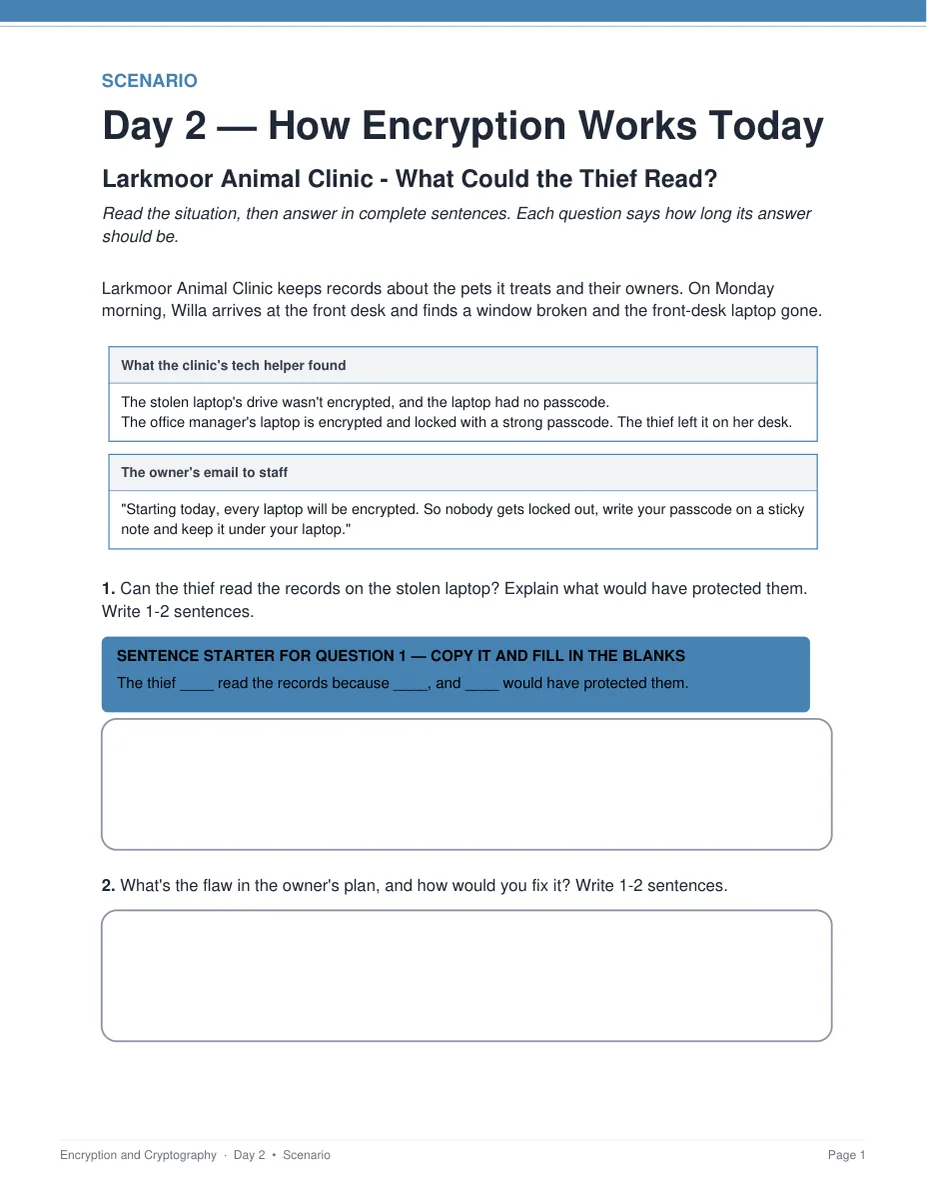
Larkmoor Animal Clinic — What Could the Thief Read?
A thief takes the front-desk laptop from a small animal clinic. Its drive was not encrypted and it had no passcode, while the encrypted, passcode-locked laptop beside it was left behind. Students say what the thief can read and what would have stopped it, then find the flaw in the owner's fix-it plan — the one that tells staff to keep the passcode on a sticky note under the laptop. Keyed with sample answers.
Everything that's included
 00 Start Here: Teacher
- READ FIRST guide: what to print, in what order
- Teacher guide and pacing: measured minute-by-minute timings
- Skills Map and state standards, with a ready-to-paste prompt for your own state's wording
 01 Present: Whole class
- One editable PowerPoint deck per day (42 slides, 10 with pictures)
- Three printable bell ringers, one per day
 02 Student Handouts
- Guided notes for all three days, in editable Word and print PDF
- Vocabulary glossary: all 30 terms, defined in the order the notes teach them
 03 Scenarios
- Larkmoor Animal Clinic — What Could the Thief Read?, keyed
- Dunmere High School — Were the Tips Protected?, a second long-form case, keyed
 04 Activities
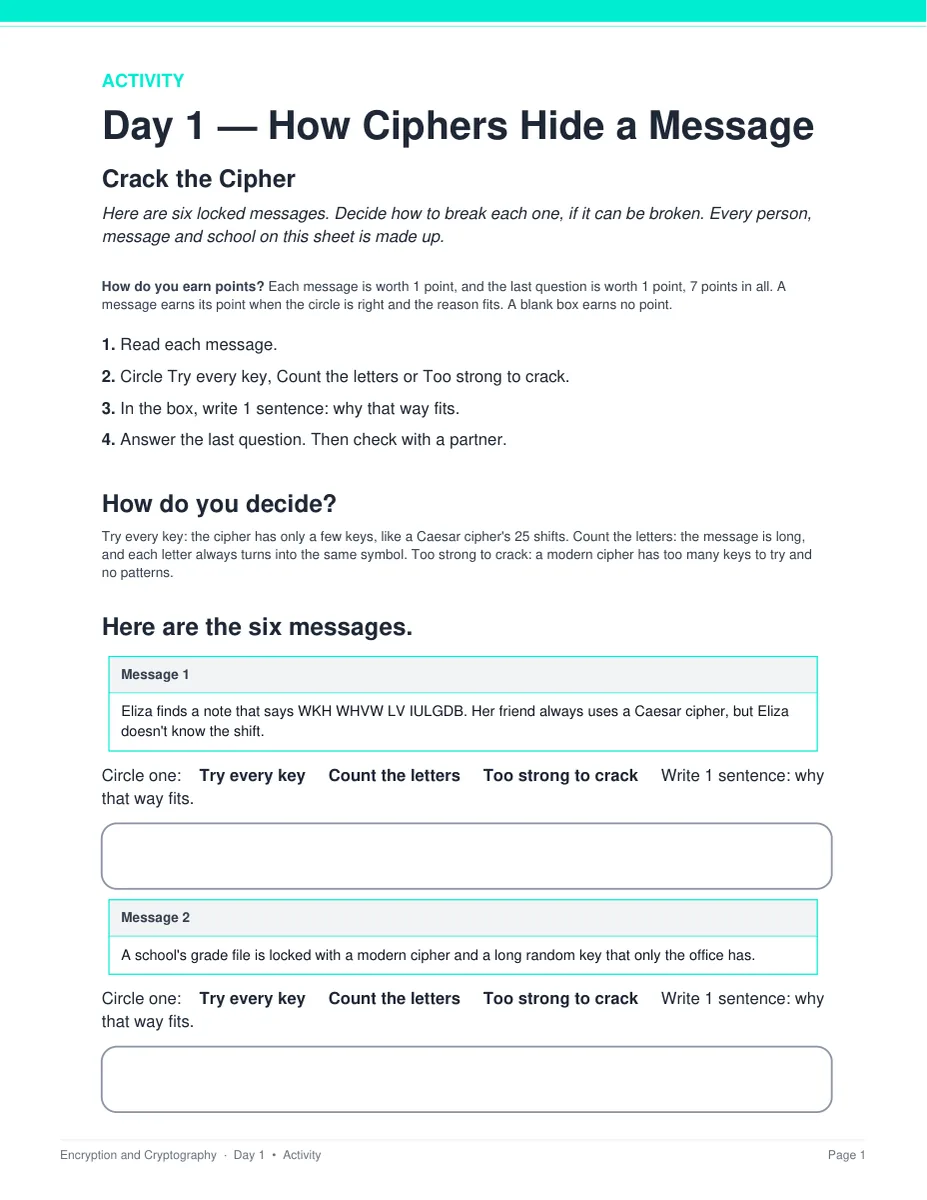
- Crack the Cipher: six locked messages, and how you would break each one
- Where Is It Protected: in transit, at rest or end to end
- What's the Job: keeps it private, proves who sent it, or shows if it changed
 05 Assessment
- Three exit tickets, one per day, 4 points each
- Unit quiz: 28 points, 20 multiple choice and 4 written
Digital: self-grading Google Forms™
- The unit quiz and all three exit tickets as ready-to-assign forms (26 auto-graded items)
- Multiple choice grades itself on submit, with feedback on every wrong answer; written responses land in your response sheet
06 Answer Keys
- Six key PDFs, 19 pages: every activity, scenario, exit ticket and the quiz
- Every written prompt keyed with what to look for, a model response, what else to accept, and what to reject
See the actual pages
Page one of four real files out of the download, exactly as they print.
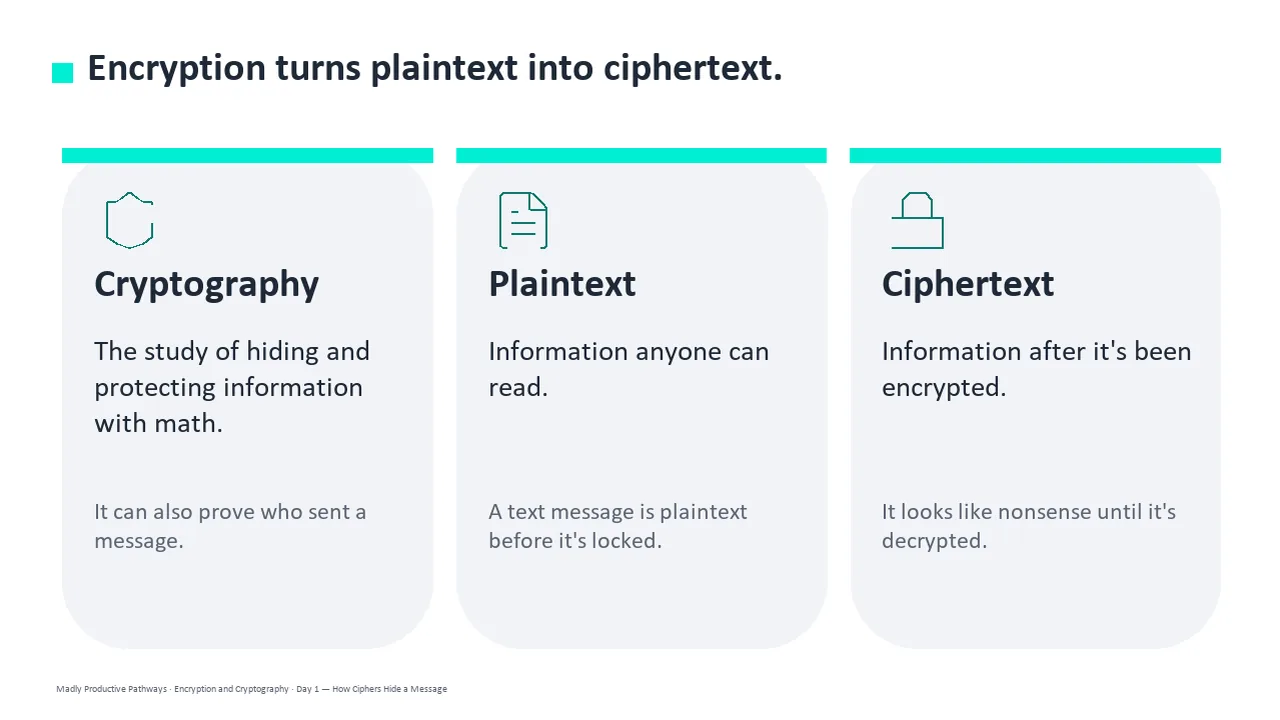
One editable deck per day
Fourteen slides a day, low text, with ten pictures across the three days. The icons and layouts are real shapes rather than flat images — recolor them to match your room, or delete any of them.
- ✓ 42 slides across the three days
- ✓ Native PowerPoint, opens in Google Slides
- ✓ The guided notes follow the slides in order
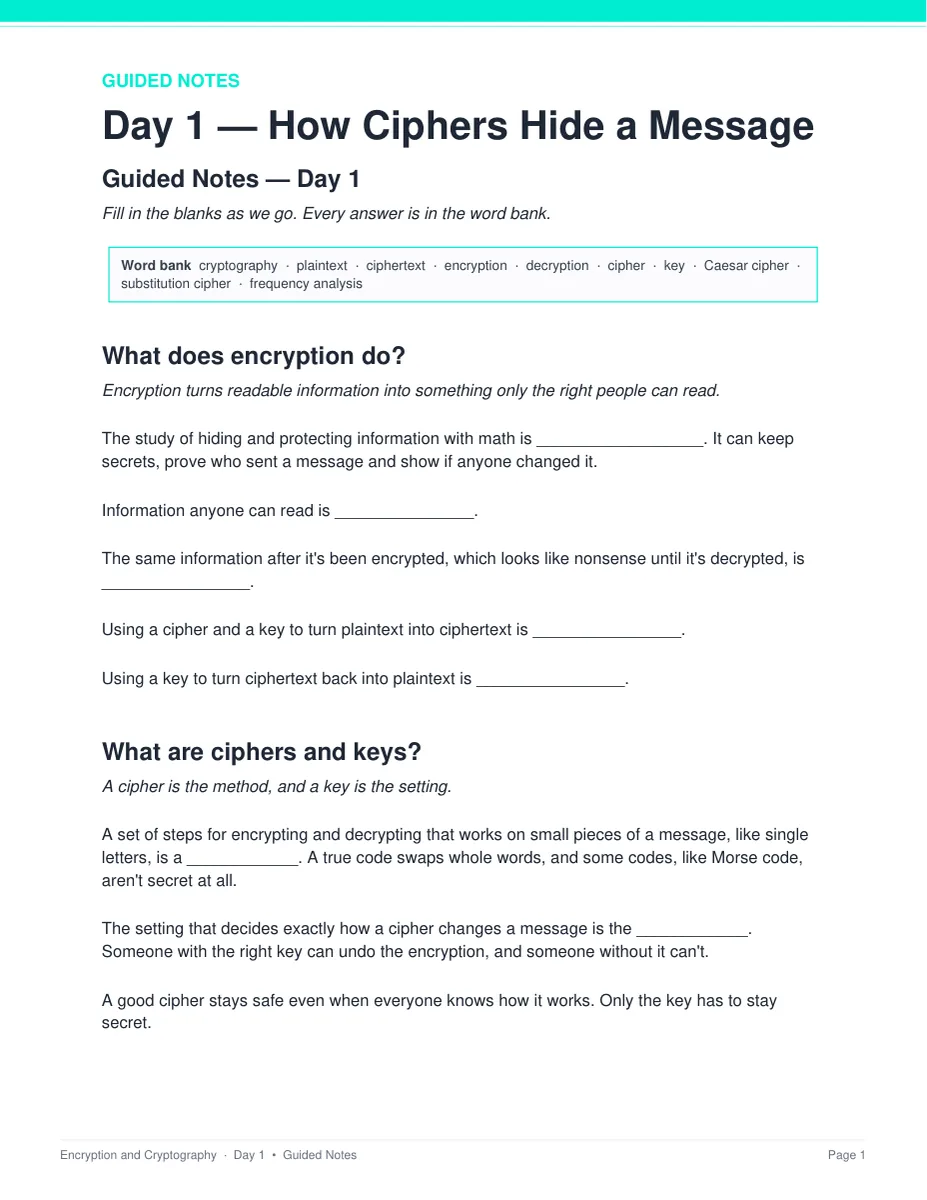
Notes students fill in as you teach
Two pages a day with a word bank at the top and real room to write, ending on a Remember box with the day's big idea. Editable Word and print-ready PDF, and every one has a complete key.
- ✓ Three days, Word and PDF, two pages each
- ✓ Grade 9-10 reading level
- ✓ Full answer key for every page
An incident that happened to nobody real
Two long-form cases about places that do not exist: a clinic that loses a laptop, and a student newspaper that told its readers the tips were encrypted when they were only encoded. Students work out what happened and what would actually have protected it, then defend the call.
- ✓ Larkmoor Animal Clinic and Dunmere High School
- ✓ Two pages and 6 points each
- ✓ Teacher key with sample answers
One printed sheet a day, six cases to argue over
Six short cases a sheet, with the answer boxes printed on the same page the student writes on. Nothing to cut out, laminate or post. Students work alone first, then check with one partner, and every item is keyed with a sample answer and the rule for the point.
- ✓ Crack the Cipher, Where Is It Protected, What's the Job
- ✓ Two pages and 7 points each
- ✓ Answer keys for all three activities
Why teachers pick this unit
 It corrects what students believe
“It's encrypted, so it's safe” is where most classes start. Three days later they can say what encryption protects, what it still leaves visible, and what a lock icon does not prove.
Nothing says “answers will vary”Every written question ships with what to look for, a model response, what else to accept, and what to reject.
The timings are measuredEvery activity was costed against real reading and writing rates. Each day fits a 45-minute period, and the extras are labeled as finish-early work.
 No background needed
Written for a teacher who has never taught cryptography. The READ FIRST says what to print and when, the pacing guide gives the minute-by-minute shape of each day, and every page has a key.
 Nothing in it is a how-to
No activity asks a student to break real encryption, decode real files or get past a security warning. Every message students decrypt was written for the page, and every person, school and business in a case is made up.
Print and digitalPrint-ready PDFs plus self-grading Google Forms™ for the quiz and all three exit tickets.
What Teachers Say
Be the first to review this
Reviews help me a lot, and they help other teachers pick the right resources for their classes. It takes about a minute.
Leave a reviewQuestions teachers ask
How do I get the files after I buy?
Instant download right after checkout. You get editable PowerPoint and Word, print-ready PDF of everything, and the links for the self-grading Google Forms™.
Do I need a computer science background?
No. Every term is taught on the slides before a student page uses it, and the guided notes follow the slides in order on all three days. The READ FIRST guide says exactly what to print and when, and every page has a key. There is no math in it beyond counting letters along the alphabet.
Does it ask students to break real encryption?
No. No activity asks a student to break real encryption, decode real files or get past a security warning. The only messages students decrypt are short ones written for the page, and the day that walks through a Caesar shift ends by telling students never to try it on real files or accounts.
When does the unit quiz happen?
It sits after the three lessons, not inside them. The quiz is about 25 minutes and all three periods are full lessons. Run it as a Day 4 in class or set it as a take-home with the Google Form. Either way you already have a grade for every student from the three exit tickets.
What standards does it map to?
The 2026 CSTA standards with their 2017 equivalents — HS-ALG-PS-03 (3B-AP-11) on Day 1, HS-SYS-SE-31 (3A-NI-08 and 3B-NI-04) on Day 2, and HS-SYS-SE-33 on Day 3 — plus Common Core RST.9-10.3, RST.9-10.4 and RST.9-10.5 with their 11-12 equivalents. A Skills Map is included, and page 2 has a ready-to-paste prompt for converting it to your own state's wording.
Can I buy this with the other cybersecurity units?
Yes. The Cybersecurity Unit Bundle holds this unit plus Phishing & Social Engineering, Deepfakes & AI Scams, Cyber Attacks & Malware, and Passwords & Account Security — 17 days in one download, for less than the five bought separately.