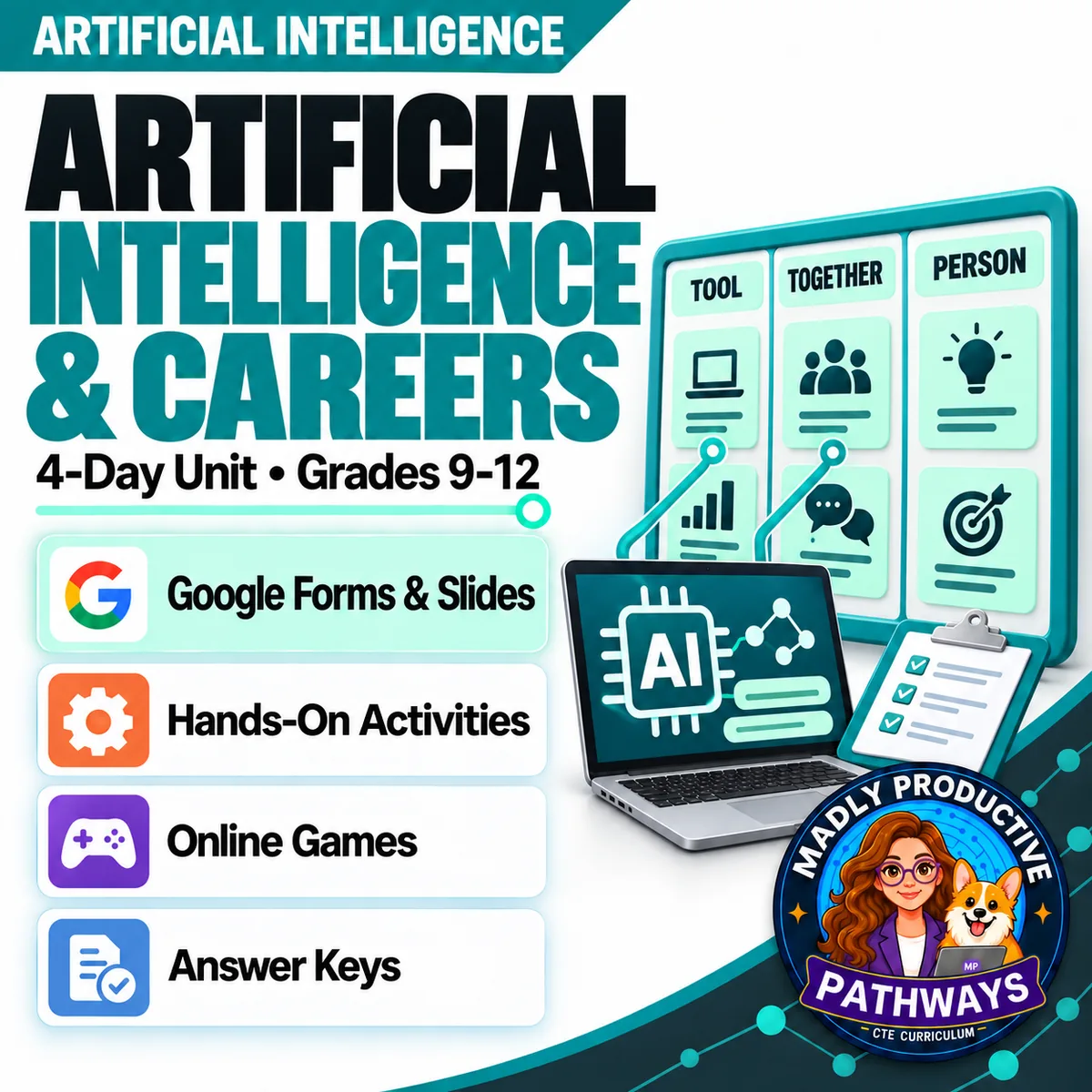
Artificial Intelligence & Careers
 Artificial Intelligence Grades 9–12 4-day unit 41 deliverables
Most lessons about AI and jobs ask which jobs are safe. Four complete days that teach students to look at any job one task at a time: which tasks AI can help with, how jobs and skills change, who answers for work a tool helped with, and what happens when AI reads a job application. The lessons run on paper, and the online games are optional.
● Instant download · Lifetime access · Editable & print-ready
 Print + digitalPDF, PowerPoint, Word & Google
 Self-grading Google FormsThe quiz and all 4 exit tickets
 4 online gamesComputer or tablet, no account
 Every page keyedNothing says “answers will vary”
Short browser games that practice each day's lesson with new examples. Students play on a computer or tablet, with no account and nothing to install. Use one with the lesson or instead of the paper activity.
See the gamesWhat does this unit cover?
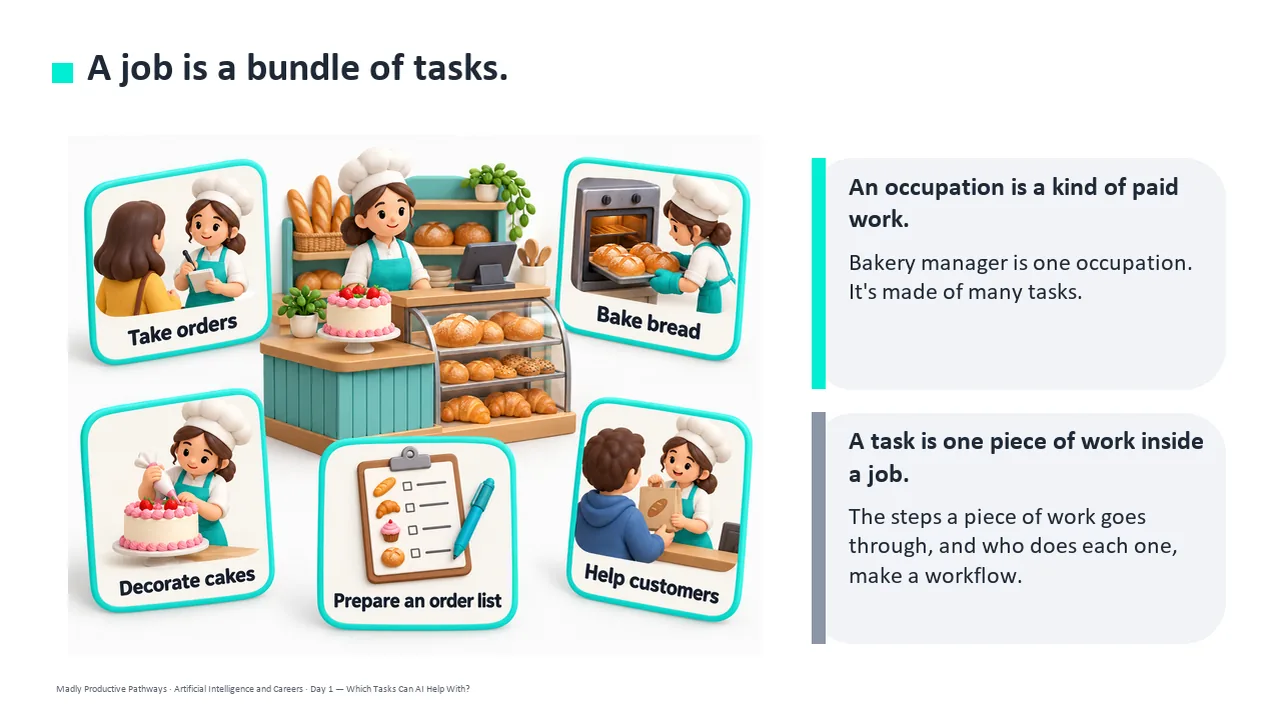
Most lessons about AI and jobs ask which jobs are safe. This one teaches students how to look at any job one task at a time. Day 1 breaks a job into tasks. Software can automate some of them, help with others while a person checks and decides, and leave the tasks that need judgment, empathy or hands-on work to a person. Day 2 follows the time that moves between tasks when a tool helps, and judges claims about the future of a job by their source and evidence. A projection isn't a promise.
Day 3 is about work a tool helped with. The person who sends or signs off on the work is accountable, so students check that a tool is approved before any data goes in, compare the draft with the source, follow the workplace policy and say when a tool helped. Day 4 is what happens when AI reads an application. A screening tool can miss a real skill written in different words, so students describe their real skills in the posting's words and learn they can ask for an accommodation or a human review.
It never promises a job is safe or doomed, and every person, workplace, posting and number a student reads is made up. Everything follows the same open-and-teach folders as the rest of the line: 00 Start Here / 01 Present / 02 Student Handouts / 03 Scenarios / 04 Activities / 05 Assessment / 06 Answer Keys.
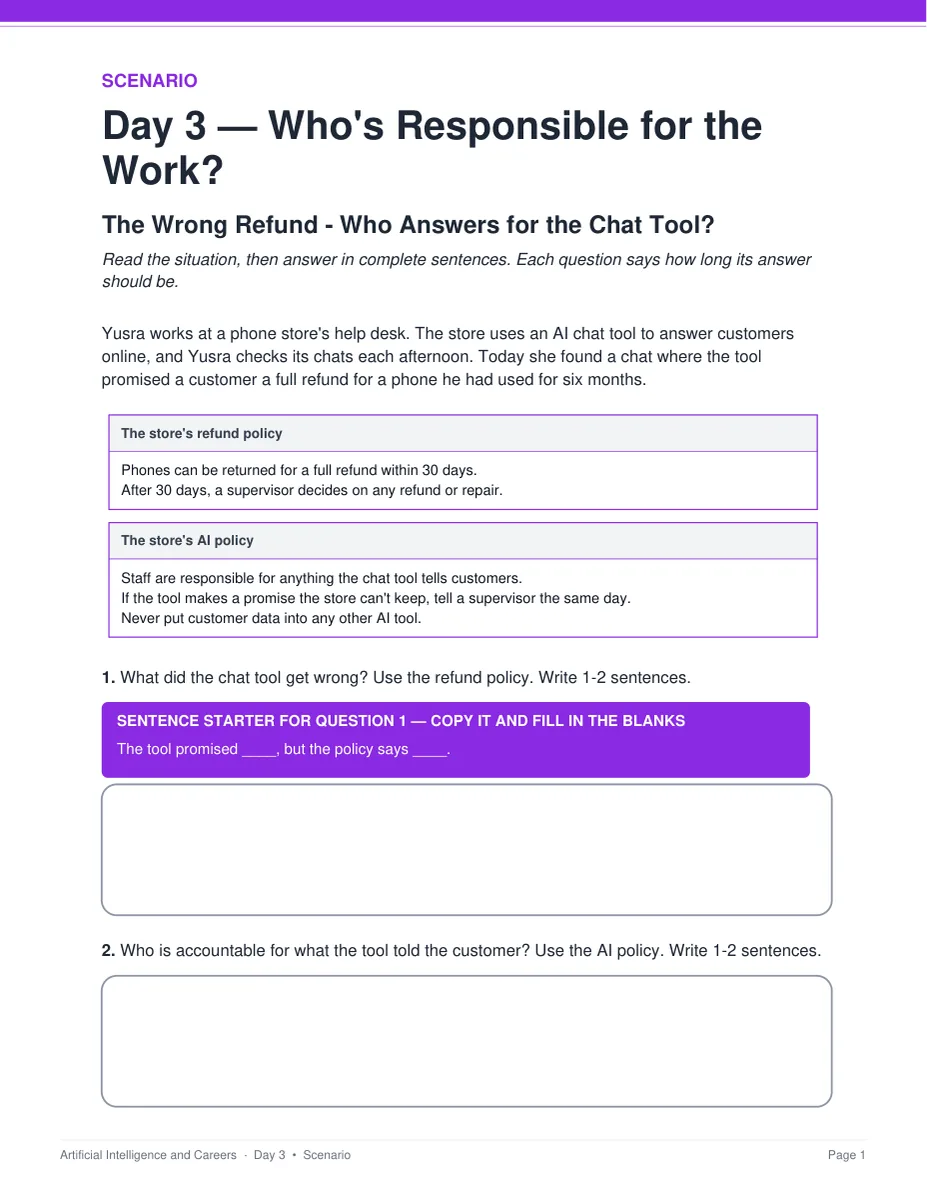
The Wrong Refund — Who Answers for the Chat Tool?
Yusra works at a phone store's help desk, and each afternoon she checks the chats from the store's AI chat tool. Today she found a chat where the tool promised a customer a full refund on a phone he had used for six months. The page prints the store's refund policy, which allows 30 days and then leaves any refund to a supervisor, and its AI policy, which makes staff responsible for anything the chat tool tells a customer. Students say what the tool got wrong, who is accountable, and what Yusra should do next and which check would stop it happening again. Two pages, three questions and 6 points, with a key that gives what to look for, a model response and what to accept or reject.
Everything that's included
 00 Start Here: Teacher
- READ FIRST teacher guide: what to print, in what order, and how to use the online games
- Teacher guide and pacing: each day's four time slots, minute by minute, plus each online game's link, play time and a question to ask afterward
- Skills Map and state standards, each code checked against its official wording, plus a ready-to-paste prompt for your own state

 01 Present: Whole class
- One editable PowerPoint deck per day (52 slides, 13 a day), with speaker notes
- The slide script: every speaker note, printed in order
- Four printable bell ringers, one warm-up per day
 02 Student Handouts
- Guided notes for all four days, in editable Word and print PDF
- Vocabulary glossary: all 40 terms, ten a day, defined
 03 Scenarios
- The Wrong Refund — Who Answers for the Chat Tool? — Day 3, two pages, 6 points, keyed
- The Rejection Email — What Can Zeke Do? — Day 4, two pages, 6 points, keyed
 04 Activities
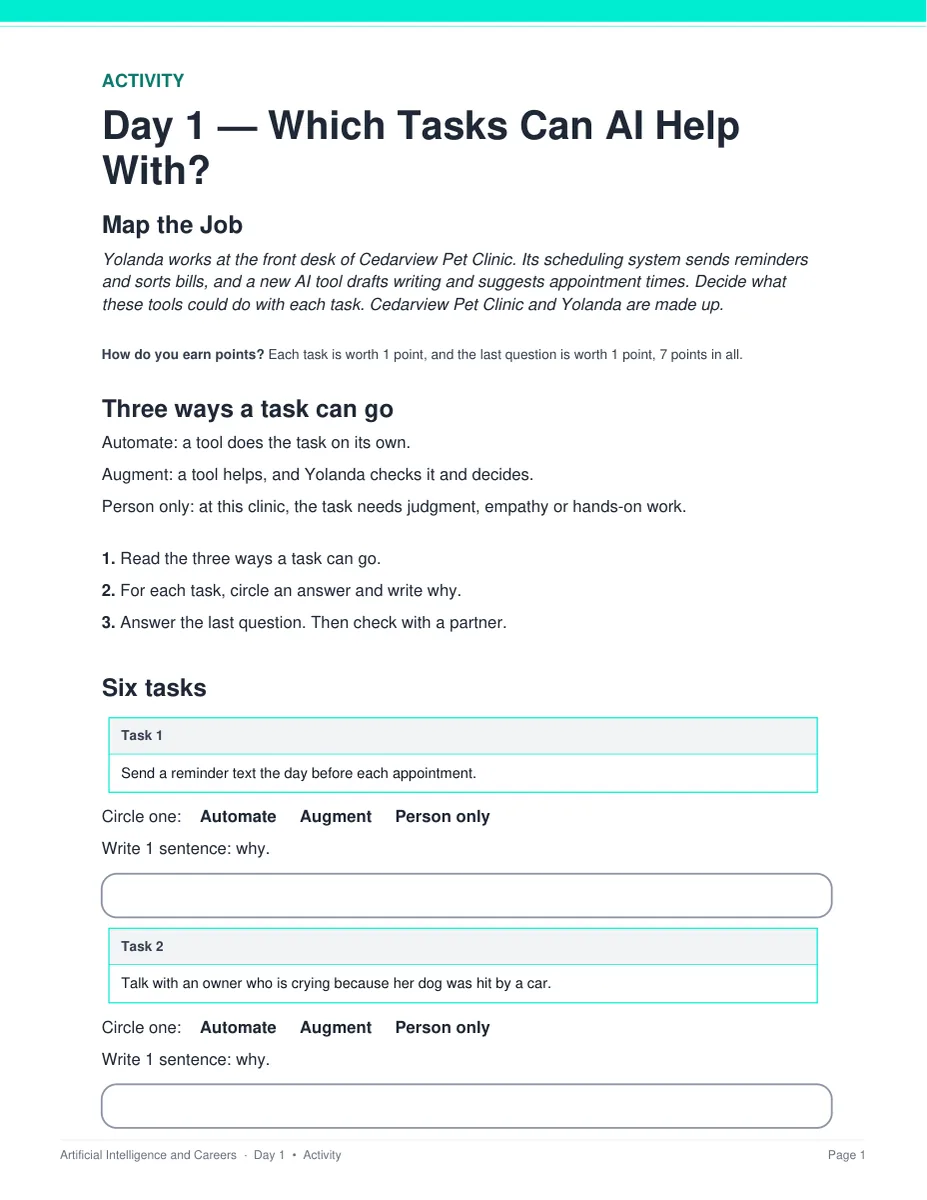
- Map the Job — Day 1: six front-desk tasks at a made-up pet clinic, each marked Automate, Augment or Person only
- Then and Now — Day 2: one worker's day before and after an AI tool, in minutes, to find what shrank, what's new and what grew
- What Went Wrong? — Day 3: three workplace incidents; what went wrong, who is accountable and which check would have stopped it
- Read It Like a Screener — Day 4: a made-up job posting and a screening tool's notes on three applicants; say what the tool missed and ask for a human review
- Two pages and 7 points each, and each one is a different shape. Everything prints on the sheet students write on — nothing to cut out or laminate
 05 Assessment
- Four exit tickets, one per day: 2 multiple choice and 1 written, 4 points each
- Unit quiz: 28 points, 20 multiple choice and 4 written, about 25 minutes
Digital: Google Forms™ and Google Slides™
- Five ready-to-assign Google Forms — the unit quiz and all four exit tickets — with 28 auto-graded items
- Multiple choice grades itself on submit, with feedback on every wrong answer; the written answers land in your response sheet for you to mark
- Four Google Slides decks, one per day, with the same slides as the PowerPoint files
- Every link makes a copy in your own Drive
Online games
- Task Shop — Day 1, about 7 to 10 minutes: decide which tasks a tool can do alone, which need a worker's check and which only the worker can do, then run the shift
- Future Desk — Day 2, about 8 to 10 minutes: open the source behind a job headline and pick the conclusion the evidence supports
- Incident Replay — Day 3, about 7 to 10 minutes: watch a mistake happen at work, then place the check that stops it before the harm
- Fair Screen — Day 4, about 7 to 10 minutes: fix a screening tool's rules so it accepts the same skill in different words and drops requirements the job doesn't need
- They play in the browser on a computer or tablet, with no account. Use one in addition to the lesson or instead of that day's paper activity. Each game's short link prints on its day's activity sheet and answer key, and the teacher guide lists all four
06 Answer Keys
- Seven key PDFs, 23 pages: every day's bell ringer, guided notes and exit ticket, every activity, both scenarios and the quiz
- Every written prompt keyed with what to look for, a model response and what to accept or reject — and every activity item carries a sample answer and a rule for the point
See the actual pages
One slide or page from four real files in the download, exactly as they appear.
One editable deck per day
Thirteen slides a day, low text, with the icons and layouts built as real shapes rather than flat images. The speaker notes say what to point to and what to say, and every deck also comes as Google Slides.
- ✓ 52 slides across the four days
- ✓ PowerPoint, plus a Google Slides copy of every deck
- ✓ 20 pictures, five a day
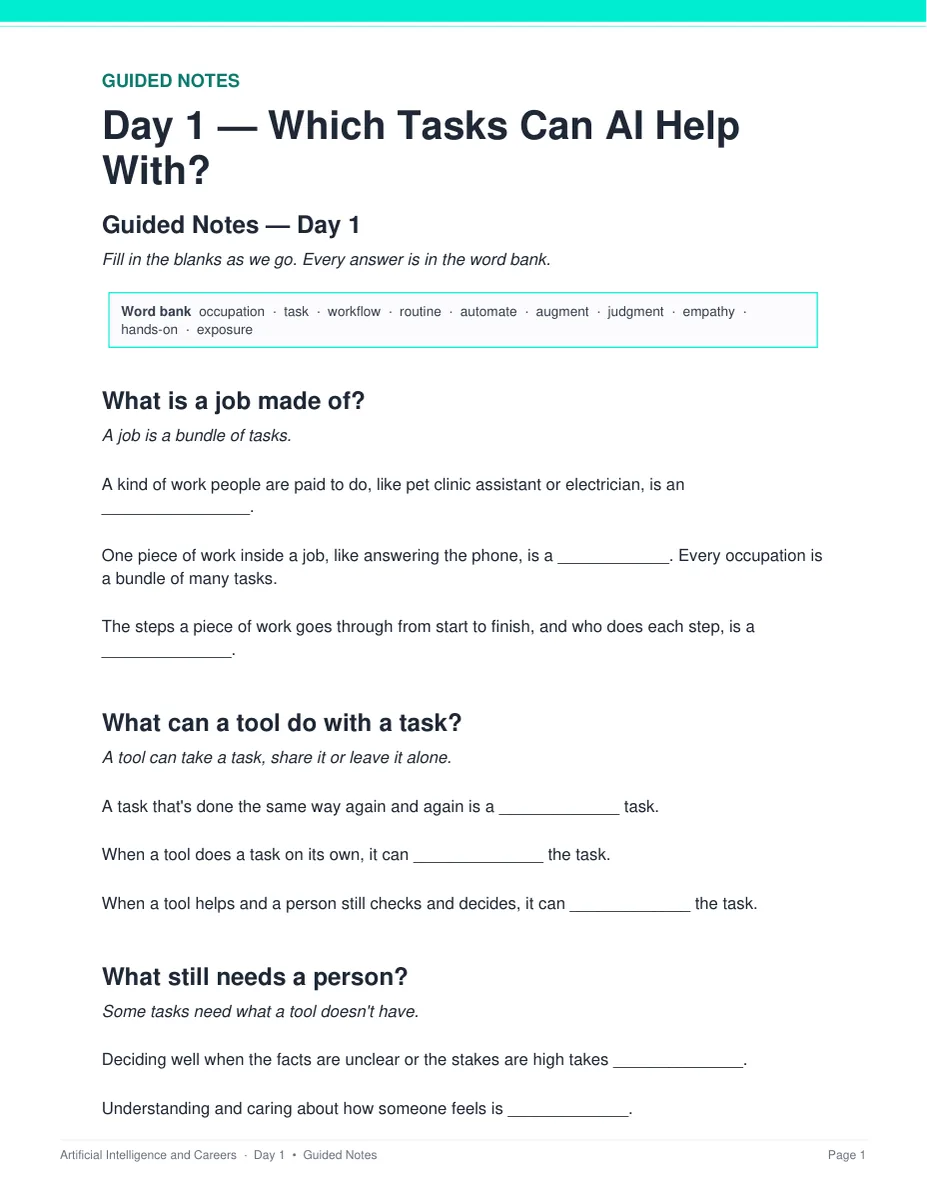
Notes students fill in as you teach
Two pages per day, following the slides in order, with that day's ten terms in a word bank on the page. Editable Word and print-ready PDF, and every one has a complete key.
- ✓ Four days, Word and PDF
- ✓ 40 terms, every one also in the glossary
- ✓ Full answer key for every page
The refund a chat tool promised
Two long-form cases, two pages each. Every person, store and policy in them is invented. Students read the policies printed on the page, then answer three questions in one or two sentences each.
- ✓ The Wrong Refund and The Rejection Email
- ✓ A sentence starter under the first question
- ✓ Scored out of 6, with a full key
Six tasks at one front desk
Yolanda works the front desk at a made-up pet clinic that uses scheduling software and a new AI tool. For each of her six tasks, students circle Automate, Augment or Person only and write why, then check with a partner.
- ✓ Two pages, 7 points, Day 1
- ✓ Nothing to cut out or laminate
- ✓ A sample answer and a rule for every point
Why teachers pick this unit
 One task at a time
Instead of asking which jobs are safe, students break any job into tasks and see which a tool can do, which it can help with, and which still need a person.
Your name on the workDay 3 keeps a person accountable for work a tool helped with, with checks before it goes out. Day 4 shows what a screening tool can miss and what an applicant can ask for.
Nothing says “answers will vary”Every written question ships with what to look for, a model response, and what to accept or reject. Every activity item has a sample answer and a rule for the point.
 Safe to hand out as it is
No student opens an AI tool, makes an account or applies for a job. Every person, workplace, posting and number is invented, and the real research stays in the teacher guide.
Four online gamesTask Shop, Future Desk, Incident Replay and Fair Screen, one for each day, practice the same skills with new cases in the browser on a computer or tablet.
 Print and digital
Print-ready PDFs, every deck in PowerPoint and Google Slides™, and five self-grading Google Forms™ for the quiz and all four exit tickets.
What Teachers Say
Be the first to review this
Reviews help me a lot, and they help other teachers pick the right resources for their classes. It takes about a minute.
Leave a reviewQuestions teachers ask
How do I get the files after I buy?
Instant download right after checkout. You get editable PowerPoint and Word, print-ready PDF of everything, and the copy links for the five self-grading Google Forms™ and the four Google Slides™ decks.
Does it tell students which jobs are safe?
No. It never promises a job is safe or doomed. Students learn to look at any job one task at a time: which tasks software can automate, which it can help with while a person checks and decides, and which still need judgment, empathy or hands-on work. A tool changing some tasks doesn't by itself tell you whether a worker keeps the job.
Is this a resume or career-exploration unit?
No. Day 4 is about how a screening tool reads an application, what it can miss, and what an applicant can ask for, like an accommodation or a human review. It doesn't teach resume format.
Do I need a technical background to teach it?
No. The READ FIRST guide says you don't need any tech background to teach it. Each slide's speaker notes say what to point to and what to say, the pacing guide gives every day minute by minute, and every page has a key.
Is it safe to hand out as-is?
Yes. No activity asks a student to open a real AI tool, sign up for anything or apply for a job, and every posting, report, email and table was written for the unit. Every person, workplace, posting and number a student reads is invented, and no student page names a real company, product or job board. The only web addresses printed are the Google Forms and Google Slides copy links and the online games' short links. The published research on tasks, jobs and hiring tools prints in the teacher guide only. Day 4 mentions disability accommodations, and the READ FIRST guide asks you to keep that talk about what any applicant can ask for, never about a student in your class.
Where are the online games?
On this site, at /activities/ai/careers. The unit has four, one a day: Task Shop on Day 1 (about 7 to 10 minutes), Future Desk on Day 2 (about 8 to 10 minutes), Incident Replay on Day 3 (about 7 to 10 minutes) and Fair Screen on Day 4 (about 7 to 10 minutes). Each game's short link prints on its day's activity sheet and at the top of its answer key, and the teacher guide lists all four with a question to ask afterward. They play in the browser on a computer or tablet, with no account, and they aren't made for phones. Use a game in addition to the lesson or instead of that day's paper activity. If a game replaces the activity, grade that day by its exit ticket.
When does the unit quiz happen?
It sits after the four lessons, not inside them. The quiz is about 25 minutes and all four periods are full lessons — the pacing check measures 42, 40, 42 and 42 minutes of work in a 45-minute period. Run it as a Day 5 in class or set it as a take-home with the self-grading Google Form. Either way you already have a grade for every student from the four exit tickets.
What if I have fewer than four days?
Teach Days 1, 3 and 4. Day 2 adds how jobs and skills change and how to judge claims about the future. If you skip it, use the exit tickets for Days 1, 3 and 4 as the check, or leave out quiz questions 6 to 10 and 22 and grade the quiz out of 21 instead of 28.
What standards does it map to?
The Skills Map lists four codes from the 2026 CSTA computer science standards: HS-SOC-ET-41 on Day 1, HS-SOC-HU-43 on Day 2, and S1-AIN-HR-08 and S1-AIN-HR-09, from its high school Artificial Intelligence specialty, on Days 3 and 4. It marks the Day 1 and Day 2 codes as partial matches and says which part each day covers. Every code was checked against its official wording, and page 2 has a ready-to-paste prompt for your own state's standards.
Can I buy this with the other Artificial Intelligence units?
Yes. The Artificial Intelligence Unit Bundle holds this unit and five more — 25 teaching days and 254 files in one download, for less than buying them one at a time.