
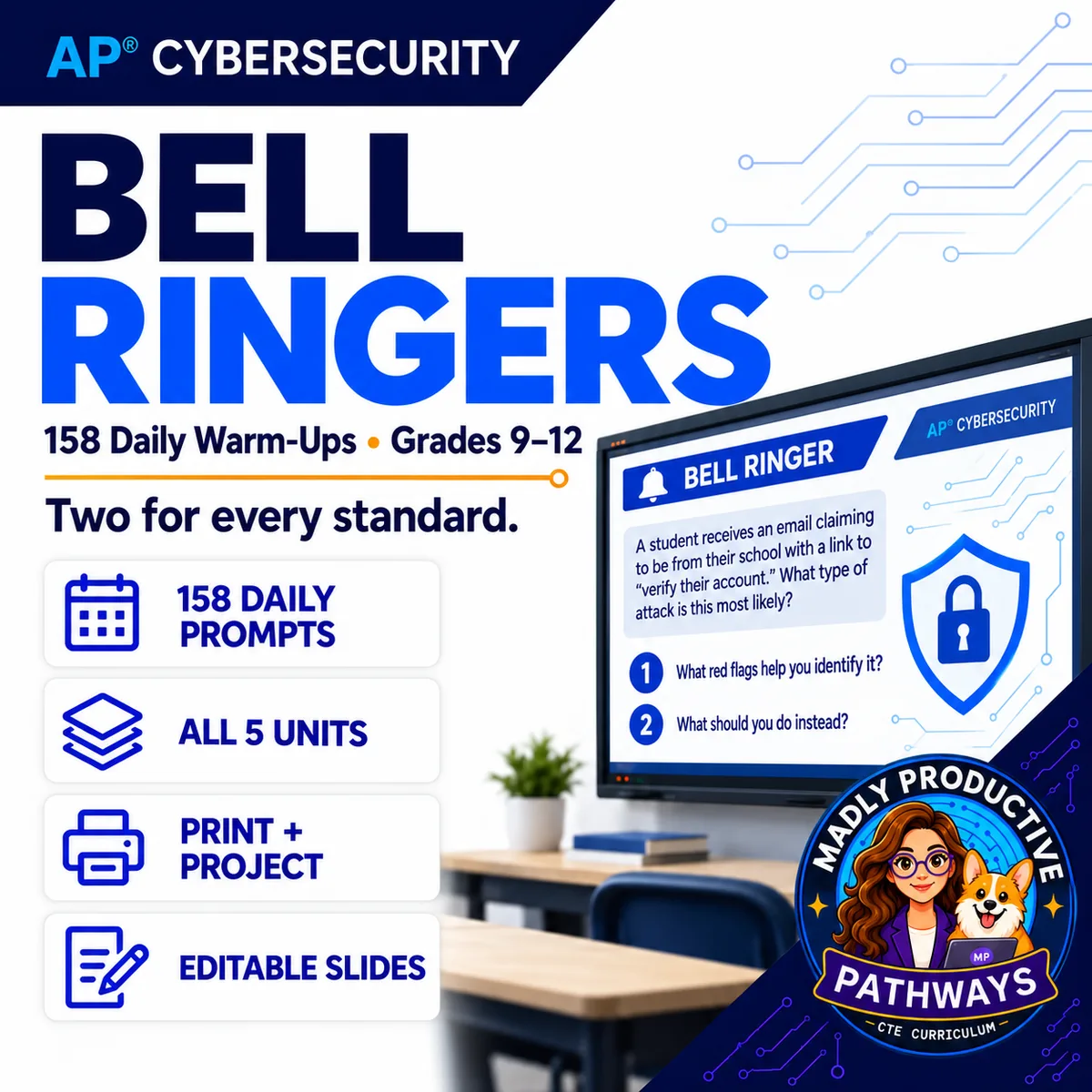
Bell Ringers
 AP Cybersecurity Grades 9–12 158 warm-ups · all 5 units 319 deliverables
 158 no-prep bell ringers — two for every standard in the AP Cybersecurity course — each with its own answer key, so the first five minutes of class are planned for the whole year, twice over. A 355-page PDF, a 159-slide editable deck, and every warm-up as its own file.
● Instant download · Lifetime access · Editable & print-ready
 158 warm-upsTwo for every standard
 158 answer keysEach after the item it marks
 PDF + editable slidesPrint, project, or lift one slide
 3–5 minutesSized to open class, not eat it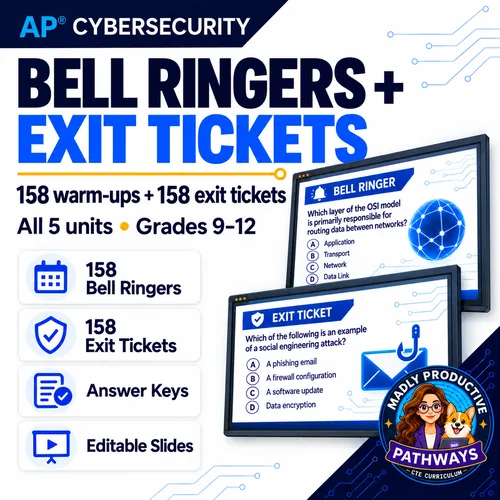
What is this?
Every class needs an opener, and writing one for every lesson is the kind of small job that quietly eats a planning period. This is that job, already done for the whole year — twice over. There are 158 bell ringers, two for every standard in the AP Cybersecurity course, in teaching order.
Each one is a concrete situation — a suspicious text, a public Wi-Fi login, an alert that demands action in the next 30 minutes — followed by two or three focused questions that surface the day's idea before you have taught it. The learning objective and skill for that topic are labeled at the top, and each is sized to about three to five minutes.
Two per standard is deliberate: one opens the idea cold before you teach it, and the second applies it afterwards as review. Every one has its own answer key, placed directly after the item it belongs to, so you are never hunting through a separate file.
This is the bell ringer set only. It does not include the lesson slides, guided notes, scenarios, collaboration activities or assessments — those are in the full course.
Everything that's included
All-in-one PDF
- All 158 bell ringers in one file, 355 pages, in topic order
- 158 answer keys, each placed directly after the item it belongs to
- Cover page and a clickable Table of Contents
- Every entry is also a PDF bookmark, so you can jump from your reader's sidebar
 Editable slide deck
- 159 slides: one per bell ringer plus a title slide
- Native editable text, not images — change any wording or recolor to match your room
- Opens in PowerPoint, Keynote, or Google Slides
- Teacher preview notes in the Notes pane, naming the topic each slide sets up
Every warm-up as its own file
- 316 individual PDFs — each bell ringer and its key, separately
- Sorted into subfolders, so you can print or assign just the one you need
- No splitting the big file to hand out a single page
 Every topic, all 5 units
- Unit 1 Introduction to Security — 26 bell ringers (1.1–1.5)
- Unit 2 Securing Spaces — 30 bell ringers (2.1–2.4)
- Unit 3 Securing Networks — 32 bell ringers (3.1–3.5)
- Unit 4 Securing Devices — 32 bell ringers (4.1–4.4)
- Unit 5 Securing Applications and Data — 38 bell ringers (5.1–5.6)
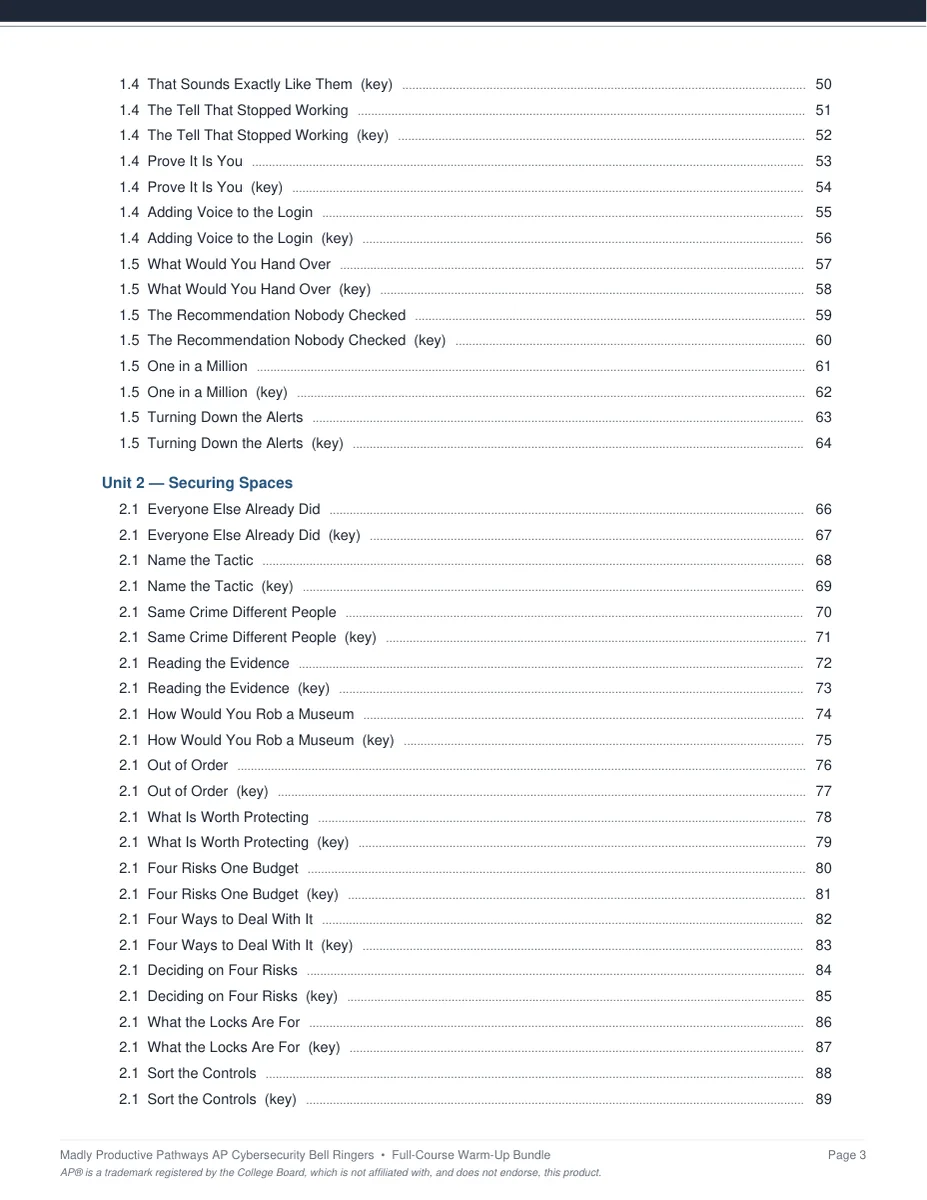
See the actual pages
One page out of the file, exactly as it prints.
A situation, then two questions
Each page opens on something recognizable and asks students to commit to an answer before the lesson starts. The topic, learning objective and skill are labeled at the top so you always know which day it belongs to.
- ✓ Topic, LO and skill tagged at the top
- ✓ Two or three focused prompts
- ✓ Room to write, sized for a half-sheet
Why teachers pick it up
The whole year, twiceTwo warm-ups for every standard, in teaching order. The first five minutes are planned through May with a spare.
Every one is keyed158 answer keys, each sitting right after its item — not in a separate file you have to cross-reference.
Print or projectA print-ready PDF, an editable deck, and every warm-up as its own file.
 Made to be argued about
Prompts that get students talking before you have taught the idea, not vocabulary recall.
Tagged to the topicThe learning objective and skill are labeled on every page, so it slots into your plan without a lookup.
 Matches the course
These are the bell ringers pulled from the full AP Cybersecurity curriculum, so the design and order line up exactly.
What Teachers Say
8 course ratings
Add your review
Reviews help me a lot, and they help other teachers pick the right resources for their classes. It takes about a minute.
Leave a reviewQuestions teachers ask
How do I get the files after I buy?
Instant download right after checkout: the 355-page all-in-one PDF, the 159-slide editable PowerPoint, all 316 individual files, and a one-page Start Here guide.
Why are there two for every standard?
One opens the idea cold, before you have taught it, and the second applies it afterwards as review. It also means you can run the course twice, or across two sections, without repeating a warm-up.
What is NOT in this?
This is the bell ringer set only. It does not include the lesson slide decks, guided notes, original scenarios, collaboration activities, assessments or unit tests — those ship with the full AP Cybersecurity course.
Are these graded?
They are discussion prompts written to open a lesson rather than a formal check for understanding, but every one now ships with an answer key so you can mark them if you want to. For a keyed, graded check at the end of the lesson, the Exit Tickets set is the matching product — or take both together in the pair bundle.
Can I edit them?
Yes. The deck is native editable text rather than images, so you can change any wording, recolor it to match your room, or lift a single slide into your own daily deck. It opens in PowerPoint, Keynote, or Google Slides.
Do I need the full course to use it?
No. The bell ringers stand on their own and work with whatever materials you already teach from. They are drawn from the full AP Cybersecurity curriculum, so they line up with it exactly if you do have it.