What's inside
What is this?
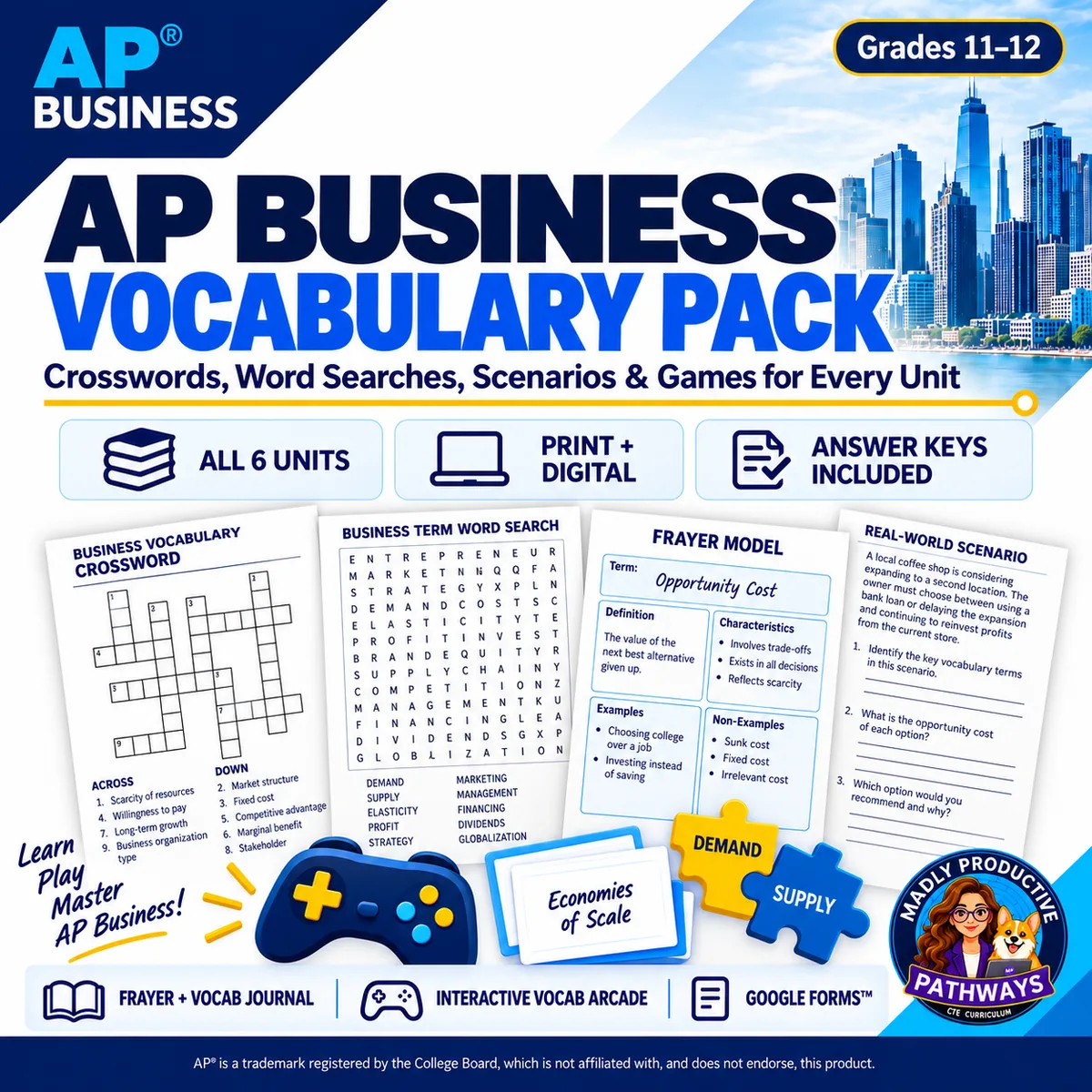
Vocabulary practice for the whole AP Business with Personal Finance course: 120 high-leverage terms, 20 per set, defined in plain student language. The Course and Exam Description runs 302 pages and contains no glossary and no key-terms appendix — the terms sit buried inside the essential knowledge statements — so this pack makes the call about which ones matter and then drills them.
The word search is not really a word search. Students are not given the word list. They get 20 definitions and have to write the term themselves before they can find anything in the grid. A wrong term simply is not in the grid, so the page is self-checking and students catch their own errors without you marking a thing.
Six sets rather than five: Unit 3 carries nine topics and roughly 130 terms, far too many for one puzzle, so it splits into Part 1 Personal Saving and Borrowing and Part 2 Business Finance and Accounting, matching how the course framework divides the unit.
Every term comes back in six formats. The crossword, both word-bank scenarios, the Forms quiz and all five arcade modes drill the same 20-term list; the word search uses a matched 20-term list built to avoid answers overlapping in a grid. The twelve scenarios are original passages written for this pack — a bike-repair startup, an oat mill, a guitar workshop, a ceramics studio, a freight company, a vet-software firm and five household finance cases. Concept Application (Skill 1.A) is 45–55% of the multiple-choice exam, and definitions in isolation do not prepare students for that; terms embedded in business situations do.
This is vocabulary practice and review, not a taught period. It does not include lesson slides, guided notes, unit tests or practice exams — those ship with the full AP Business course and its assessment packs.

 AP Business



 Vocab journal and Frayer system
 Terms inside situations
 Print and go